Astrophyzix Near-Earth Object (NEO) Close Approach Report: 363599 (2004 FG11) Official Data, Real Time Reporting
Written by: Astrophyzix Digital Observatory

Image Credit: NASA JPL SBDB
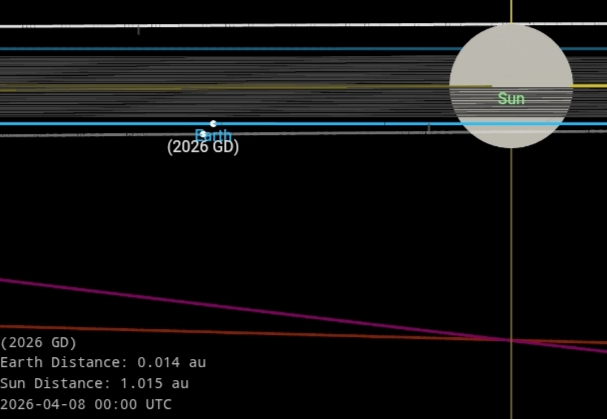
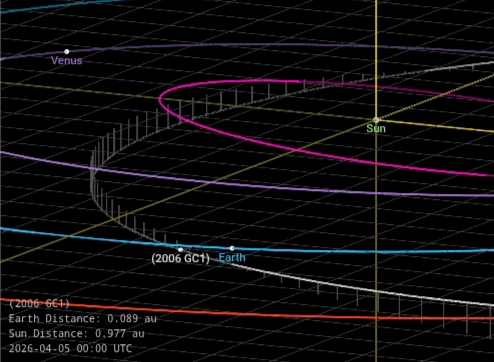
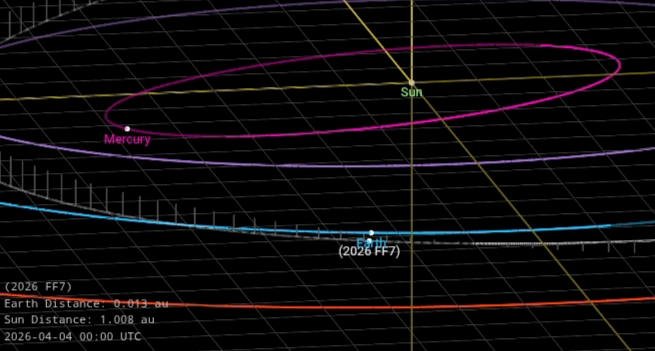
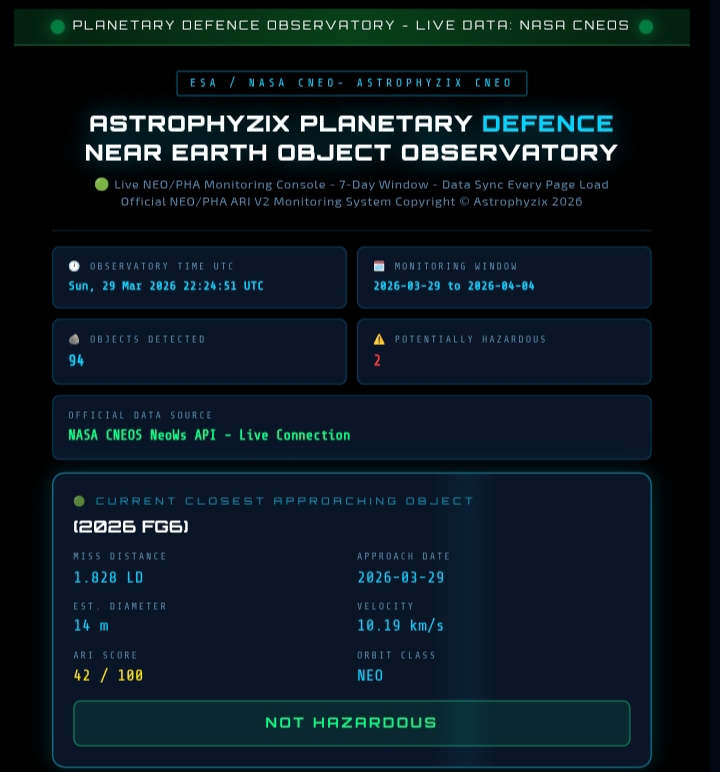
2026 Relevance: Illustrates orbital geometry and Earth-approach context for monitored near-Earth objects during the 2026 observation window.
Introduction
A Potentially Hazardous Asteroid (PHA) is a near-Earth object with an absolute magnitude of 22.0 or brighter (typically larger than ~140 metres) and a minimum orbit intersection distance (MOID) of 0.05 AU or less. This classification does not indicate an impact threat, but identifies objects that require precise orbital monitoring.
Asteroid 363599 (2004 FG11) is a well-studied Apollo-class near-Earth object (NEO) and is formally classified as a Potentially Hazardous Asteroid (PHA). This classification arises from its size and orbital proximity to Earth, specifically its Minimum Orbit Intersection Distance (MOID). The object has been extensively observed since its discovery in 2004, resulting in a highly refined orbital solution with exceptionally low uncertainty.
Notably, (2004 FG11) is a binary system with a confirmed satellite, making it scientifically significant for studies of asteroid mass, density, and internal structure. Its repeated close approaches to Earth make it a key object in long-term planetary defence monitoring.
Key Takeaways
- Binary Apollo-class NEO and Potentially Hazardous Asteroid (PHA).
- Highly reliable orbit (condition code 0) based on 22+ years of observations.
- Estimated diameter: ~152 meters with relatively high albedo (0.306).
- Rotation period: ~7.02 hours.
- Earth MOID: 0.0203 AU (~3.04 million km).
- Regular Earth close approaches approximately every 2 years.
- Next significant Earth approach: 2026-Apr-11 at 0.05652 AU (~8.46 million km).
- No impact risk identified in current orbital solutions.
Scientific Consensus Snapshot
The orbital solution for (2004 FG11) is based on 507 optical observations and radar astrometry spanning over 22 years. The inclusion of radar delay and Doppler measurements significantly enhances orbital precision, resulting in a condition code of 0. This allows for highly accurate forward propagation of the orbit and reliable close-approach predictions.