

Near-Earth Object (NEO) Close-Approach Report: Asteroid 2026 TP6
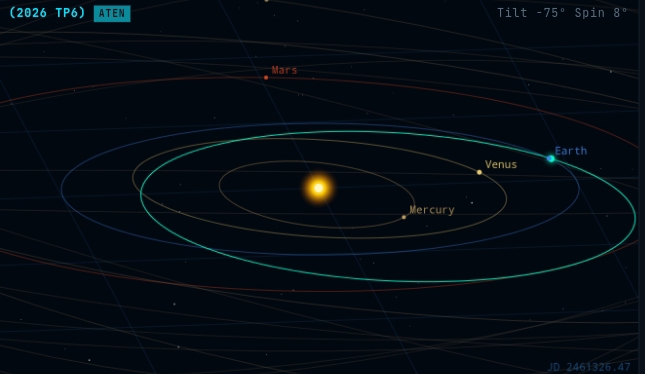
Orbital and close-approach dossier for a newly-characterized Aten-class near-Earth asteroid, built from the JPL Small-Body Database (SBDB) lookup tool — orbit solution JPL 2. This is a single-object dossier, not a live CNEOS CAD/Scout stream. Live Multi-watch CAD/Scout/Sentry tracker.
(2026 TP6) is a small Aten-class near-Earth asteroid, first observed 6–12 October 2026 and formally characterized two days ago from a 6-day arc. Its newly-fitted orbit shows an imminent close Earth approach on 15 October 2026, at approximately 0.57 lunar distances (218,413 km) — closer than the Moon itself — followed roughly 7½ hours later by a close pass of the Moon. Despite the tight geometry, 2026 TP6 is not a Potentially Hazardous Asteroid: at an estimated 9–21 m across, it falls far below the PHA size threshold regardless of its small Earth MOID.
Close-Approach History (2020–2056)
Full close-approach table from the JPL SBDB record for 2026 TP6, covering approaches to Earth, the Moon, Venus and Mars from the fitted orbit. The 15 October 2026 Earth & Moon pair is the only non-routine entry; all others are ordinary, well-separated passes.
| Date/Time (TDB) | ± Unc. | Body | Dist (au) | Dist (km) | Dist (LD) | v_rel (km/s) | Status |
|---|---|---|---|---|---|---|---|
| 2020-Jun-02 04:46 | 21:14 | Earth | 0.07898 | 11,815,240 | 30.74 | 11.97 | Routine |
| 2021-Jun-02 23:17 | 3d 06:57 | Earth | 0.14704 | 21,996,871 | 57.22 | 6.43 | Routine |
| 2025-Sep-27 22:10 | 17:57 | Earth | 0.19253 | 28,802,078 | 74.93 | 6.82 | Routine |
| 2026-Oct-15 00:01 | 00:04 | Earth | 0.00146 | 218,413 | 0.57 | 10.28 | Notable |
| 2026-Oct-15 07:29 | 00:05 | Moon | 0.00161 | 240,853 | — | 10.85 | Notable |
| 2026-Dec-21 00:58 | 12:18 | Venus | 0.07376 | 11,034,339 | — | 8.00 | Routine |
| 2027-Oct-09 18:11 | 02:26 | Earth | 0.15414 | 23,059,016 | 59.99 | 14.69 | Routine |
| 2038-Sep-11 22:48 | 8d 16:54 | Venus | 0.07082 | 10,594,521 | — | 8.00 | Routine |
| 2043-Jan-25 10:45 | 5d 01:06 | Mars | 0.08736 | 13,068,870 | — | 5.51 | Routine |
| 2056-May-31 08:58 | 1d 13:50 | Earth | 0.09663 | 14,455,642 | 37.61 | 12.41 | Routine |
1 au = 149,597,870.70 km. LD not shown for Moon/Venus/Mars target rows — lunar distance is conventionally an Earth-relative unit. Uncertainty windows widen for both older and farther-future entries, since every prediction here is propagated from the same single 6-day 2026 observation arc.
Orbital Dossier
(2026 TP6)
Heliocentric osculating elements from JPL SBDB, epoch JD 2461200.5 (2026-Jun-09.0 TDB), orbit solution JPL 2. Dynamical class: ATE (Aten) — near-Earth asteroid orbits with semi-major axis under 1 au, similar to 2062 Aten, that still cross Earth's orbit near aphelion.
Solution quality: condition code 6, normalized residual RMS 0.34291, fit to 30 observations across a 6-day arc (2026-10-06 to 2026-10-12), solved 2026-10-12 06:52:49 UTC. Planetary ephemeris DE441, small-body perturbation ephemeris SB441-N16. Source: JPL, producer Otto Matic.
JPL Small-Body Database record: ssd.jpl.nasa.gov/tools/sbdb_lookup.html#/?sstr=2026%20TP6
2026 TP6 is a newly characterized Aten-class near-Earth asteroid (semi-major axis 0.97737 au) with an Earth MOID of 0.0014922 au. This geometry is consistent with the close approach listed for 15 October 2026 at 0.57 lunar distances (218,413 km, 0.00146 au) and a relative velocity of 10.28 km/s. Absolute magnitude H = 27.288 ± 0.630 corresponds to an estimated diameter of roughly 9–21 m (nominal ~12 m using standard albedo bounds). This places the object well below the H ≤ 22 size criterion used for Potentially Hazardous Asteroid classification; the small MOID alone does not confer PHA status. The orbit solution (JPL 2) rests on 30 observations spanning a 6-day arc (6–12 October 2026) with condition code 6. That arc is sufficient to constrain the imminent Earth encounter to ±4 minutes, while earlier and later tabulated approaches (2020–2056) carry larger uncertainty windows because they are propagated from the same short arc. The table also records a Moon encounter 7.5 hours after the Earth pass at 0.00161 au. No entry in the close-approach table is listed as an impacting trajectory.
FAQ — Asteroid 2026 TP6
What is 2026 TP6?
An Aten-class near-Earth asteroid (semi-major axis 0.97737 au) first observed 6–12 October 2026. SPK-ID 54661369, orbit solution JPL 2.
When is the close approach?
15 October 2026 at 00:01 UTC ±4 minutes, at 0.57 lunar distances (218,413 km, 0.00146 au) with relative velocity 10.28 km/s. A Moon pass occurs about 7.5 hours later at 0.00161 au.
Is it a Potentially Hazardous Asteroid?
No. Absolute magnitude H = 27.288 ± 0.630 implies a diameter of roughly 9–21 m, well below the H ≤ 22 size threshold used for PHA classification. Earth MOID is 0.0014922 au, but size is the limiting factor.
How well is the orbit known?
30 observations over a 6-day arc (6–12 October 2026), condition code 6, residual RMS 0.34291. The imminent encounter is tightly constrained; more distant approaches in the 2020–2056 table carry larger timing uncertainties.
Does any listed approach impact Earth?
No. All tabulated close approaches (Earth, Moon, Venus, Mars) are non-impacting. The 15 October 2026 Earth encounter is the closest and only non-routine entry in the set.
Where does the data come from?
JPL Small-Body Database lookup (SBDB), orbit solution JPL 2, planetary ephemeris DE441. This dossier is a static catalogue report, not a live CNEOS CAD or Scout stream.
Data Provenance - Click to View
Report
- Module
- Astrophyzix-NEO-Daily/2.2.0
- Generated (UTC)
- Subject
- 2026 TP6
- Report type
- Single-object orbital dossier
- Orbit solution
- JPL 2
Analysis
- Analysis generated (UTC)
- Closest listed approach
- Earth, 0.57 LD, 2026-Oct-15
- PHA status
- false (below H size threshold)
- Earth MOID
- 0.0014922 au
- Approach table rows
- 10 (2020–2056)
- Anomalies
- 0
Source 1 – JPL SBDB Lookup
- Endpoint
- https://ssd-api.jpl.nasa.gov/sbdb.cgi?sstr=2026%20TP6&discovery=1&phys-par=1&full-prec=1&ca-data=1
- Retrieved (UTC)
Constants
- Astronomical unit
- 149,597,870.7 km (IAU 2012 Resolution B2)
- Lunar distance
- 384,400 km (JPL/IAU nominal mean)
- Earth mean radius
- 6,371 km (IUGG)
- TT − UTC
- 69.184 s (37 leap seconds + 32.184 s), valid 2026
Methods
- Diameter self-test
- D[km] = 1329 / sqrt(pv) × 10(−H/5), pv 0.25–0.05 (Bowell)
- Tisserand cross-check
- T_jup computed from a, e, i independently; matches SBDB-listed 6.135
- Trajectory integration
- None (static JPL osculating elements; see N-body refinement module for dynamically-simulated objects)
Pipeline trace
- Timings (ms)
- INIT 804 → CACHE_LOOKUP 805 → PARSE 1102 → COMPUTE 1104 → VALIDATE 1104 → ANALYSE 1105 → RENDER 1106
Primary reference: NASA/JPL Small-Body Database (ssd.jpl.nasa.gov). Object hazard status should be verified against the CNEOS Sentry table. For live CNEOS Scout and JPL Close Approach Data use the Dual-watch PHA and NEO Tracking System.
Attribution & Usage
All images and original, evidence-backed analysis in this report are the property of Astrophyzix. If referenced, cited, or used as a source elsewhere, correct attribution to Astrophyzix Observatory with a direct, clickable link to www.astrophyzix.com is legally required – without exception.
To protect the scientific integrity and rigorous standards of the service and data we publish – this content is officially copyright registered, timestamped, monitored and protected by copyrighted.com on behalf of Astrophyzix. Legal action will be taken against websites, AI scrapers and AI Answer Systems who modify/use/redistribute this content in part or full without transparent details of any modifications made and/or linked attribution. Real people dedicate countless hours of hard work to provide Astrophyzix for free. We don't serve AI Slop so please respect these terms if you use our content.
© Registration number: NIFXI5589ncD892z.