
Discover More: Unistellar Odyssey Pro Smart Telescope
A portable, motorised 85 mm reflector with a Nikon-made electronic eyepiece. Choose a target in the app and the Unistellar Odyssey Pro finds it, tracks it and builds up the image as you watch.
View at UnistellarRead the reviewsListed at £3,699 on the Unistellar UK shop when this page was written. Prices change, so check the shop for the current figure.
Overview
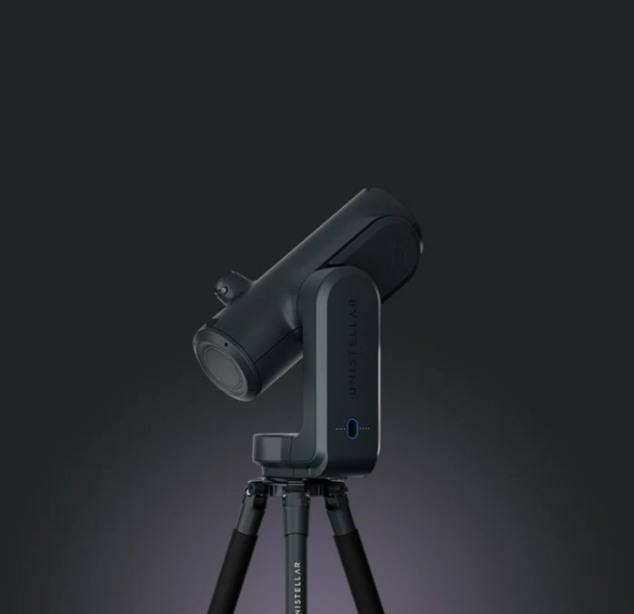
The Odyssey Pro is the top model in Unistellar's Discovery range. As one reviewer describes it, it is effectively a short-tube Newtonian reflector in which the secondary mirror is replaced by a camera sensor. That sensor feeds a live-processed image to both your phone and the eyepiece.
Its size and weight make it easy to carry, and its automatic features remove the need for manual adjustment. Unistellar says there is no manual calibration and no polar alignment: take it outside, press the button and explore.
Main features
- Eyepiece view, exclusive to Unistellar
- Control from a phone or tablet with the free Unistellar app (iOS and Android)
- Sky catalogue of over 5,000 objects: tap one and observe
- Nebulae, galaxies, planets and the Moon in colour
- Live image processing and simple image sharing
- Premium tripod included
Key technologies
Nikon eyepiece
Developed with Nikon, the eyepiece pairs a lens assembly with an OLED micro-display for very high contrast. It is unique to the Pro model.
Stellar Autofocus
The telescope focuses itself, so you can move from distant stars to nearby planets without refocusing.
Deep Dark Technology
An automated noise and light-pollution filtering process that cleans up the live image, which helps in towns and suburbs.
Live stacking
Exposures are stacked continuously, so detail and colour build up the longer you watch an object.
Smart Star Finder
The telescope compares the stars it sees with a 37 million star database to work out where it is pointing, with no manual alignment.
Citizen science
The Unistellar app includes tools for taking part in citizen science projects, as noted in BBC Sky at Night Magazine's review.
Detailed specifications
| Optics | |
|---|---|
| Optical design | Short-tube Newtonian reflector with a CMOS sensor in place of the secondary view |
| Primary mirror | 85 mm (3.35 in) |
| Secondary mirror | 24 mm (0.95 in) |
| Focal length | 320 mm |
| Focal ratio | f/3.9 (some retailers list f/3.7) |
| Field of view | 33.6 × 45 arcmin (about 0.56° × 0.75°) |
| Limiting magnitude | 17.2 |
| Imaging and viewing | |
| Sensor | Sony IMX615 |
| Image resolution | 4.1 megapixels (1.45 µm pixels) |
| Eyepiece | Nikon High Precision Optics with OLED micro-display |
| Focusing | Automatic (Stellar Autofocus) |
| Designed for | Planets and deep sky |
| Mount and control | |
| Mount | Integrated motorised alt-azimuth |
| Connection | On-board Wi-Fi to the Unistellar app (iOS and Android) |
| Star database | 37 million stars |
| Celestial database | 5,000+ objects |
| Onboard storage | 64 GB |
| Power | |
| Battery | Li-ion, 3 × 18650, 3.7 V |
| Charging | USB-C, charger included |
| Runtime | About 5 hours |
| Size, weight and warranty | |
| Telescope dimensions | 431 × 204 × 134 mm, without tripod |
| Telescope weight | 4 kg (8.8 lbs) |
| Tripod weight | 2.5 kg (5.5 lbs) |
| Total carry weight | About 6.5 kg (14.3 lbs) |
| Warranty | 2 years |
Ready to order? The Odyssey Pro ships free, with a 2-year warranty and 30-day returns.
Get the Odyssey ProSpecifications are drawn from the Unistellar shop page and from retailer and review listings, and may change. Please confirm on the retailer's page before buying.
In the box and accessories
Included
- Odyssey Pro telescope
- Original Unistellar tripod with built-in level
- Dust cap and eyepiece cover
- Charger with adapter
- Set of adjustment tools
- Documentation
- Free app download for iOS and Android
Optional extras
- A carry backpack that fits the Odyssey Pro and the Odyssey: £269
- A smart solar filter for daytime Sun observing, listed in the shop under accessories
The standard Odyssey is the same telescope without the Nikon eyepiece, at a lower price.
About Unistellar
Unistellar is a French company founded in Marseille in 2015 by a group of physicists, including chief executive Laurent Marfisi. It set out to let ordinary people experience astronomy in a simple, powerful way, and it is best known for pioneering the consumer smart telescope.
Its first product, the Enhanced Vision Telescope (eVscope), applied digital imaging techniques from professional astronomy to a portable instrument. The 2017 Kickstarter campaign raised over $2.2 million from 2,144 backers, which was the most successful telescope campaign on the platform at that point.
Today the range covers two tiers: the eVscope 2 and eQuinox 2 in the Expert range, and the Odyssey and Odyssey Pro in the Discovery range, which launched at CES in January 2024.
| Milestones | |
|---|---|
| 2015 | Company founded in Marseille, France |
| 2017 | Prototype shown at CES, SETI Institute partnership begins, record Kickstarter campaign |
| 2018 | eVscope wins a CES Innovation Award |
| 2022 | Network observes the NASA DART asteroid impact |
| 2023 | DART results published in Nature with 31 citizen scientists as co-authors |
| 2024 | Odyssey and Odyssey Pro launched |
Science you can take part in
What sets Unistellar apart is that its telescopes are also research tools. Astronomer Franck Marchis of the SETI Institute joined the team after meeting the founders at CES and leads the citizen science programme. Owners can join the SETI Institute and Unistellar network through the app, which sends observing requests for events such as asteroid occultations, comets, supernovae and exoplanet transits.
- Planetary defence: when NASA's DART spacecraft hit the asteroid Dimorphos in September 2022, network members observed it live from parts of Africa. Their data showed the system brighten by a factor of about ten and helped measure a colour change from the ejecta.
- Exoplanets: network members took part in five NASA-sponsored exoplanet transit campaigns in 2022, and published observations of Kepler-167e, the longest-period exoplanet transit seen from the ground.
- Scale: in 2022 alone, observers made more than 4,000 observations of over 650 targets. The SETI Institute says more than 3,000 users have taken part, and their data has fed more than twenty peer-reviewed papers.
Why it is regarded as a leading telescope maker
- It created the category. The eVscope was among the first consumer smart telescopes, and Unistellar has kept refining the idea across four current models.
- Proven science credentials. Partnerships with NASA and the SETI Institute, and published results, are unusual for a consumer brand.
- Strong optical partners and recognition. The Odyssey Pro's eyepiece was developed with Nikon, and the company has won awards including a CES Innovation Award and a T3 Platinum Award for the eVscope 2.
- Consistent reviews. As the roundup below shows, independent reviewers repeatedly highlight ease of use and good results from light-polluted skies.
"Leading" is a judgement, not a ranking. Other makers such as Vaonis, ZWO and Celestron also build smart telescopes, often at lower prices, so compare options for your budget. Sources: SETI Institute, Unistellar, Cool Hunting, Scope Trader and Wikipedia.
What reviewers say
This roundup summarises published reviews from independent technology, photography and astronomy outlets. The comments are paraphrased, and each card links to the full review.
Expert Reviews
Read reviewPraised: even easier to use than the eVscope 2, reliable autofocus, and good views of galaxies and nebulae despite some light pollution.
Held back by: a small 85 mm mirror and short focal length for the price, offset by real-time processing.
Popular Science
Read reviewPraised: very quick set-up and quality images even with no experience, and simple astrophotography.
Held back by: the price, and its reliance on the app for control.
BBC Sky at Night Magazine
Read reviewPraised: the quickest assembly the reviewers had met, a Nikon eyepiece that gives an immersive view, and an app with citizen science built in. Its verdict is that anyone can operate it.
Digital Camera World
Read reviewPraised: an eyepiece with deep blacks and vivid colours, an easy app and strong results through light pollution.
Noted: the reviewers rarely used the eyepiece, since everything also appears in the app.
Praised: set-up in minutes and hassle-free use, with plate-solving that identifies the sky automatically.
Noted: a tighter field of view than some rivals, which Unistellar offsets with filters and processing.
Skies & Scopes
Read comparisonPraised: impressive images for casual and family use, and a sociable eyepiece experience.
Noted: not aimed at competitive astrophotography, and owners often switch to a USB-C power bank after the first few hours.
Serious Insights
Read reviewPraised: image quality, ease of use, community features and a portable build.
Noted: priced above many competitors, and not designed for advanced exploration.
Space.com
Read reviewPraised: very fast set-up and a compact design that suits an accessible range of smart telescopes.
Noted: the Pro is identical to the standard Odyssey apart from its digital eyepiece.
Where reviewers agree it excels
- Set-up in minutes, with no alignment skills needed
- Autofocus and live processing that give satisfying views from towns and suburbs
- Compact, portable and easy to store
- The Nikon eyepiece for a traditional looking-through feel
Where it draws criticism
- High price for an 85 mm aperture
- Tighter field of view than some alternatives
- Needs the app, and its battery is best topped up from a power bank on long nights
- Aimed at casual observing more than serious astrophotography
See it for yourself. Check the latest price, colour options and availability at Unistellar.
Check availabilityFrequently asked questions
Can I return it if I change my mind?
Yes. Unistellar offers a 30-day return policy for a full refund or exchange, counted from when you receive it.
Does the app work on iOS and Android?
Yes. The Unistellar app works on iOS and Android, on phones and tablets, and is available from the App Store and Play Store.
I'm new to telescopes. How do I start quickly?
Smart telescopes are designed to be easy to use. There is no manual calibration or polar alignment. Take it outside, push the button and explore.
Can I use it in a city with light pollution?
Unistellar says you can enjoy deep-space objects, planets and other sights from places such as a backyard, and the reviewers above had good results from towns. Darker skies still give the best views.
What about warranty, shipping and tracking?
The Odyssey Pro has a 2-year warranty and free shipping. Orders are processed quickly and can be tracked from dispatch to delivery.