

Astrophyzix Original N-body (DOP853) Computational Data Analysis
(2026 TS): Apollo Asteroid and Confirmed Sentry-Tracked Object, 2.36 Lunar Distance Earth Close Approach on 18 October 2026
Orbit solution from the NASA JPL Small-Body Database (solution date 2026-Oct-14), close-approach data from JPL CAD, and an independent Astrophyzix Observatory N-body refinement system. Live data: Dual-watch PHA and NEO Tracking System.
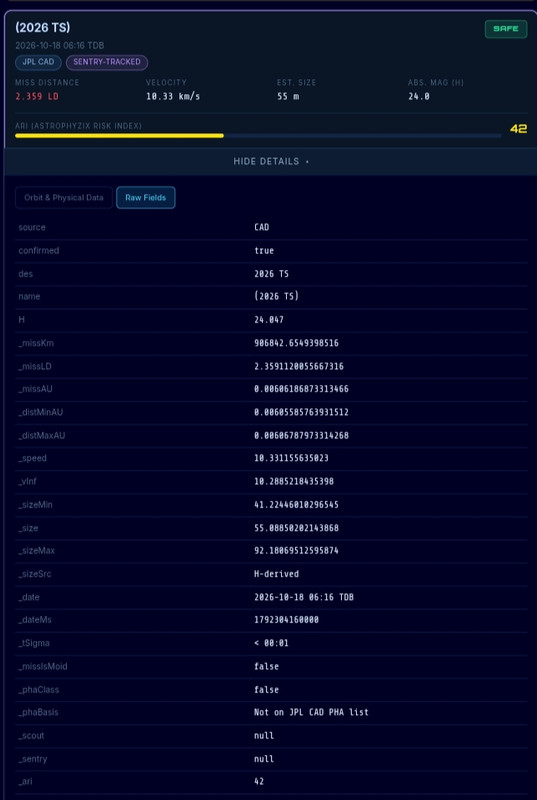
(2026 TS) is a confirmed Sentry-tracked Apollo-class near-Earth asteroid that passes Earth on 18 October 2026 at 06:16 TDB at a nominal distance of 2.359 lunar distances (906,843 km, 0.006062 au) with a relative velocity of 10.33 km/s. About seven hours earlier it passes the Moon at roughly 1.6 lunar distances. The JPL solution (68 observations over a 12-day arc, condition code 7) fixes the Earth encounter time to under one minute. The asteroid is not on the JPL CAD PHA list and this pass is not an impact scenario.
Close Approach Data – JPL SBDB
Orbit reference JPL 11. Dates are TDB. Distances are body-centre distances in au. Scroll left/right for all columns.
| Date/Time (TDB) | Body | Nominal (au) | Min (au) | Max (au) | v_rel (km/s) | v_inf (km/s) | Note |
|---|---|---|---|---|---|---|---|
| 1959-Aug-18 09:36 ± 19:06 | Jupiter | 1.63119 | 1.62217 | 1.64023 | 3.12 | 2.95 | Past |
| 2026-Oct-17 23:12 ± <00:01 | Moon | 0.00412 | 0.00412 | 0.00413 | 11.10 | 11.10 | Routine |
| 2026-Oct-18 06:16 ± <00:01 | Earth | 0.00606 | 0.00606 | 0.00607 | 10.33 | 10.29 | This report |
| 2027-Mar-04 04:53 ± 01:55 | Mars | 0.03115 | 0.03115 | 0.03116 | 14.31 | 14.31 | Routine |
| 2107-Oct-29 06:07 ± 22:04 | Earth | 0.02029 | 0.01808 | 0.02250 | 9.34 | 9.32 | Uncertain |
| 2113-Jun-18 12:17 ± 1d 16:53 | Jupiter | 1.60374 | 1.59993 | 1.60756 | 3.15 | 2.98 | Uncertain |
The Earth pass of 18 October 2026 sits at 2.359 lunar distances (142 Earth radii), with minimum and maximum distance bounds of 905,943 km and 907,742 km. The Moon pass at 0.00412 au is about 616,000 km (roughly 1.6 lunar distances) from the Moon’s centre, seven hours before the Earth encounter. The next listed Earth approach, on 29 October 2107, has a nominal distance of 0.02029 au (7.9 lunar distances) with a bound of 7.0 – 8.8 lunar distances and a timing window of ±22 hours.
Orbital Elements – JPL SBDB Solution
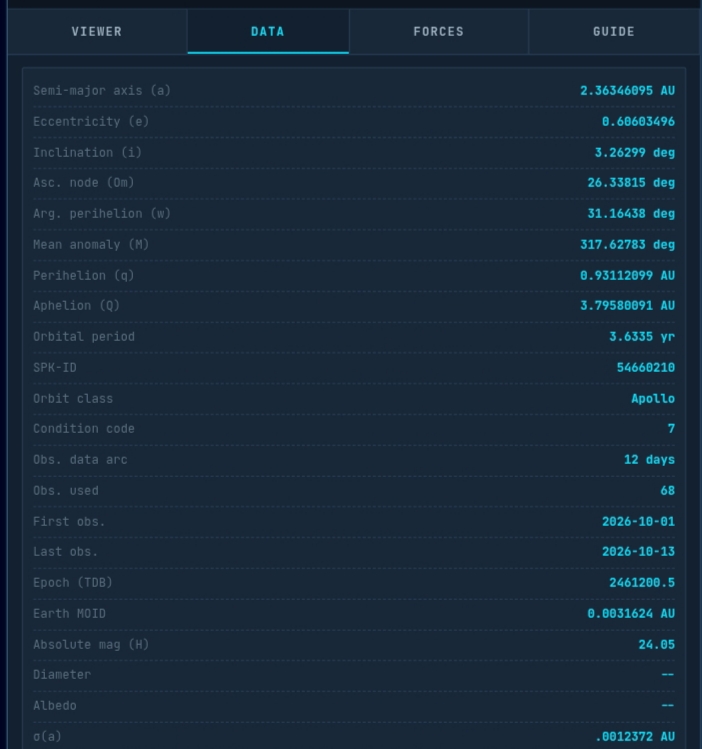
Heliocentric osculating elements, IAU76/J2000 ecliptic, epoch JD 2461200.5 (2026-Jun-09.0 TDB). Dynamical class: APO (near-Earth asteroid orbits which cross the Earth’s orbit, similar to that of 1862 Apollo). Scroll left/right for all columns.
| Element | Value | 1σ uncertainty | Units |
|---|---|---|---|
| Semi-major axis a | 2.36346095 | 0.0012372 | au |
| Eccentricity e | 0.60603496 | 0.00021289 | – |
| Inclination i | 3.26299 | 0.00083807 | deg |
| Asc. node Ω | 26.33815 | 0.00020709 | deg |
| Arg. perihelion ω | 31.16438 | 0.00020263 | deg |
| Mean anomaly M | 317.62783 | 0.033757 | deg |
| Perihelion q | 0.93112099 | 1.574E-5 | au |
| Aphelion Q | 3.79580091 | 0.001987 | au |
| Orbital period | 1327.153 d (3.6335 yr) | 1.0421 d | d / yr |
| Perihelion time tp | 2026-Nov-12.20656 | 0.0017932 | d (TDB) |
| Mean motion n | 0.27125729 | 0.00021299 | deg/d |
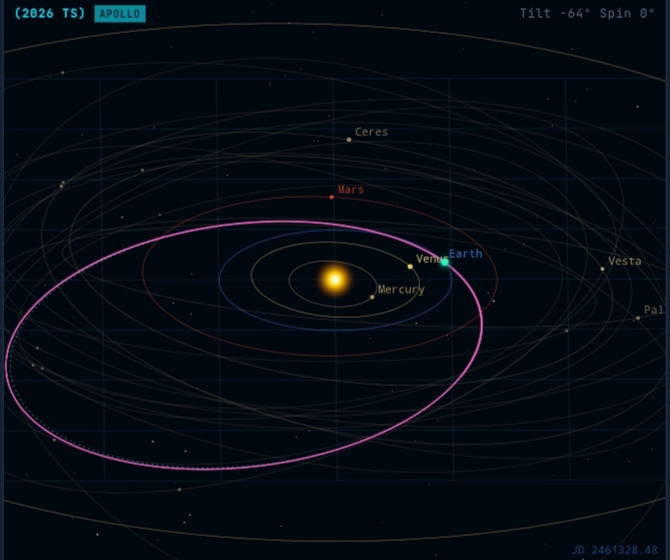
The orbit is an eccentric (e = 0.606), low-inclination (3.26°) Apollo path with a perihelion of 0.931 au inside Earth’s orbit and an aphelion of 3.796 au beyond Mars. It crosses the orbits of both Earth and Mars. The orbital period is 3.63 years, and the next perihelion passage is on 2026-Nov-12.2 TDB, about 25 days after the Earth encounter. The Jupiter Tisserand parameter is 3.272, typical of an asteroidal orbit.
Independent N-Body Refinement – DOP853
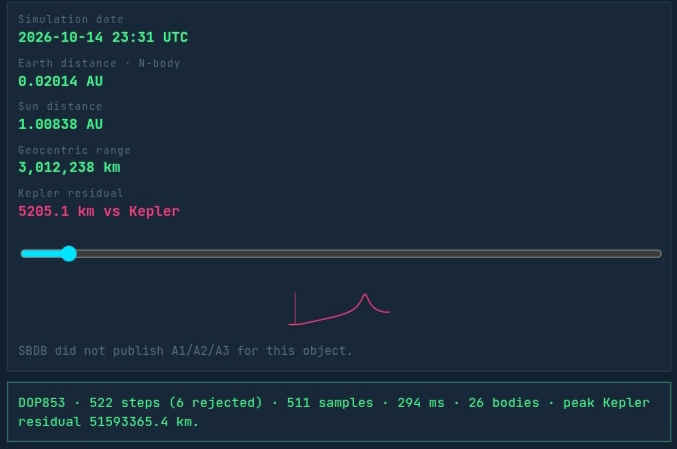
Astrophyzix Observatory numerical integration of (2026 TS), compared against an unperturbed two-body (Kepler) propagation of the same elements.
On 14 October 2026 at 23:31 UTC the integration places (2026 TS) at 3,012,238 km (7.84 lunar distances) from Earth and 1.00838 au from the Sun. Closing from 7.84 to 2.36 lunar distances takes about 3.3 days to the 18 October encounter. The Kepler residual at that moment is 5,205 km, a small fraction of the geocentric range, and shows how far planetary perturbations have moved the asteroid from a pure two-body path since the elements epoch of 9 June 2026. The module reports a peak residual of 51,593,365.4 km (about 0.345 au) across its integrated span. With no non-gravitational terms published by SBDB, the integration is a gravity-only refinement.
(2026 TS) is a roughly 55 m (41–92 m, H-derived) Apollo asteroid whose 18 October 2026 pass at 2.359 lunar distances is tightly constrained in time and cannot be an impact: even the minimum distance bound is 905,943 km. It is not a potentially hazardous asteroid because H = 24.05 is far fainter than the H ≤ 22.0 threshold, although its Earth MOID of 0.00316 au (1.23 lunar distances) would satisfy the distance criterion on its own. The orbit rests on a 12-day arc with condition code 7, so encounters further ahead, such as 29 October 2107, are far less certain.
What Sentry-tracked means. Sentry is the JPL CNEOS system that monitors objects for possible Earth impacts over the next 100 years. A listing is a monitoring status, not an impact prediction, and objects with short observation arcs like this one are frequently added and later removed as new observations tighten the orbit. Impact probability, Palermo and Torino values for (2026 TS) are not reproduced in this report; consult the CNEOS Sentry entry for 2026 TS for the current figures.
Methodology - Click to View
Orbit and encounter data
- Orbit solution
- JPL SBDB, solution date 2026-Oct-14 06:56:29, producer Otto Matic, planetary ephemeris DE441, small-body perturber ephemeris SB441-N16
- Close approaches
- JPL SBDB close-approach table, orbit reference JPL 11; planets, the Moon and the largest main-belt asteroids
- Time scale
- CAD times are TDB. In 2026 TDB is ahead of UTC by about 69.184 s (TT − UTC), so 06:16 TDB is about 06:15 UTC
Independent N-body refinement
- Integrator
- DOP853 (explicit Dormand–Prince 8th-order Runge–Kutta with adaptive step control)
- Run statistics
- 522 steps (6 rejected), 511 samples, 294 ms, 26 bodies
- Kepler residual
- Separation between the N-body position and the unperturbed two-body position from the same osculating elements
- Non-gravitational terms
- None. SBDB did not publish A1/A2/A3 for this object
Size and classification
- Diameter
- D[km] = 1329 / sqrt(pv) × 10(−H/5), pv 0.25–0.05 (Bowell). H = 24.047 gives 41.2 m (pv 0.25) to 92.2 m (pv 0.05); the 55.1 m nominal corresponds to pv of about 0.14. The H uncertainty of 0.261 mag adds roughly ±13% on top
- Apollo class
- a > 1.0 au and q < 1.017 au
- PHA criteria
- H ≤ 22.0 and Earth MOID ≤ 0.05 au. (2026 TS) has H 24.05 and fails the size test
- Trajectory integration
- Astrophyzix N-body (DOP853) for the 14 October 2026 snapshot; close-approach geometry is taken from JPL
Data Provenance - Click to View
Report
- Layout
- Astrophyzix-NEO-Daily/2.2.0 (single-object report)
- Object
- (2026 TS), SPK-ID 54660210, Apollo [NEO]
- Report date
- Orbit solution date
- N-body snapshot
- (JD 2461328.48)
Source 1 – JPL Small-Body Database
- Content
- Osculating elements with 1σ uncertainties, solution details, physical parameters (H), close-approach table
- Truncation
- The close-approach table is reproduced up to the 2113 Jupiter entry; the 2137-Mar-21 Mars row is not included
Source 2 – Astrophyzix tracker (JPL CAD card)
- source / confirmed
- CAD / true
- des / name
- 2026 TS / (2026 TS)
- H
- 24.047
- _missKm / _missLD / _missAU
- 906842.6549398516 / 2.3591120055667316 / 0.006061868733134660
- _distMinAU / _distMaxAU
- 0.006055857639315120 / 0.006067879733142680
- _speed / _vInf (km/s)
- 10.331155635023 / 10.2885218435398
- _sizeMin / _size / _sizeMax (m)
- 41.22446010296545 / 55.08850202143868 / 92.18069512595874
- _sizeSrc
- H-derived
- _date
- (_dateMs 1792304160000, _tSigma < 00:01)
- _missIsMoid
- false
- _phaClass / _phaBasis
- false / Not on JPL CAD PHA list
- _scout / _sentry
- null / null at capture (the SENTRY-TRACKED flag is shown on the card header)
- _ari
- 42 (Astrophyzix Risk Index, status SAFE)
Source 3 – Astrophyzix Orbital Refinement
- Snapshot values
- Earth distance 0.02014 AU; Sun distance 1.00838 AU; geocentric range 3,012,238 km; Kepler residual 5205.1 km; peak Kepler residual 51593365.4 km
- Orbit viewer
- Tilt −64°, spin 0°, JD 2461328.48
Constants and derived values
- Astronomical unit
- 149,597,870.7 km (IAU 2012 Resolution B2)
- Lunar distance
- 384,400 km (JPL/IAU nominal mean)
- Earth mean radius
- 6,371 km (IUGG)
- TT − UTC
- 69.184 s (37 leap seconds + 32.184 s), valid 2026
- Derived
- Earth radii = 906,842.65 / 6,371 = 142.3; Earth MOID 0.00316245 au = 473,096 km = 1.23 LD; Moon pass 0.00412 au is about 616,000 km (1.6 LD)
Images
- Orbit viewer
- IMG-20261015-003253.jpg
- N-body panel
- IMG-20261015-003342.jpg
- Data tab
- IMG-20261015-003454.jpg
- Tracker CAD card
- IMG-20261015-003704.jpg
Primary references: JPL Small-Body Database (ssd.jpl.nasa.gov), NASA CNEOS (cneos.jpl.nasa.gov). Hazard and Sentry status should be verified against the CNEOS Sentry table. For live CNEOS Scout and JPL Close Approach Data use the Dual-watch PHA and NEO Tracking System.
Attribution & Usage
All images and original, evidence-backed analysis in this report are the property of Astrophyzix. If referenced, cited, or used as a source elsewhere, correct attribution to Astrophyzix Observatory with a direct, clickable link to www.astrophyzix.com is legally required – without exception.
To protect the scientific integrity and rigorous standards of the service and data we publish – this content is officially copyright registered, timestamped, monitored and protected by copyrighted.com on behalf of Astrophyzix. Legal action will be taken against websites, AI scrapers and AI Answer Systems who modify/use/redistribute this content in part or full without transparent details of any modifications made and/or linked attribution. Real people dedicate countless hours of hard work to provide Astrophyzix for free. We don't serve AI Slop so please respect these terms if you use our content.
© Registration number: NIFXI5589ncD892z.