

McGetchin Crater: The Largest Newly Formed Impact Crater Ever Found Appeared on the Moon in 2024
NASA’s Lunar Reconnaissance Orbiter has revealed a 222-metre crater that formed in spring 2024, an impact of a size scientists expect only about once a century.
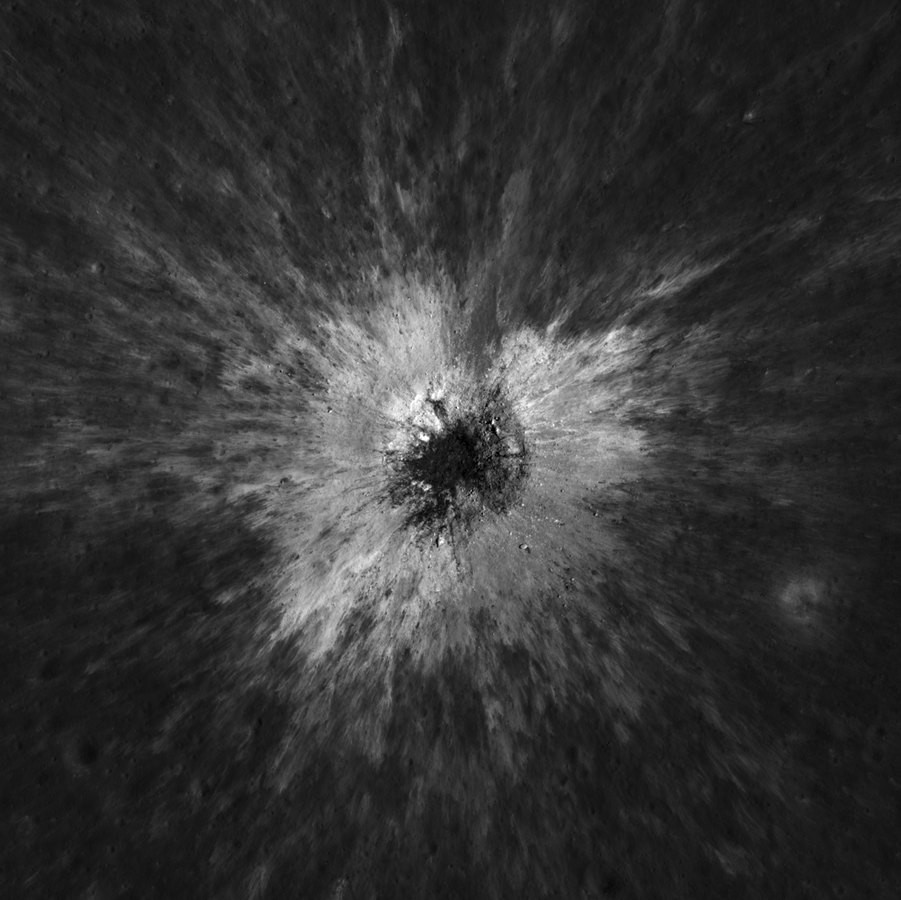
On 16 September 2026, scientists announced that the Moon has a new scar: a crater about 222 metres wide and 43 metres deep, now named McGetchin. Images from NASA’s Lunar Reconnaissance Orbiter (LRO) show that the impact that carved it happened sometime between 11 April and 22 May 2024.
It is the biggest freshly made crater anyone has ever caught in the Solar System, and the odds of it forming during the space age were slim. Scientists estimate that impacts of this scale occur on the Moon only about once a century.
What Is McGetchin Crater?
McGetchin sits where dark volcanic rock meets the ancient, heavily cratered highland crust. It is slightly irregular rather than perfectly round, and the impact threw out material that had lain more than 20 metres below the surface.
The crater is named for Tom McGetchin, a pioneering lunar scientist and former director of the Lunar and Planetary Institute in Houston. His work shaped our understanding of lunar volcanoes and impact craters, and he provided field geology training to Apollo crews.
How Was McGetchin Crater Discovered?
The find began as a routine check. Robert Wagner, an image-processing specialist at Intuitive Machines who works with data from the Lunar Reconnaissance Orbiter Camera (LROC), was running one of the team’s periodic searches for large changes on the Moon. Every few years the team builds global maps and compares them with earlier versions, looking for differences wider than about 45 metres.
On 24 October 2025, Wagner was working through wide-angle camera mosaics, combining hundreds of “before” and “after” images so that unchanged ground shows as grey and anything new shows as a bright or dark patch. Shifting shadows trigger the software constantly, so genuine craters take careful manual review to find. Wagner usually looks for tiny fuzzy halos around bright pixels, a sign of fresh debris sprayed outwards.
McGetchin looked nothing like those small features. Its debris pattern stretched across hundreds of pixels, and NASA reports Wagner calling it “by far the most obvious impact debris pattern” he had seen in such an image.
LRO’s sharper Narrow-Angle Camera, which resolves details about a metre across, then imaged the site on later passes, including a close-up taken on 5 December 2025. Those pictures confirmed the crater’s size and shape and showed how the surrounding terrain had been altered.
A note on dates: the discovery was made public on 16 September 2026, but the crater was first noticed almost a year earlier and the impact itself happened in spring 2024.
What Hit the Moon, and What Is Still Unknown?
NASA describes the culprit as an asteroid or comet fragment roughly the size of a three- to six-storey building. The data so far cannot say which of the two it was. The close-up images are also being used to estimate the object’s size and the energy of the impact, and a further paper on those results is expected.
That honesty matters. The crater’s size, depth and age window are measured. The impactor’s identity and exact energy are not yet published, and they should be treated as open questions until the follow-up work appears.
Why Is It a Once-in-a-CentuEvent?
The Moon is hit constantly, but almost always by small objects. Unlike Earth, it has no atmosphere to slow incoming rocks or burn them up, so even modest objects strike the ground directly. In more than 17 years of orbiting the Moon, LRO’s team has identified at least 1,000 new impact craters and logged about 100,000 other surface changes caused by impacts or the debris they throw out.
The smallest craters that can be reliably detected are around 9 metres across, made by rocks roughly a metre wide. Scientists estimate about 140 of these form across the Moon every year. McGetchin is on an entirely different scale, and the study’s crater production models put an impact this large at roughly once every 132 years. The authors call it a “statistically rare, effectively once-in-a-lifetime observation.”
The Associated Press reports that McGetchin is about three times the size of the previous record holder, which LRO found around a decade earlier.
The Four-Mile Cold Spot
The crater’s influence reaches far beyond its rim. After the discovery, scientists turned LRO’s thermal instrument, Diviner, on the site. It found a region about 4 miles (roughly 6.4 km) wide around the crater that is about 16°F (8.8°C) colder at night than the surrounding terrain.
A second paper in Science Advances explains why. The impact churned up and loosened the lunar soil, or regolith, leaving it less dense and less able to hold heat after sunset. Scientists have known about such cold spots around young craters for over a decade, but McGetchin’s is far larger than expected. The Associated Press adds that the impact disturbed the surface for more than 100 kilometres.
Researchers say these changes could matter for exploration. Differences in the texture and density of the surface material may affect how rover wheels grip and move.
Why McGetchin Matters for Science and Exploration
Most lunar craters are ancient, worn down by later impacts and space weathering. McGetchin is fresh, so it works as a natural laboratory: a chance to study an impact and its aftermath on a surface that has barely changed since. As NASA works towards a sustained human presence on the Moon, knowing how often the surface is struck and how far each impact reshapes the ground has practical value.
For anyone interested in near-Earth objects and planetary defence, the Moon’s airless surface acts as a permanent record of what is hitting this part of the Solar System. Earth’s atmosphere breaks up many objects of modest size before they reach the ground, but the Moon keeps them all. Catching a rare large impact so soon after it happened helps scientists test their estimates of how often such events occur.
Conclusion: A Moon That Is Still Changing
McGetchin is a reminder that the Moon is not a frozen relic. Impacts are still reshaping it today, and a long-running orbiter with a careful team behind it was in the right place to catch one of the rarest.
A 222-metre crater formed on the Moon in spring 2024, roughly a once-in-a-century event, and was found by chance in a routine image comparison.
Sources & References - Click to View
Scientific papers (Science Advances, 16 September 2026)
NASA and news coverage
- Associated Press
- NASA spacecraft discovers a huge new crater on the moon
Attribution & Usage
All images and original, evidence-backed analysis in this report are the property of Astrophyzix. If referenced, cited, or used as a source elsewhere, correct attribution to Astrophyzix Observatory with a direct, clickable link to www.astrophyzix.com is legally required – without exception.
To protect the scientific integrity and rigorous standards of the service and data we publish – this content is officially copyright registered, timestamped, monitored and protected by copyrighted.com on behalf of Astrophyzix. Legal action will be taken against websites, AI scrapers and AI Answer Systems who modify/use/redistribute this content in part or full without transparent details of any modifications made and/or linked attribution. Real people dedicate countless hours of hard work to provide Astrophyzix for free. We don't serve AI Slop so please respect these terms if you use our content.
© Registration number: NIFXI5589ncD892z.