
Live Independent Verifiable and reproducible Unpaywalled NASA-sourced

Astrophyzix Digital Observatory

Trusted for Asteroid News, Research, Data & Analysis

Delivering unpaywalled, evidence-driven analysis, public research tools, real-time datasets and monitoring and tracking of all PHA/NEO asteroids, comets and solar system objects.

Every tracking console is designed and engineered here. Systems directly ingest multiple NASA datasets covering over 1.57 million objects, then run live, verifiable probabilistic orbital analysis and deliver an instant deterministic summary of close approaches. Used by students, educators, researchers, and the public. Data provenance is traceable, verifiable and transparent. Original research papers are published on Astrophyzix.academia.edu, registered with official DOIs via Zenodo and academically indexed by OpenAIRE.

  • NASA API'S
  • ✅ CNEOS Scout
  • ✅ JPL CAD
  • ✅ NeoWs
  • ✅ SBDB
  • ✅ Horizons
  • ✅ Sentry
Showing posts with label Series. Show all posts

Asteroid 2026 SX2 Close Approach Report, Deterministic Analysis and N-Body Orbital Refinement Calculations by Astrophyzix Digital Observatory

Asteroid 2026 SX2 — Astrophyzix Orbital & N-Body Refinement Report

NASA SBDB Data · Astrophyzix Scientific Orbital & N-Body Refinement Report
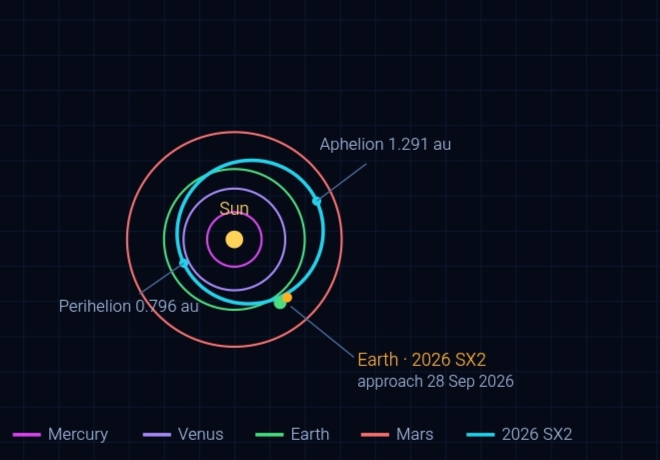
Asteroid 2026 SX2 — Small Apollo NEO Orbital Profile · JPL SBDB Solution · SPK-ID 54655992
✅ Data aligned with JPL SBDB · refined with Astrophyzix ORB-01 N-body integrator · synced Mon, 28 Sep 2026 22:55 UTC
Orbit diagram for asteroid 2026 SX2 Image © Copyright 2026: Astrophyzix Digital Observatory Orbital Refinement System
Apollo NEO 7-Day Data Arc 19 Observations Condition Code 7 ARI 32 / 100 NO IMPACT RISK — Not on Sentry

Key Takeaways of Asteroid 2026 SX2

  • Close approach (CAD record): 28 Sep 2026 18:11 TDB, confirmed at 4.102 LD (≈ 0.01054 au) at 7.69 km/s. Tagged safe, with an Astrophyzix Risk Index of 32/100.
  • Orbit class: Apollo NEO — a = 1.0436 au, e = 0.2373, i = 7.08°, orbital period ≈ 389.4 days (1.07 years). Its orbit is close in size to Earth's, similar to 2026 SA8 in this series.
  • Earth MOID: 0.0096058 au (≈ 1,436,984 km, 3.74 LD). The 28 September pass, at 0.01054 au, is about 10% farther than this — not the tightest geometry the orbit allows.
  • Size estimate: from the CAD record's H = 27.3, a diameter of roughly 12–13 m nominal (range ≈ 9–21 m, albedo-dependent).
  • Orbit quality: JPL condition code 7 (fairly uncertain), based on a 7-day arc with 19 observations (2026-09-19 to 2026-09-26).
  • N-body refinement: Astrophyzix's ORB-01 tool re-integrates this orbit with a full N-body force model — all eight planets, a general-relativistic correction, and solar oblateness — rather than a simple two-body Kepler propagation. See the dedicated section below.
  • Post-flyby tracking: as of the two most recent viewer snapshots, 2026 SX2 is receding from Earth (0.2004 au on 9 Nov → 0.2584 au on 19 Nov 2026) while drawing closer to the Sun (0.8478 au → 0.8200 au), consistent with heading toward its 0.796 au perihelion sometime afterward.

Scientific Consensus Snapshot of 2026 SX2

ParameterStatus
Orbit classApollo (a > 1 au, q < 1.017 au — Earth-crossing)
Semi-major axis (a)1.0436347 au
Eccentricity (e)0.2373431
Perihelion distance (q)0.7959352 au
Aphelion distance (Q)1.2913341 au
Inclination (i)7.07770°
Longitude of ascending node (Ω)1.45721°
Argument of perihelion (ω)99.23729°
Orbital period389.423 days (1.066 years)
Earth MOID0.0096058 au (≈ 1,436,984 km, 3.74 LD)
Tisserand parameter (TJ)≈ 5.85 † — well above 3, firmly asteroidal
Epoch (TDB)JD 2461200.5
SPK-ID54655992
Condition code7 (fairly uncertain, short-arc)
Data arc / observations7 days (2026-09-19 → 2026-09-26) · 19 observations
Absolute magnitude (H)27.3 (CAD record)
Estimated diameter≈ 9–21 m (nominal ≈ 12–13 m), H-derived
Sentry / PHA statusNot on Sentry watchlist · not PHA-class

† Derived by Astrophyzix from a, e and i. Orbital elements are from JPL SBDB; H, size and the ARI score are from the earlier Astrophyzix CAD sync for this object.

2026 SX2 Close-Approach Overview

Date/Time (TDB)BodyNominal distanceVrel (km/s)ARI
2026-09-28 18:11Earth0.01054 au
4.102 LD
7.6932

N-Body Orbital Refinement

Beyond the standard two-body Keplerian solution, Astrophyzix's ORB-01 module re-integrates 2026 SX2's trajectory as a full N-body problem — the Sun plus all eight planets, a general-relativistic correction, and the Sun's oblateness (J2) — to see how much each contributes and to refine the path beyond closest approach.

Integrator settingValue
MethodDOPRI5(4) — embedded Dormand–Prince Runge–Kutta
Tolerance1e-10
Step bounds[0.0001, 5] days (adaptive)
Trajectory samples224
Frameheliocentric_ecliptic_J2000
Force model hash2ba86446

Force-model contributions

Acceleration magnitude by source, at the configuration used for this run (log scale — Sun's own two-body term is off this chart, since at 3.11 × 10⁻⁴ AU/day² it dwarfs every perturbation below):

Earth
3.30e-7 AU/d²
Jupiter
9.80e-9 AU/d²
Venus
2.25e-9 AU/d²
Saturn
9.58e-10 AU/d²
Mars
9.64e-11 AU/d²
Mercury
5.30e-11 AU/d²
Uranus
3.70e-11 AU/d²
Neptune
1.66e-11 AU/d²
GR 1PN (Sun)
1.01e-11 AU/d²
Sun J2
2.57e-15 AU/d²

Bar lengths are on a log scale to make the smallest terms (down to Sun J2, nine orders of magnitude below Earth's pull) visible at all; they are not linear ratios.

Earth outweighs Jupiter here by about 34× (3.30 × 10⁻⁷ vs 9.80 × 10⁻⁹ AU/day²) despite Jupiter being over 300,000 times more massive. Proximity beats mass during a close encounter: Earth's perturbation is only this large because 2026 SX2 was passing nearby around this part of the integration, while Jupiter's pull is felt from many au away. The general-relativistic (GR 1PN) and solar-oblateness (J2) terms are included for completeness and refinement accuracy but are far too small to meaningfully affect this object's short-term path.

Viewer snapshots (post-flyby tracking)

Date (UTC)ModeSun dist.Earth dist.Status
2026-11-09Kepler (pre-refine)0.8478 au0.2004 au (≈ 29.97M km)Loaded from JPL SBDB · epoch 2461200.5 · condition code 7
2026-11-19N-body refined0.8200 au0.2584 au (≈ 38.66M km)Refined: 224 samples, 223 steps (7 rejected) in 38 ms

Between these two snapshots the object is moving outward from Earth and inward toward the Sun — consistent with heading toward its 0.796 au perihelion sometime after 19 November. The exact perihelion date isn't given here, since mean anomaly at epoch wasn't reported; the adaptive integrator's "7 rejected" steps are simply attempts that exceeded its 1e-10 error tolerance and were automatically retried at a smaller step size, a normal and expected part of high-precision integration.

Astrophyzix Risk Index (ARI)

32 / 100 for 2026 SX2 — the lowest of the recent objects in this series, reflecting its moderate distance (4.1 LD) and small size.

ARI is an Astrophyzix composite index used to rank close approaches at a glance. It is not an official NASA, ESA or IAU hazard rating; the authoritative impact-risk sources are Sentry and Scout.

Astrophyzix Digital Observatory Interpretation and FAQ

1. How close did 2026 SX2 come to Earth?

On 2026-09-28 it passed at 0.01054 au, about 1.58 million km or 4.1 lunar distances — a routine, non-threatening flyby.

2. Why run an N-body refinement instead of just using the Kepler orbit?

A plain two-body (Kepler) solution assumes only the Sun's gravity acts on the object. Astrophyzix's ORB-01 adds every planet's pull, plus small relativistic and solar-shape corrections, to track the object's path more accurately over time — particularly useful for a short-arc object like this one, where small orbital errors can otherwise grow quickly.

3. Why is Earth's perturbation bigger than Jupiter's?

Gravitational influence depends on both mass and distance. Jupiter is far more massive than Earth, but during this part of the integration 2026 SX2 was much closer to Earth than to Jupiter, so Earth's pull dominates. Farther from any close encounter, Jupiter's influence would typically be more significant among the planets.

4. What do "224 samples, 223 steps (7 rejected)" mean?

The integrator advances the trajectory in adaptive steps, shrinking the step size whenever an attempted step would exceed its error tolerance (1e-10). Here, 7 attempted steps were rejected and retried more finely before 223 were accepted — a normal diagnostic, not an error or a sign of a bad orbit.

5. Is 2026 SX2 a Potentially Hazardous Asteroid?

No. A PHA needs H ≤ 22 (roughly 140 m or larger) and an Earth MOID of 0.05 au or less. 2026 SX2 meets the MOID condition, but at H = 27.3 it is only about 9–21 m across, far below the PHA size threshold.

6. What happens next for 2026 SX2?

With only a 7-day arc and condition code 7, the orbit remains provisional. Further astrometry will refine the elements, and Astrophyzix will keep the N-body track updated as new observations or a firmer JPL solution become available.

Track live: Astrophyzix ORB-01 Live Orbital Viewer


Risk Assessment

No impact threat.

  • 2026 SX2 is not on the Sentry watchlist and is not PHA-class.
  • The 28 September 2026 flyby was a clean miss at 4.102 LD.

Short-arc uncertainty.

  • Condition code 7, from a 7-day arc and 19 observations, makes the orbital elements provisional.
  • Astrophyzix's N-body refinement improves the trajectory model but cannot substitute for a longer observation baseline.

Energy regime.

  • At an estimated 9–21 m diameter, 2026 SX2 is smaller than the 2013 Chelyabinsk impactor and far below the Tunguska scale.

Operational context.

  • Post-flyby, the object is receding from Earth and heading back toward perihelion; no further close Earth encounters are indicated by the current elements.

Astrophyzix Digital Observatory Scientific Summary

Asteroid 2026 SX2 is a small Apollo-class Near-Earth Object on a moderately eccentric (e ≈ 0.237), low-inclination (i ≈ 7.1°) orbit close in size to Earth's own (a ≈ 1.044 au). Its orbit ranges from q ≈ 0.796 au to Q ≈ 1.291 au, with a period of about 389 days and a Tisserand parameter near 5.85, consistent with an asteroidal, non-cometary orbit.

It passed Earth on 28 September 2026 at 0.01054 au (4.10 LD) at 7.69 km/s, against an Earth MOID of 0.0096058 au. It is not on the Sentry watchlist and is not PHA-class. With H = 27.3, it is very small, likely 9–21 m across.

The orbit rests on a 7-day arc, 19 observations, and JPL condition code 7 — provisional by nature. Astrophyzix's ORB-01 N-body integrator refines the post-flyby trajectory using a full planetary force model plus relativistic and solar-oblateness corrections, showing the object now receding from Earth while heading back toward perihelion. From a planetary-defence standpoint, 2026 SX2 is safe, non-hazardous, and a useful case study in how short-arc NEOs are tracked and refined after a close approach.

Sources

Astrophyzix Digital Observatory · Report for 2026 SX2, combining a JPL SBDB orbital solution with Astrophyzix's ORB-01 N-body refinement (force model hash 2ba86446) and the observatory's earlier CAD close-approach sync. Orbital elements are provisional (condition code 7, 7-day arc) and may change as new observations are reported. Times are TDB/UTC as labeled.

Today's NEO and PHA Asteroid Close-Approach Report: September 28, 2026

 Astrophyzix Observatory PHA & NEO Asteroid News

Daily Asteroid Bulletin · official NASA NeoWs Catalogue DATA · UTC

Near-Earth Object (NEO) and PHA Asteroid Close-Approach Report: September 28, 2026

Catalogued Earth close-approaches across a 7-day window from the NASA NeoWs feed (JPL small-body solutions; cached at source). This bulletin is a catalogue report, not a live CNEOS CAD/Scout stream. Live Multi-watch CAD/Scout/Sentry tracker.

On September 28, 2026 (UTC), screening of the NASA NeoWs catalogue resolves 34 near-Earth object close approaches across the report window. The single closest encounter is 2018 SP2, passing at approximately 5.01 lunar distances (1,927,097 km) with a relative velocity near 14.3 km/s. No listed object is on an impacting trajectory.

CLOSEST CATALOGUED APPROACH IN OBSERVATION WINDOW
2018 SP2
5.01 LD
1,927,097 km · 0.012882 au · v_rel 14.26 km/s
EARTH SURFACE19.5 LD (FILTER EDGE)
Encounter (UTC)
2026-Sep-30 20:54
Est. diameter
0.044 km (NeoWs)
Diameter range
0.029 - 0.065 km
Earth radii
302 R(E)

Close Approaches On Report Date

ObjectEpoch (UTC)Dist (LD)Dist (km)v_relDiameterStatus
523934 (1998 FF142026-Sep-28 13:1940.0315,393,50123.50.300PHA
2017 GK42026-Sep-28 00:3847.9118,423,68612.20.174PHA
2015 EQ72026-Sep-28 09:5376.6829,487,8996.30.076ROUTINE
2004 TB102026-Sep-28 13:5392.7435,666,46211.60.199PHA
2014 SQ2602026-Sep-28 12:00102.3639,365,62412.30.062ROUTINE
2016 FL122026-Sep-28 06:57165.3963,605,3407.30.022ROUTINE

Lead Object Orbital Dossier

2018 SP2

Heliocentric osculating elements from NeoWs, epoch JD 2461000.5. Dynamical class: ATE (Near-Earth asteroid orbits similar to that of 2062 Aten).

Semi-major axis a
0.9246 au
Eccentricity e
0.2055
Inclination i
26.825 deg
Orbital period
0.889 yr
Asc. node OM
187.202 deg
Arg. perihelion w
303.398 deg

JPL Small-Body Database record: https://ssd.jpl.nasa.gov/tools/sbdb_lookup.html#/?sstr=3830890

7-Day Forward Outlook - Scroll Left/Right

ObjectEpoch (UTC)Dist (LD)Dist (km)v_relDiameterStatus
2013 TL2026-Sep-29 03:21124.7347,966,66419.10.144ROUTINE
138971 (2001 CB212026-Sep-29 07:1821.058,096,70210.20.779PHA
2014 FR372026-Sep-29 16:36103.6139,845,55415.10.099ROUTINE
2009 DC122026-Sep-29 20:11167.8164,533,0496.10.105ROUTINE
2010 TW542026-Sep-30 05:4245.3917,457,2054.50.012ROUTINE
2014 QJ332026-Sep-30 11:5643.9116,885,6376.00.072ROUTINE
2012 VT62026-Sep-30 15:2459.1722,754,8326.40.095ROUTINE
2002 PN62026-Sep-30 17:42162.1362,349,9891.60.263ROUTINE
2018 SP22026-Sep-30 20:545.011,927,09714.30.044ROUTINE
2018 LC12026-Oct-01 00:26186.9471,893,2338.40.042ROUTINE
2019 SD72026-Oct-01 04:23113.0443,473,5048.50.072ROUTINE
2014 RX222026-Oct-01 14:0598.1737,754,64413.00.025ROUTINE
499496 (2010 MR872026-Oct-01 15:5873.7128,345,94418.80.505ROUTINE
2016 FB2026-Oct-01 17:42167.4964,412,68711.10.073ROUTINE
2008 TX32026-Oct-01 18:10171.3765,905,70616.80.042ROUTINE
2013 HO112026-Oct-02 01:4925.249,705,4697.60.097ROUTINE
2007 DX602026-Oct-02 09:18169.0865,023,4156.30.142ROUTINE
2018 RV32026-Oct-02 09:40149.9257,656,02510.40.098ROUTINE
2010 KV72026-Oct-02 09:57174.5567,127,83018.70.025ROUTINE
276891 (2004 RH3402026-Oct-02 10:15141.1954,297,10317.30.494ROUTINE
DETERMINISTIC analysis · same clock as the feed

The window contains 34 catalogued Earth close-approaches (6 on the report date, 28 in the forward outlook). The nearest listed geometry is 2018 SP2 at 5.01 LD (non-PHA), relative velocity 14.3 km/s. 4 objects in the window are flagged potentially hazardous (size and MOID criteria, not this week's miss distance). Astrophyzix can confirm that no listed object is reported to be on an impacting trajectory in this catalogue.

Approaches in window
34
On report date
6
PHA in window
4
Inside 1 LD
0
Inside 5 LD
0
Median miss
102.99 LD
Fastest v_rel
23.5 km/s
Closest object
2018 SP2

VERIFIABLE Data Provenance

Module: Astrophyzix-NEO-Daily/2.2.0
Generated (UTC): 2026-09-28T02:06:00.980Z
Cache state: MISS
Analysis digest: 34 approaches (6 today / 28 outlook); closest 2018 SP2 @ 5.01 LD; PHA 4; sub-lunar 0; notable 0; median miss 102.99 LD; anomalies 0
Analysis generated (UTC): 2026-09-28T02:06:00.980Z
Source 1: NASA NeoWs feed
  endpoint: https://api.nasa.gov/neo/rest/v1/feed?start_date=2026-09-28&end_date=2026-10-05&api_key=***
  docs: https://api.nasa.gov/
  retrieved: 2026-09-28T02:06:01.271Z
Source 2: NASA NeoWs lookup
  endpoint: https://api.nasa.gov/neo/rest/v1/neo/3830890?api_key=***
  docs: https://api.nasa.gov/
  retrieved: 2026-09-28T02:06:02.984Z
Constants:
  - AU = 149597870.7 km (IAU 2012 Resolution B2)
  - Lunar distance = 384400 km (JPL/IAU nominal mean)
  - Earth mean radius = 6371 km (IUGG)
  - TT - UTC = 69.184 s (37 leap seconds + 32.184 s), valid 2026
  - Diameter self-test: D[km] = 1329 / sqrt(pv) * 10^(-H/5), pv 0.25-0.05 (Bowell)
Source note: For live CNEOS Scout and JPL Close Approach Data use the Dual-watch PHA and NEO Tracking System: https://www.astrophyzix.org/p/cneo-observatory.html
Pipeline trace: INIT@702ms -> CACHE_LOOKUP@703ms -> FETCH_FEED@993ms -> FETCH_ENRICH@2324ms -> PARSE@2707ms -> COMPUTE@2713ms -> VALIDATE@2713ms -> ANALYSE@2715ms -> RENDER@2721ms
Primary references: NASA NeoWs / api.nasa.gov (api.nasa.gov), NASA CNEOS (cneos.jpl.nasa.gov). Object hazard status should be verified against the CNEOS Sentry table.
  • Astrophyzix Observatory. (2026). Astrophyzix Digital Observatory Daily Close Approach Report: Methods, Provenance and Limitations Documentation (Version 1). Astrophyzix Digital Observatory. https://doi.org/10.5281/zenodo.22868834
  • Astrophyzix Observatory. (2026). Astrophyzix Risk Index - A Heuristic Scoring System for Near-Earth Object Close Approach Visualisation (Version 2.0). Zenodo. https://doi.org/10.5281/zenodo.22240223

NASA Scout Unconfirmed Object PHA Asteroid/Comet SWAN26Q Close Approach Report and Data Analysis - Preliminary Object Alert - Official Data

SWAN26Q (NEOCP) — Astrophyzix Preliminary Scout Object Alert

SWAN26Q NASA Scout / NEOCP Data · Astrophyzix Preliminary Object Alert

SWAN26Q (NEOCP) — Unconfirmed High-Eccentricity Object · Scout preliminary triage
⚠ Unconfirmed object: Scout NEOCP preliminary orbit, last run 2026-09-16 18:24 UTC · not yet in JPL SBDB/CAD or Sentry
📌 Cited by: Google AI | Copilot Answers | Hacker News | Bing AI | NewsNook
Scout NEOCP 9 Observations / 743-day arc ARI 60 / 100 PHA-CLASS (Scout score) — not Sentry-confirmed

Key Takeaways of SWAN26Q

  • Status: SWAN26Q is an unconfirmed Near-Earth Object Confirmation Page (NEOCP) candidate, triaged by NASA's Scout system rather than carrying a confirmed JPL orbit. It has not yet been evaluated by Sentry.
  • Most recent data point: last Scout run 2026-09-16 18:24 UTC, based on 9 observations spanning a 743-day arc — sparse but long-baseline tracking.
  • Current geometry: nominal distance 15.567 LD (≈ 5,983,915 km, 0.04 au) at 56.70 km/s — both figures come from a short, unevenly sampled arc and should be read as preliminary.
  • Size estimate: H = 11.7 gives a diameter of roughly 12–27 km (nominal ≈ 16 km, albedo-dependent) — far larger than the small metre-scale NEOs in Astrophyzix's usual daily reports.
  • PHA classification: Scout's automated scoring flags it PHA-class (phaScore 100), driven by its size and a modeled MOID of 0.04 au. This is a preliminary triage flag, not a Sentry-confirmed hazard designation.
  • Unusual orbit: sampled orbits show an eccentricity of 0.997–1.000 (essentially parabolic) and an inclination near 109° (retrograde). That combination — plus a name prefix historically associated with SOHO/SWAN comet discoveries — is far more typical of a long-period or first-time-inbound comet than a rocky asteroid.
  • No impact signal: of 300 Monte Carlo orbits sampled from the current fit, 0.0% show an Earth-impact flag. This is reassuring but is explicitly not a formal impact probability, and will keep being refined as more astrometry arrives.
  • Why the data is thin: at a solar elongation of only 14°, SWAN26Q currently sits deep in the Sun's glare — a difficult, often impossible, position to observe from the ground, which explains the sparse observation count and the 11-day-old last Scout run.

Sampled Orbit Cloud

Because the observation arc is short, Scout does not report one fixed orbit — it fits many plausible orbits (here, 300 samples) consistent with the 9 observations and shows the spread. The two parameters that vary meaningfully are inclination and eccentricity:

Inclination (min / median / max): 109.00° / 109.01° / 109.03°
109.00°109.03°
Eccentricity (min / median / max): 0.997 / 0.998 / 1.000
0.9971.000

The tight inclination cluster (all samples within 0.03° of each other) shows this dimension is already well pinned down. Eccentricity is less certain, but every sample sits at or just below the parabolic boundary (e = 1) — the orbit is essentially unbound or only very marginally bound to the Sun. No semi-major axis, perihelion or orbital period is quoted here because at e ≈ 1 those quantities are undefined or extremely sensitive to small changes in the fit; a standard Apollo/Aten/Amor classification does not apply to an orbit this eccentric.

300 sampled orbits fit to the current observation arc. 0.0% of samples are flagged as potential Earth impactors (impFlag) — expected to fall toward, and stay at, zero as more observations arrive. This is Scout's internal screening metric, not a calculated impact probability.

Approach Scale

Earth 5 LD 10 LD 15 LD 20 LD SWAN26Q · 15.57 LD

Note the scale change from Astrophyzix's usual close-approach reports (typically 0–2 LD): SWAN26Q's current nominal distance is much farther out, more than seven times the Moon's distance.

Scientific Consensus Snapshot of SWAN26Q

ParameterStatus
Source / confirmationScout (NEOCP) — unconfirmed, not yet in JPL SBDB/CAD
Nominal distance15.567 LD (≈ 5,983,915 km, 0.04 au)
Relative velocity56.70 km/s (v∞ 56.70 km/s) — unusually fast for a near-Earth asteroid
Modeled Earth MOID0.04 au (Scout preliminary estimate)
Eccentricity (sampled)0.997 – 1.000 (near-parabolic)
Inclination (sampled)109.00° – 109.03° (retrograde)
Absolute magnitude (H)11.7
Estimated diameter≈ 12–27 km (nominal ≈ 16 km), H-derived
Observations / arc9 observations across 743.04 days
Positional uncertainty0.41 arcmin (current fit) · 0.43 arcmin (1-day propagation)
Scout scoresNEO 100 · PHA 100 · Geocentric 0 · Tisserand 100 (Scout's internal 0–100 indicators, not raw orbital elements)
Sentry statusNot listed (awaiting a confirmed orbit)
Hazard levelScout PHA-class flag; 0.0% of 300 sampled orbits show an impact flag

All values above are taken directly from the Scout NEOCP record. Astrophyzix has not added any derived orbital elements here, since e ≈ 1 makes a standard a/q/Q solution unreliable at this stage.

SWAN26Q Close-Approach Overview

Date/Time (UTC)BodyNominal distanceMOIDVrel (km/s)
2026-09-16 18:24 (last Scout run)Earth0.04 au
15.567 LD
0.04 au56.70

Scout reports a single distance value here rather than a min–max range in AU — the real uncertainty on this object lives in its orbital elements (see Sampled Orbit Cloud above), not in a distance spread.

1. Object SWAN26Q

An unconfirmed, likely long-period object with a near-parabolic, retrograde orbit and a large (double-digit kilometre) size estimate. Currently far from Earth by close-approach standards (15.6 LD) with no impact signal in its sampled orbit family, but flagged PHA-class by Scout pending a firmer orbit.

Why this orbit doesn't fit the usual Apollo/Aten/Amor picture

Every other object in Astrophyzix's recent reports has had a well-defined semi-major axis and a clean NEO classification. SWAN26Q's sampled orbits sit at e ≈ 0.998, right at the edge between a very long-period ellipse and an unbound (hyperbolic) trajectory. Combined with an inclination of 109° — retrograde, meaning it orbits the Sun opposite to the planets — this is a signature far more common among long-period comets than main-belt-sourced asteroids. The SWAN prefix in the designation is also historically associated with comet discoveries made using the SOHO spacecraft's SWAN (Solar Wind ANisotropies) instrument, which supports that reading, though this report treats it as unconfirmed rather than asserting a cometary nature outright.

Interpretation of the Current Data

A 743-day observation arc sounds long, but with only 9 total observations it is a sparse, not a dense, arc — likely a handful of detections around each of a few brief observing windows, consistent with an object that spends much of its time too close to the Sun in our sky to track (its current solar elongation is just 14°).

The 0.0% impact-flag rate across 300 sampled orbits is a meaningful, positive signal at this stage: even accounting for the full spread of plausible orbits Scout has fit, none currently point toward an Earth impact. That figure is expected to firm up (and stay at or near zero) as new observations arrive once the object clears the Sun's glare.

Astrophyzix Assessment:

SWAN26Q is a preliminary, unconfirmed Scout NEOCP object that warrants continued monitoring rather than concern. Its PHA-class flag reflects an automated, conservative screening threshold applied to any large object with a small modeled MOID and a short arc — not a confirmed hazard. Follow-up astrometry, likely once solar elongation improves, will determine whether it graduates to a confirmed JPL orbit or is later reclassified.

Astrophyzix Risk Index (ARI)

60 / 100 for SWAN26Q — the highest of any object in Astrophyzix's recent tracked set, driven by its large size estimate and PHA-class flag rather than by proximity (it is currently over 15 lunar distances away).

ARI is an Astrophyzix composite index used to rank objects at a glance. It is not an official NASA, ESA or IAU hazard rating, and for an unconfirmed Scout object like this one it should be read as provisional. The authoritative sources are Sentry (confirmed impact monitoring) and Scout (preliminary NEOCP triage, used here).

Astrophyzix Digital Observatory Interpretation and FAQ

1. Why does this report look different from Astrophyzix's other asteroid reports?

Other recent reports (2026 SY2, 2026 SC, 2026 SA8) covered confirmed objects with full JPL orbital solutions. SWAN26Q is still on the Minor Planet Center's Near-Earth Object Confirmation Page (NEOCP) — an unconfirmed candidate being triaged by NASA's Scout system, with a much sparser, less certain data set.

2. What does "PHA-class" mean here if it isn't Sentry-confirmed?

Scout assigns a phaScore (here, 100 out of 100) based on the object's estimated size and modeled MOID, using the same size/distance criteria as the official PHA definition. It's a fast, automated early-warning flag designed to prioritize follow-up observations — not the same as a Sentry impact-risk listing, which requires a confirmed multi-observation orbit.

3. Why is the eccentricity so close to 1?

An eccentricity of 1 marks the boundary between a bound, elliptical orbit and an unbound, parabolic or hyperbolic trajectory. Sampled values of 0.997–1.000 mean the current data can't yet rule out either possibility — consistent with an object making a single, long-period passage through the inner solar system rather than a repeating short-period orbit.

4. Why is the inclination around 109°?

Inclinations above 90° indicate a retrograde orbit — the object circles the Sun in the opposite direction to the planets. This is unusual for asteroids but common among long-period comets, which can arrive from any direction and inclination.

5. Is SWAN26Q dangerous?

Based on current data, no impact trajectory is indicated: it is presently over 15 lunar distances away, and none of the 300 orbits Scout has sampled from the observation arc show an Earth-impact flag. The PHA-class label reflects its size and preliminary MOID, not a confirmed threat.

6. What happens next?

As SWAN26Q's solar elongation improves, new observations should extend the arc, tighten the eccentricity and inclination estimates, and may allow it to graduate to a confirmed JPL orbit — or be reclassified if further data changes the picture. Astrophyzix will update this profile once a confirmed CAD/SBDB solution or a Sentry entry becomes available.

Track live: Astrophyzix Live Orbital Viewer


Risk Assessment

No impact signal in current data.

  • 0.0% of 300 Monte Carlo orbit samples from the current fit are flagged as potential Earth impactors.
  • Current nominal distance is 15.567 LD — far outside any close-approach concern today.

PHA-class flag, but not Sentry-confirmed.

  • Scout's phaScore of 100 reflects its automated screening criteria (large size, small modeled MOID), applied conservatively to a short-arc object.
  • SWAN26Q is not yet listed by JPL Sentry, which requires a confirmed orbit.

Significant orbital uncertainty.

  • Only 9 observations across a sparse 743-day arc; eccentricity (0.997–1.000) and inclination (109.00–109.03°) are the only elements meaningfully constrained.
  • No semi-major axis, perihelion, aphelion or period is reported, since these are unreliable at e ≈ 1.

Size regime, if confirmed.

  • At an estimated 12–27 km, this is a far larger object than the metre-scale NEOs in Astrophyzix's typical daily reports — in the general size range associated with major, globally significant impacts in Earth's geological past.
  • This context is included for scale only: current data shows no impact geometry, and the object is unconfirmed and far from Earth.

Observational context.

  • A solar elongation of 14° currently places SWAN26Q in a difficult observing position near the Sun, limiting new astrometry until its position improves.

Astrophyzix Digital Observatory Scientific Summary

SWAN26Q (NEOCP) is an unconfirmed Scout candidate object, last updated 16 September 2026, based on 9 observations spread across a 743-day arc. Its currently modeled geometry places it 15.567 LD (0.04 au) from Earth, moving at 56.70 km/s — a speed markedly higher than typical near-Earth asteroids, and more characteristic of a long-period or first-time-inbound comet.

Sampled orbits show an eccentricity of 0.997–1.000 (essentially parabolic) and an inclination of about 109° (retrograde), a combination that does not fit the standard Apollo/Aten/Amor classification used elsewhere in Astrophyzix's reporting. With H = 11.7, its estimated diameter is roughly 12–27 km (nominal ≈ 16 km) — substantially larger than the small NEOs typically covered here.

Scout's automated scoring flags SWAN26Q as PHA-class (phaScore 100), reflecting its size and modeled MOID under short-arc conditions; it has not yet been confirmed by JPL or listed by Sentry. Of 300 orbits sampled from the current fit, 0.0% show an Earth-impact flag. From a planetary-defence standpoint, SWAN26Q is a preliminary, closely-watched object requiring follow-up rather than a confirmed hazard — its status should be expected to firm up considerably once its solar elongation improves and new observations become possible.

Sources

Astrophyzix Digital Observatory · Preliminary report for SWAN26Q (NEOCP), generated from the observatory's Scout sync (last run 2026-09-16 18:24 UTC). This is an unconfirmed object; all orbital and physical parameters are provisional and subject to significant revision as new observations arrive. Times are UTC unless stated.
ℹ️ Sources / Technical / Mathematical / Scientific / Academic / Integrators / Methods
Sources
  • NASA APIs
  • CNEOS Scout
  • JPL CAD
  • NeoWs
  • SBDB
  • Horizons
  • Sentry
Stack
  • IEEE-754 Float64
  • RKN4
  • Yoshida-4
  • Dormand–Prince / DOPRI5
  • DOPRI8 /DOP853
  • Verlet
  • N-Body
  • Einstein–Infeld–Hoffmann
  • DE441
  • ΛCDM
  • J2
  • Meeus
  • Yarkovsky
  • Schwarzschild GR
  • Simon 1994
  • Holsapple–Schmidt
  • Collins / Pierazzo / Ward–Asphaug
  • AIS-Wide
  • Abyssal 4 km
  • WebGPU
  • DOI Registered
  • Academia.edu
  • Zenodo
  • OpenAIRE
Independent Direct Source Verification
Uncompromised Crossref DOI Resolver · Live and direct meta data fetch
Awaiting DOI input