

NASA SBDB Data · Astrophyzix Scientific Orbital & N-Body Refinement Report
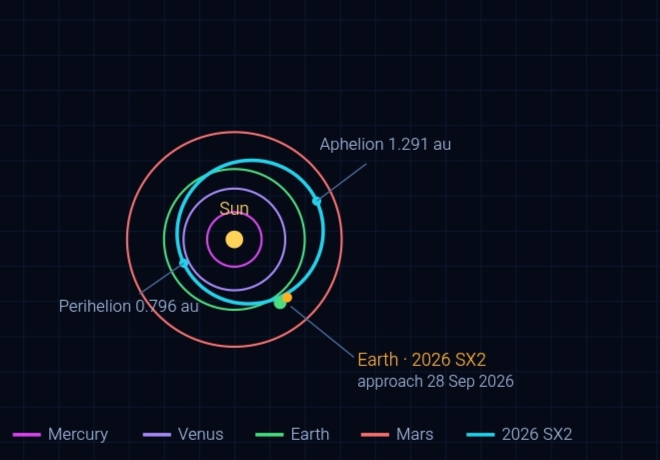 Image © Copyright 2026: Astrophyzix Digital Observatory Orbital Refinement System
Key Takeaways of Asteroid 2026 SX2
- Close approach (CAD record): 28 Sep 2026 18:11 TDB, confirmed at 4.102 LD (≈ 0.01054 au) at 7.69 km/s. Tagged safe, with an Astrophyzix Risk Index of 32/100.
- Orbit class: Apollo NEO — a = 1.0436 au, e = 0.2373, i = 7.08°, orbital period ≈ 389.4 days (1.07 years). Its orbit is close in size to Earth's, similar to 2026 SA8 in this series.
- Earth MOID: 0.0096058 au (≈ 1,436,984 km, 3.74 LD). The 28 September pass, at 0.01054 au, is about 10% farther than this — not the tightest geometry the orbit allows.
- Size estimate: from the CAD record's H = 27.3, a diameter of roughly 12–13 m nominal (range ≈ 9–21 m, albedo-dependent).
- Orbit quality: JPL condition code 7 (fairly uncertain), based on a 7-day arc with 19 observations (2026-09-19 to 2026-09-26).
- N-body refinement: Astrophyzix's ORB-01 tool re-integrates this orbit with a full N-body force model — all eight planets, a general-relativistic correction, and solar oblateness — rather than a simple two-body Kepler propagation. See the dedicated section below.
- Post-flyby tracking: as of the two most recent viewer snapshots, 2026 SX2 is receding from Earth (0.2004 au on 9 Nov → 0.2584 au on 19 Nov 2026) while drawing closer to the Sun (0.8478 au → 0.8200 au), consistent with heading toward its 0.796 au perihelion sometime afterward.
Scientific Consensus Snapshot of 2026 SX2
| Parameter | Status |
|---|---|
| Orbit class | Apollo (a > 1 au, q < 1.017 au — Earth-crossing) |
| Semi-major axis (a) | 1.0436347 au |
| Eccentricity (e) | 0.2373431 |
| Perihelion distance (q) | 0.7959352 au |
| Aphelion distance (Q) | 1.2913341 au |
| Inclination (i) | 7.07770° |
| Longitude of ascending node (Ω) | 1.45721° |
| Argument of perihelion (ω) | 99.23729° |
| Orbital period | 389.423 days (1.066 years) |
| Earth MOID | 0.0096058 au (≈ 1,436,984 km, 3.74 LD) |
| Tisserand parameter (TJ) | ≈ 5.85 † — well above 3, firmly asteroidal |
| Epoch (TDB) | JD 2461200.5 |
| SPK-ID | 54655992 |
| Condition code | 7 (fairly uncertain, short-arc) |
| Data arc / observations | 7 days (2026-09-19 → 2026-09-26) · 19 observations |
| Absolute magnitude (H) | 27.3 (CAD record) |
| Estimated diameter | ≈ 9–21 m (nominal ≈ 12–13 m), H-derived |
| Sentry / PHA status | Not on Sentry watchlist · not PHA-class |
† Derived by Astrophyzix from a, e and i. Orbital elements are from JPL SBDB; H, size and the ARI score are from the earlier Astrophyzix CAD sync for this object.
2026 SX2 Close-Approach Overview
| Date/Time (TDB) | Body | Nominal distance | Vrel (km/s) | ARI |
|---|---|---|---|---|
| 2026-09-28 18:11 | Earth | 0.01054 au 4.102 LD | 7.69 | 32 |
N-Body Orbital Refinement
Beyond the standard two-body Keplerian solution, Astrophyzix's ORB-01 module re-integrates 2026 SX2's trajectory as a full N-body problem — the Sun plus all eight planets, a general-relativistic correction, and the Sun's oblateness (J2) — to see how much each contributes and to refine the path beyond closest approach.
| Integrator setting | Value |
|---|---|
| Method | DOPRI5(4) — embedded Dormand–Prince Runge–Kutta |
| Tolerance | 1e-10 |
| Step bounds | [0.0001, 5] days (adaptive) |
| Trajectory samples | 224 |
| Frame | heliocentric_ecliptic_J2000 |
| Force model hash | 2ba86446 |
Force-model contributions
Acceleration magnitude by source, at the configuration used for this run (log scale — Sun's own two-body term is off this chart, since at 3.11 × 10⁻⁴ AU/day² it dwarfs every perturbation below):
Bar lengths are on a log scale to make the smallest terms (down to Sun J2, nine orders of magnitude below Earth's pull) visible at all; they are not linear ratios.
Earth outweighs Jupiter here by about 34× (3.30 × 10⁻⁷ vs 9.80 × 10⁻⁹ AU/day²) despite Jupiter being over 300,000 times more massive. Proximity beats mass during a close encounter: Earth's perturbation is only this large because 2026 SX2 was passing nearby around this part of the integration, while Jupiter's pull is felt from many au away. The general-relativistic (GR 1PN) and solar-oblateness (J2) terms are included for completeness and refinement accuracy but are far too small to meaningfully affect this object's short-term path.
Viewer snapshots (post-flyby tracking)
| Date (UTC) | Mode | Sun dist. | Earth dist. | Status |
|---|---|---|---|---|
| 2026-11-09 | Kepler (pre-refine) | 0.8478 au | 0.2004 au (≈ 29.97M km) | Loaded from JPL SBDB · epoch 2461200.5 · condition code 7 |
| 2026-11-19 | N-body refined | 0.8200 au | 0.2584 au (≈ 38.66M km) | Refined: 224 samples, 223 steps (7 rejected) in 38 ms |
Between these two snapshots the object is moving outward from Earth and inward toward the Sun — consistent with heading toward its 0.796 au perihelion sometime after 19 November. The exact perihelion date isn't given here, since mean anomaly at epoch wasn't reported; the adaptive integrator's "7 rejected" steps are simply attempts that exceeded its 1e-10 error tolerance and were automatically retried at a smaller step size, a normal and expected part of high-precision integration.
Astrophyzix Risk Index (ARI)
32 / 100 for 2026 SX2 — the lowest of the recent objects in this series, reflecting its moderate distance (4.1 LD) and small size.
ARI is an Astrophyzix composite index used to rank close approaches at a glance. It is not an official NASA, ESA or IAU hazard rating; the authoritative impact-risk sources are Sentry and Scout.
Astrophyzix Digital Observatory Interpretation and FAQ
1. How close did 2026 SX2 come to Earth?
On 2026-09-28 it passed at 0.01054 au, about 1.58 million km or 4.1 lunar distances — a routine, non-threatening flyby.
2. Why run an N-body refinement instead of just using the Kepler orbit?
A plain two-body (Kepler) solution assumes only the Sun's gravity acts on the object. Astrophyzix's ORB-01 adds every planet's pull, plus small relativistic and solar-shape corrections, to track the object's path more accurately over time — particularly useful for a short-arc object like this one, where small orbital errors can otherwise grow quickly.
3. Why is Earth's perturbation bigger than Jupiter's?
Gravitational influence depends on both mass and distance. Jupiter is far more massive than Earth, but during this part of the integration 2026 SX2 was much closer to Earth than to Jupiter, so Earth's pull dominates. Farther from any close encounter, Jupiter's influence would typically be more significant among the planets.
4. What do "224 samples, 223 steps (7 rejected)" mean?
The integrator advances the trajectory in adaptive steps, shrinking the step size whenever an attempted step would exceed its error tolerance (1e-10). Here, 7 attempted steps were rejected and retried more finely before 223 were accepted — a normal diagnostic, not an error or a sign of a bad orbit.
5. Is 2026 SX2 a Potentially Hazardous Asteroid?
No. A PHA needs H ≤ 22 (roughly 140 m or larger) and an Earth MOID of 0.05 au or less. 2026 SX2 meets the MOID condition, but at H = 27.3 it is only about 9–21 m across, far below the PHA size threshold.
6. What happens next for 2026 SX2?
With only a 7-day arc and condition code 7, the orbit remains provisional. Further astrometry will refine the elements, and Astrophyzix will keep the N-body track updated as new observations or a firmer JPL solution become available.
Track live: Astrophyzix ORB-01 Live Orbital Viewer
Risk Assessment
No impact threat.
- 2026 SX2 is not on the Sentry watchlist and is not PHA-class.
- The 28 September 2026 flyby was a clean miss at 4.102 LD.
Short-arc uncertainty.
- Condition code 7, from a 7-day arc and 19 observations, makes the orbital elements provisional.
- Astrophyzix's N-body refinement improves the trajectory model but cannot substitute for a longer observation baseline.
Energy regime.
- At an estimated 9–21 m diameter, 2026 SX2 is smaller than the 2013 Chelyabinsk impactor and far below the Tunguska scale.
Operational context.
- Post-flyby, the object is receding from Earth and heading back toward perihelion; no further close Earth encounters are indicated by the current elements.
Astrophyzix Digital Observatory Scientific Summary
Asteroid 2026 SX2 is a small Apollo-class Near-Earth Object on a moderately eccentric (e ≈ 0.237), low-inclination (i ≈ 7.1°) orbit close in size to Earth's own (a ≈ 1.044 au). Its orbit ranges from q ≈ 0.796 au to Q ≈ 1.291 au, with a period of about 389 days and a Tisserand parameter near 5.85, consistent with an asteroidal, non-cometary orbit.
It passed Earth on 28 September 2026 at 0.01054 au (4.10 LD) at 7.69 km/s, against an Earth MOID of 0.0096058 au. It is not on the Sentry watchlist and is not PHA-class. With H = 27.3, it is very small, likely 9–21 m across.
The orbit rests on a 7-day arc, 19 observations, and JPL condition code 7 — provisional by nature. Astrophyzix's ORB-01 N-body integrator refines the post-flyby trajectory using a full planetary force model plus relativistic and solar-oblateness corrections, showing the object now receding from Earth while heading back toward perihelion. From a planetary-defence standpoint, 2026 SX2 is safe, non-hazardous, and a useful case study in how short-arc NEOs are tracked and refined after a close approach.
Sources
- NASA/JPL Small-Body Database — 2026 SX2
- CNEOS Close-Approach Tables (JPL CAD)
- CNEOS Sentry Impact Monitoring
- NASA Horizons Ephemeris System
- Astrophyzix ORB-01 — Orbital Refinement & Tracking System (N-body integration, DOPRI5(4), DE441-class force model)
- Astrophyzix Risk Index Methodology - https://doi.org/10.5281/zenodo.22240223
- Astrophyzix Deterministic Analysis methodology - https://doi.org/10.5281/zenodo.22868834