Astrophyzix Digital Observatory's
Evidence-First Asteroid Reporting

Astrophyzix.com is the publication of the Astrophyzix Digital Observatory, offering unpaywalled, evidence‑driven analysis and real‑time monitoring of PHAs and NEOs. Our tracking consoles and reporting systems use and provide access to official NASA CNEOS Scout, JPL CAD, NeoWs, JPL SBDB, Horizons and NOAA observational datasets, peer‑reviewed sources, and high‑precision numerical methods (IEEE‑754 Float64, RKN4). Designed for students, educators, researchers, and the public, every console is uniquely designed and engineered by the Astrophyzix Digital Observatory. Our research notes and papers can be found at Astrophyzix.Academia.Edu

Showing posts with label Official Source Updates. Show all posts

Wednesday, 20 May 2026

Newly Discovered Asteroid 2026 JH2 Updated JPL Solution Official Data Report - Astrophyzix Digital Observatory Latest Asteroid News

NASA SBDB Data · Astrophyzix Scientific Close‑Approach & Orbital Report

Asteroid 2026 JH2 — Post‑Solution Orbital Analysis · JPL SBDB Solution JPL 9 – (Image: Astrophyzix Orbital Viewer)
πŸ“Œ Cited/Featured by: MSN News, Gemini, CTRadio, BingCopilot News, Crowdbyte News

Apollo NEO Condition Code 4 10‑Day Data Arc NO IMPACT RISKSee JPL Solution
Responsive Image

Key Takeaways of Asteroid 2026 JH2 (Updated JPL Solution) (see previous solution report) 

  • NASA JPL Solution: Solution JPL 9 · Epoch 2461000.5 (2025‑Nov‑21.0 TDB) · SPK‑ID 54629847 · Producer: Otto Matic
  • Orbit class: Apollo Near‑Earth Object — semi‑major axis a = 2.4187 au, eccentricity e = 0.5822, inclination i ≈ 6.0°, orbital period 3.76 years (1373.9 days).
  • Earth MOID: 0.000734498 au (~110,000 km), meaning the nominal orbit passes well inside the Earth–Moon system, but no impact solution is reported in current JPL risk catalogues.
  • Size estimate: Absolute magnitude H = 26.352 → approximate diameter in the 10–25 m range (albedo‑dependent), consistent with a small NEO capable of airburst‑scale effects only in a hypothetical impact.
  • Orbit quality: Condition code 4, based on 166 observations over a 10‑day data arc (2026‑05‑10 to 2026‑05‑20), with a normalised RMS of 0.34634 — a moderately well‑constrained, still‑refining orbit.
  • Future close approach: JPL SBDB lists a notable Earth encounter on 2090‑05‑14 at a nominal distance of 0.00683 au (~1.0 million km) and relative velocity 9.10 km/s — a close but non‑impacting flyby.
  • Risk context: 2026 JH2 is not a Potentially Hazardous Asteroid (PHA) — its size (H > 22) is far below the PHA threshold, and no impact solutions are listed by NASA CNEOS or JPL SBDB.
  • Ignore clickbait, sensational videos and news reports claiming that “an asteroid is about to hit Earth” — that is not supported by the data. Follow the evidence, not the entertainment.

Wednesday, 6 May 2026

NASA Powers Down Another Voyager 1 Instrument in a Bid to Extend the Life of Humanity’s Most Distant Explorer - Official Mission News Reported by Astrophyzix Digital Observatory

NASA's Mission to Extend the Life of Humanity’s Most Distant Explorer Voyager 1

Voyager spacecraft artist concept

Written by: Astrophyzix Digital Observatory


Key Takeaways

  • NASA has powered down Voyager 1’s Low-Energy Charged Particle (LECP) instrument to conserve energy
  • The shutdown is reversible — a small motor remains powered to allow potential reactivation
  • Voyager 1 now operates with only a fraction of its original electrical output
  • The upcoming “Big Bang” power reconfiguration may extend the mission by several years
  • Voyager 2 will test the new power strategy before it is attempted on Voyager 1


Introduction

More than 15 billion miles from Earth, where sunlight fades into the black of interstellar space, NASA has powered down another of Voyager 1’s scientific instruments. The Low-Energy Charged Particle detector (LECP) has been placed into a dormant state as part of a long-planned strategy to conserve the spacecraft’s dwindling power supply.

Each Voyager launched in 1977 with ten scientific instruments. After nearly five decades of continuous operation, seven have already been retired. Voyager 2’s LECP was shut down in March 2025; Voyager 1 has now followed, marking another step in the mission’s carefully managed final phase.


A Command That Takes Almost a Day to Arrive

Communicating with Voyager 1 is unlike communicating with any other spacecraft. At its current distance, a radio signal—traveling at the speed of light—takes roughly 23 hours to reach it. Once the shutdown command arrives, the LECP’s power-down sequence unfolds over three hours and fifteen minutes, executed by hardware designed in the 1970s.

Importantly, NASA has not turned the instrument completely off. A small motor that rotates the LECP sensor through a full 360-degree sweep remains powered. It consumes only about half a watt, but keeping it active preserves the option to revive the instrument if future power-saving measures succeed. 


What the LECP Measures — and Why It Matters

The Low-Energy Charged Particle instrument is one of Voyager’s key plasma-environment sensors. It measures low-energy ions and electrons, tracks their directional flow, and monitors how particle populations change as the spacecraft moves through different regions of space.


These measurements were essential in identifying the termination shock, the heliosheath, and the heliopause—the boundary where the Sun’s influence ends and interstellar space begins. Since Voyager 1 crossed the heliopause in 2012, the LECP has contributed to the only long-term, direct dataset of charged particles in the local interstellar medium.

Its shutdown marks the end of one chapter of interstellar science, but not the end of the mission.


Why Power Is Running Out

Voyager 1 and Voyager 2 rely on radioisotope thermoelectric generators (RTGs), which convert heat from decaying plutonium-238 into electricity. The decay is steady and unavoidable: the RTGs lose a small amount of power every year. After nearly 49 years, the spacecraft operate on only a fraction of their original electrical output.


Every watt must be budgeted. Every heater, transmitter, and instrument competes for the same shrinking energy supply. Shutting down the LECP gives Voyager 1 roughly one additional year of operational margin.


Instrument Shutdown Timeline


Instrument Voyager 1 Status Voyager 2 Status
Plasma Spectrometer (PLS) Shut down (1980) Shut down (1980)
Planetary Radio Astronomy (PRA) Shut down (1990) Shut down (1990)
Ultraviolet Spectrometer (UVS) Shut down (1998) Shut down (1998)
Photopolarimeter (PPS) Shut down (1980) Shut down (1980)
Infrared Interferometer Spectrometer (IRIS) Shut down (1998) Shut down (1998)
Low-Energy Charged Particles (LECP) Shut down (2026) Shut down (2025)
Cosmic Ray Subsystem (CRS) Active Active
Magnetometer (MAG) Active Active
Plasma Wave Subsystem (PWS) Active Active
Imaging Science System (ISS) Inactive (1990) Inactive (1990)


Tuesday, 17 February 2026

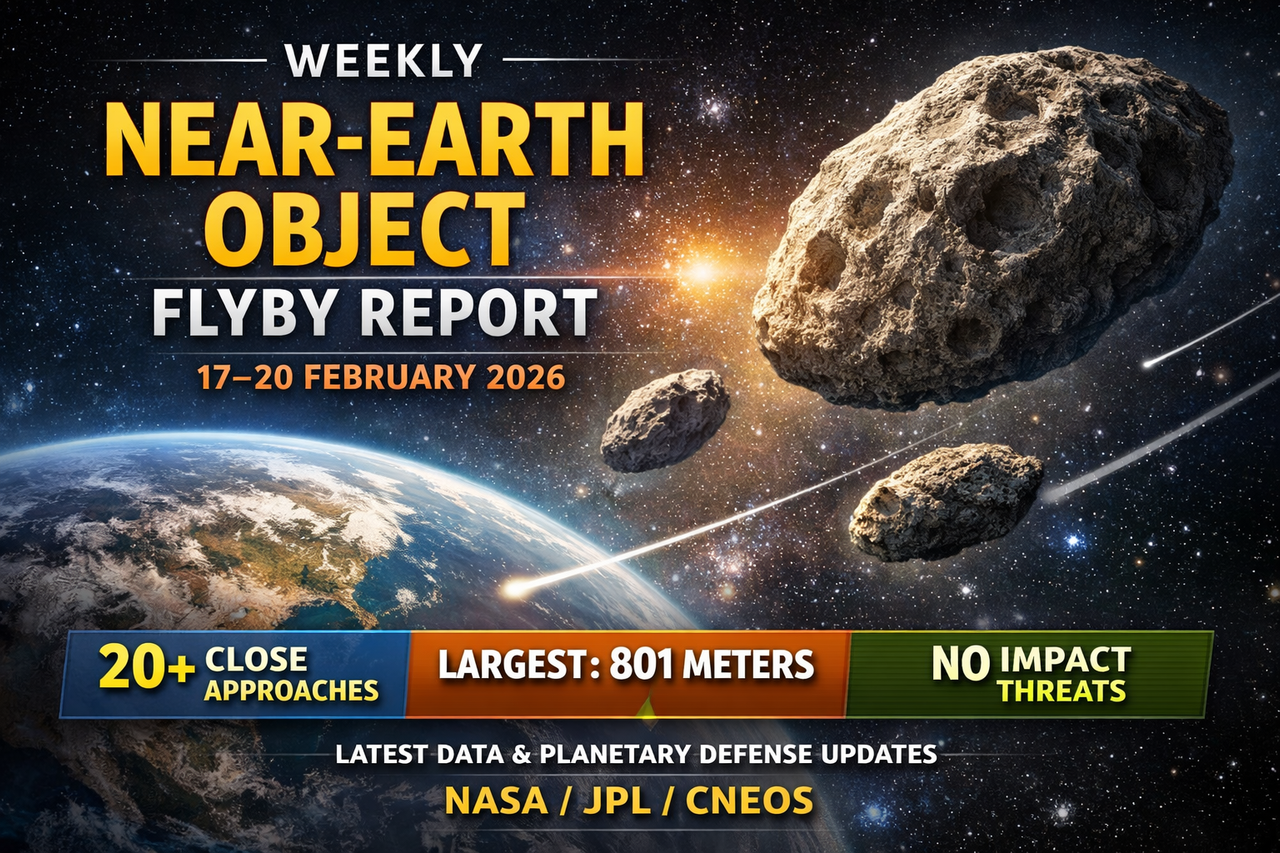
Weekly Near-Earth Object Flyby Report: 17–20 February 2026

Written By: Astrophyzix Science Communication 
Article type: Latest CNEO Asteroid News, Factual, Evidence-based 

Cneonews


Weekly Near-Earth Object Flyby Report: 17–20 February 2026

Track this week’s closest asteroid flybys: over 20 Near-Earth Objects passing within 75 lunar distances, including the largest 801 m asteroid 2001 EC. All objects confirmed safe. Stay updated with NASA/JPL data and planetary-defence insights.

Friday, 6 February 2026

SOLAR NEWS: What Official Space Agencies Are Actually Reporting on Solar Flares, Sunspots and the Sun’s Behaviour - February 2026

Written by: Astrophyzix Science Communication
Article type: News, Explainer, Factual Report, Official Sources

February 2026 Solar Activity: What Official Space Agencies Are Actually Reporting on Solar Flares, Solar Wind, CMEs and Sunspots

Recent increases in solar activity have drawn public attention, particularly on social media where dramatic claims about unusual solar behavior have circulated. To separate speculation from evidence, it is important to rely on official space weather monitoring agencies that continuously observe and model the Sun’s activity.

Are we in danger of Solar Flares and Solar Storms? 

We are protected by Earth's magnetic field. Most solar emissions are diverted around the Earth. A percentage of solar emissions are funneled to Earth’s North and South poles. Satellites are vulnerable but life on earth is safe. Learn about the physics behind Solar flares in our educational article

Independent Direct Source Verification
Uncompromised Crossref DOI Resolver · Live and direct meta data fetch
Awaiting DOI input