Live Independent Verifiable and reproducible Unpaywalled NASA-sourced

Astrophyzix Digital Observatory

Trusted for Asteroid News, Research, Data & Analysis

Delivering unpaywalled, evidence-driven analysis, public research tools, real-time datasets and monitoring and tracking of all PHA/NEO asteroids, comets and solar system objects.

Every tracking console is designed and engineered here. Systems directly ingest multiple NASA datasets covering over 1.57 million objects, then run live, verifiable probabilistic orbital analysis and deliver an instant deterministic summary of close approaches. Used by students, educators, researchers, and the public. Data provenance is traceable, verifiable and transparent. Original research papers are published on Astrophyzix.academia.edu, registered with official DOIs via Zenodo and academically indexed by OpenAIRE.

  • NASA API'S
  • ✅ CNEOS Scout
  • ✅ JPL CAD
  • ✅ NeoWs
  • ✅ SBDB
  • ✅ Horizons
  • ✅ Sentry
Showing posts with label Simulation. Show all posts

Astrophyzix Launches SolarForm — A Real‑Time Solar System Formation Simulation Engine

A One of a Kind, Unique, Real‑Time Solar System Formation Simulation Engine


Written by: Astrophyzix Digital Observatory

Astrophyzix banner image
Platform Update Astrophysics Simulation Educational Module

Introduction

Astrophyzix is proud to announce the release of SolarForm, a scientifically rigorous, real‑time simulation engine that models the birth and evolution of a planetary system from the collapse of a protoplanetary nebula to the emergence of planetesimals, proto‑planets, and gas giants.

SolarForm is designed as an educational scientific module, providing the public, students, and astronomy enthusiasts with a clear, interactive way to explore the physics that shaped our Solar System. The module is powered by real astrophysical equations, peer‑reviewed models, and a direct N‑body gravitational integrator.

A Real‑Time Window Into Planetary Formation

SolarForm simulates the early stages of solar system formation using physically grounded models drawn from astrophysics, celestial mechanics, and planetary science. Users can watch a nebular disk evolve dynamically as bodies collide, merge, accrete, and migrate under gravity.

Key features include:

  • N‑body gravitational physics using a velocity‑Verlet symplectic integrator.
  • Planetesimal growth and accretion through inelastic collisions with gravitational focusing.
  • Protoplanetary disk density profiles based on the Minimum Mass Solar Nebula (MMSN).
  • Keplerian orbital initialization scaled by nebula mass and angular momentum.
  • Snowline physics determining where ice bodies and gas giant cores can form.
  • Real‑time classification of bodies into planetesimals, proto‑planets, rocky planets, and gas giants.

The simulation updates continuously, allowing users to observe the chaotic, emergent behaviour of early planetary systems as they stabilize over time.

Earth’s True Shape: Understanding the Geoid and the Planet’s Gravity Field

Written by: Astrophyzix Digital Observatory for Space Science and Planetary Defence Research
Article Type: Gravitational modelling, Explainer, Deep-Dive, Evidence-First Science

Earth’s True Shape: Understanding the Geoid and the Planet’s Gravity Field


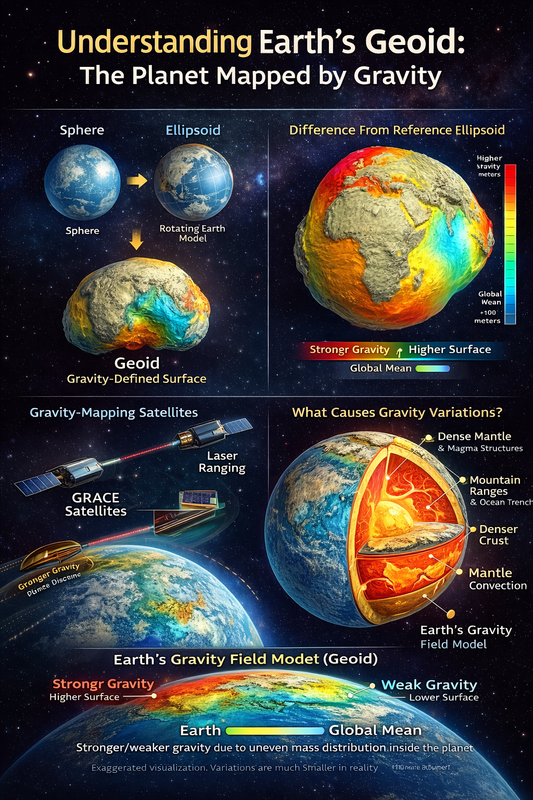
Geoid
Image property of Astrophyzix Digital Observatory 

What is the Geoid? 

Images of a distorted, lumpy Earth (as above) occasionally circulate across social media with captions claiming that the image shows the planet “as it really looks.” In reality, these images are scientific visualisations of Earth’s geoid—a model that represents the structure of the planet’s gravity field rather than its physical surface. While the visualisation appears dramatic, the actual deviations from Earth’s average radius are extremely small when viewed on planetary scales.

ℹ️ Sources / Technical / Mathematical / Scientific / Academic / Integrators / Methods
Sources
  • NASA APIs
  • CNEOS Scout
  • JPL CAD
  • NeoWs
  • SBDB
  • Horizons
  • Sentry
Stack
  • IEEE-754 Float64
  • RKN4
  • Yoshida-4
  • Dormand–Prince / DOPRI5
  • DOPRI8 /DOP853
  • Verlet
  • N-Body
  • Einstein–Infeld–Hoffmann
  • DE441
  • ΛCDM
  • J2
  • Meeus
  • Yarkovsky
  • Schwarzschild GR
  • Simon 1994
  • Holsapple–Schmidt
  • Collins / Pierazzo / Ward–Asphaug
  • AIS-Wide
  • Abyssal 4 km
  • WebGPU
  • DOI Registered
  • Academia.edu
  • Zenodo
  • OpenAIRE
Independent Direct Source Verification
Uncompromised Crossref DOI Resolver · Live and direct meta data fetch
Awaiting DOI input