
Article Type: Gravitational modelling, Explainer, Deep-Dive, Evidence-First Science
Earth’s True Shape: Understanding the Geoid and the Planet’s Gravity Field
What is the Geoid?
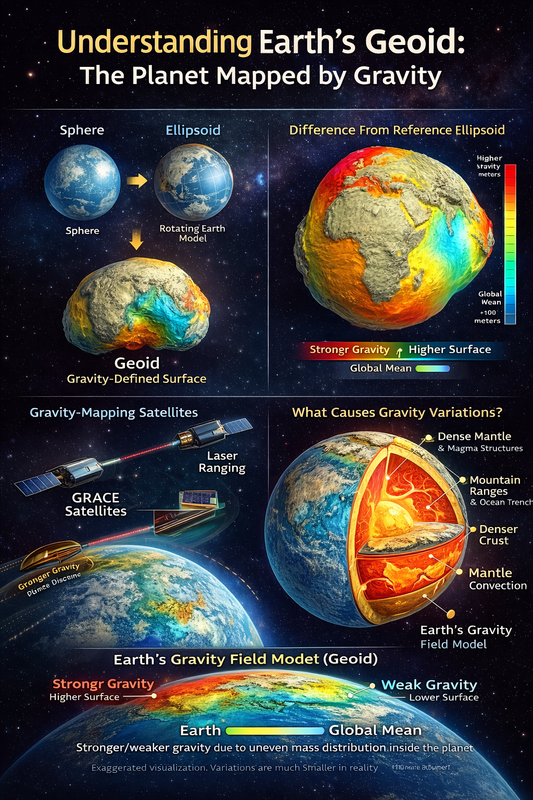
Images of a distorted, lumpy Earth (as above) occasionally circulate across social media with captions claiming that the image shows the planet “as it really looks.” In reality, these images are scientific visualisations of Earth’s geoid—a model that represents the structure of the planet’s gravity field rather than its physical surface. While the visualisation appears dramatic, the actual deviations from Earth’s average radius are extremely small when viewed on planetary scales.
The geoid is one of the most important reference surfaces used in modern geophysics, satellite navigation, oceanography, and planetary science. It provides the baseline used to define mean sea level across the globe and enables researchers to measure subtle mass changes within Earth’s system. Data used to construct modern geoid models come primarily from dedicated gravity-mapping satellite missions such as NASA and the German Aerospace Center’s GRACE mission and its successor GRACE-Follow On.
This article examines the scientific meaning of the geoid, how it is measured, why the visualisation appears distorted, and what gravity field mapping reveals about the interior structure and dynamics of our planet.
The Shape of Earth: Sphere, Ellipsoid, and Geoid
At first approximation Earth is often described as a sphere. However, precise measurements show that the planet is slightly flattened at the poles and bulged at the equator due to its rotation. This shape is known as an oblate spheroid or ellipsoid. Earth’s equatorial radius is approximately 6,378 km while the polar radius is roughly 6,357 km, creating a flattening of about 21 km.
The ellipsoid provides a mathematically convenient approximation of Earth’s shape and is widely used in cartography and satellite navigation systems such as GPS. However, the real distribution of mass inside Earth causes slight variations in gravitational pull across the planet’s surface. These variations mean that the ocean surface, if influenced only by gravity and rotation, would not follow the simple ellipsoid shape. Instead it would form an irregular but continuous surface known as the geoid.
The geoid therefore represents the gravitational “level surface” of Earth. It is the surface everywhere perpendicular to the direction of gravity. In practical terms it defines what scientists consider global mean sea level.
- Sphere – simple conceptual model
- Ellipsoid – mathematically smooth rotating Earth model
- Geoid – gravity-defined sea-level surface
The geoid is the most physically meaningful representation of Earth’s gravitational shape.
What the Geoid Represents
The geoid can be imagined as the shape the oceans would take if the planet were completely covered by water and there were no winds, tides, or ocean currents. In this hypothetical scenario, the water surface would settle into a configuration controlled solely by gravity and Earth’s rotation. The resulting surface would vary slightly in height depending on regional gravitational differences.
These variations are caused by uneven mass distribution inside the planet. Regions containing more mass produce stronger gravitational attraction, slightly raising the geoid surface. Areas with lower density produce weaker gravitational pull, causing the geoid to dip slightly lower.
The differences between the geoid and the reference ellipsoid are called geoid height anomalies. Globally these variations typically range between about −100 metres and +100 metres relative to the ellipsoid.
Although the visualisation of the geoid appears dramatically distorted, the vertical exaggeration used in such models is enormous. When scaled realistically, the geoid variations are extremely subtle compared with Earth’s radius of over 6,300 km.
Mapping Earth’s Gravity Field from Space
Modern geoid models are built using precise measurements of Earth’s gravitational field collected by satellite missions. One of the most important missions for this work was the Gravity Recovery and Climate Experiment (GRACE), launched in 2002 by NASA and the German Aerospace Center.
GRACE consisted of two identical satellites flying in tandem roughly 220 kilometres apart. As the pair orbited Earth, variations in the planet’s gravitational field caused tiny changes in the distance between the spacecraft. These changes were measured using an extremely precise microwave ranging system capable of detecting variations smaller than a micron.
When the leading satellite passed over a region with slightly stronger gravity, it was pulled forward and accelerated slightly. The trailing satellite experienced the same effect moments later. By measuring the changing distance between the spacecraft, scientists could map the gravitational field beneath them.
- GRACE launched in 2002
- Twin satellites measuring gravitational variations
- Precision distance measurement between spacecraft
- Global gravity field mapping over time
The mission produced an unprecedented dataset describing the structure of Earth’s gravity field and how it changes over time. In 2018 the GRACE Follow-On mission was launched to continue these measurements with improved instrumentation.
Why Earth’s Gravity Is Not Uniform
The gravitational field of a planet depends on how mass is distributed within it. Earth is geologically complex, and its interior contains variations in density and structure that influence gravity at the surface.
Several major factors contribute to gravity variations:
- Mountain ranges and crustal thickness variations
- Subduction zones and tectonic plate boundaries
- Density differences in the mantle
- Large underground magma structures
- Ocean trenches and seafloor topography
Deep within Earth’s mantle, convection currents slowly transport heat and material upward and downward. These flows create regions with slightly higher or lower density, which affect the gravitational field above them. Over millions of years, these processes shape the global geoid pattern.
For example, a large geoid depression exists in the Indian Ocean known as the “Indian Ocean Geoid Low.” This region represents one of the most significant gravity anomalies on the planet and may be linked to deep mantle structures beneath the region.
Understanding the Colours in Geoid Visualisations
The colourful geoid images frequently shared online represent gravitational potential variations relative to the reference ellipsoid. The colour scale indicates whether the geoid surface is higher or lower than average.
- Red and orange regions indicate areas where the geoid is slightly higher
- Blue regions indicate areas where the geoid is slightly lower
- Yellow and green represent values near the global mean
These differences correspond to changes in gravitational potential rather than topographic height. The exaggerated appearance in visualisations helps researchers identify patterns in the gravity field that would otherwise be invisible.
Without vertical exaggeration, the geoid surface would appear almost perfectly smooth.
Why the Geoid Matters for Science
Although the geoid may appear to be an abstract scientific concept, it plays a crucial role in many areas of Earth science and space technology.
Because the geoid defines global mean sea level, it provides the baseline for measuring ocean height variations. Satellite altimeters measure the height of the ocean surface relative to spacecraft orbit. By comparing these measurements with the geoid model, scientists can determine ocean circulation patterns and sea-level changes.
The geoid is also essential for converting satellite positioning data into accurate elevation measurements on Earth’s surface. GPS satellites determine positions relative to a reference ellipsoid, but engineers and surveyors require elevations relative to mean sea level. Geoid models provide the necessary conversion between these coordinate systems.
- Sea-level measurement and ocean circulation studies
- Satellite navigation and geodesy
- Mapping groundwater depletion
- Monitoring ice sheet mass loss
- Studying mantle dynamics
GRACE data has even allowed scientists to monitor seasonal changes in groundwater storage and track the melting of polar ice sheets. As mass redistributes across the planet, the gravity field changes slightly, and satellites detect these shifts.
Tracking Climate and Water Movement
One of the most powerful applications of gravity field monitoring is the ability to measure changes in the distribution of water and ice on Earth. Because water has mass, large-scale movement of water alters the gravitational field in measurable ways.
GRACE observations have been used to track groundwater depletion in agricultural regions, changes in polar ice mass in Greenland and Antarctica, and shifts in ocean circulation associated with climate variability.
These measurements provide a global perspective that would be impossible using ground-based instruments alone. By observing gravity changes from space, scientists can quantify how water moves through Earth’s system over time.
Why Social Media Often Misrepresents the Image
The geoid visualisation is frequently shared online with captions suggesting that it shows the “true shape of Earth.” This interpretation is misleading. The physical surface of the planet remains very close to an oblate spheroid. The geoid instead represents variations in gravitational potential.
The dramatic distortions in the image result from extreme vertical exaggeration applied for scientific visualisation. Without exaggeration, the geoid deviations would be nearly imperceptible on a globe.
Understanding this distinction is important because it illustrates how scientific models can be misinterpreted when removed from their proper context. The geoid is a powerful analytical tool, not a literal photograph of Earth’s surface.
Future Gravity Mapping Missions
Gravity field science continues to evolve as new satellite missions and improved data analysis techniques become available. GRACE Follow-On continues the legacy of the original GRACE mission while introducing laser ranging systems capable of measuring inter-satellite distance with even greater precision.
Future missions may provide even higher resolution gravity maps, enabling scientists to study subsurface geological structures, track water resources more accurately, and improve climate models.
As observational capabilities advance, the geoid will remain one of the fundamental reference surfaces used to understand Earth as a dynamic planetary system.
Conclusion
The distorted Earth images widely shared online represent a scientific visualisation of the geoid, the gravity-defined surface that approximates global mean sea level. Rather than depicting the physical shape of the planet, the geoid reveals subtle variations in Earth’s gravitational field caused by uneven mass distribution within the planet.
Satellite missions such as GRACE and GRACE Follow-On have transformed our ability to map these variations and monitor changes in Earth’s system. Through precise gravity measurements, scientists can observe groundwater depletion, ice sheet loss, and large-scale ocean dynamics.
Although the geoid visualisation appears dramatic, the actual deviations from Earth’s average radius are small compared with the planet’s overall size. The model remains an essential scientific tool for geodesy, oceanography, climate science, and planetary physics.
Understanding the geoid provides a deeper appreciation of how Earth’s gravity field shapes the behaviour of oceans, atmosphere, and planetary dynamics—revealing that even subtle gravitational variations can carry critical information about the processes occurring deep within our world.
Sources
- Tapley et al. (2004) The Gravity Recovery and Climate Experiment – DOI:10.1029/2005EO140001
- Velicogna & Wahr (2006) Measurements of ice mass loss from Greenland – DOI:10.1038/nature07010
- NASA Jet Propulsion Laboratory – GRACE Mission Overview
- NASA Earth Observatory – Mapping Earth’s Gravity
- GFZ German Research Centre for Geosciences – GRACE Mission Data