
Live Independent Verifiable and reproducible Unpaywalled NASA-sourced

Astrophyzix Digital Observatory

Trusted for Asteroid News, Research, Data & Analysis

Delivering unpaywalled, evidence-driven analysis, public research tools, real-time datasets and monitoring and tracking of all PHA/NEO asteroids, comets and solar system objects.

Every tracking console is designed and engineered here. Systems directly ingest multiple NASA datasets covering over 1.57 million objects, then run live, verifiable probabilistic orbital analysis and deliver an instant deterministic summary of close approaches. Used by students, educators, researchers, and the public. Data provenance is traceable, verifiable and transparent. Original research papers are published on Astrophyzix.academia.edu, registered with official DOIs via Zenodo and academically indexed by OpenAIRE.

  • NASA API'S
  • ✅ CNEOS Scout
  • ✅ JPL CAD
  • ✅ NeoWs
  • ✅ SBDB
  • ✅ Horizons
  • ✅ Sentry
Showing posts with label offical data. Show all posts

Potentially Hazardous Asteroid 2026GU Close Approach Report and Asteroid Profile Latest Near Earth Object News

Near-Earth Object (NEO) Close Approach Report & Asteroid Profile Potentially Hazardous Asteroid 2026 GU

Written by: Astrophyzix Digital Observatory

📌 Cited by iAsk Student

Astrophyzix Image
Image Credit: NASA JPL SBDB

Introduction


A Potentially Hazardous Asteroid (PHA)  is a near-Earth object with an absolute magnitude of 22.0 or brighter (typically larger than ~140 metres) and a minimum orbit intersection distance (MOID) of 0.05 AU or less. This classification does not indicate an impact threat, but identifies objects that require precise orbital monitoring.

Asteroid (2026 GU) is an Amor-class near-Earth object (NEO) classified as a Potentially Hazardous Asteroid (PHA) based on its size and orbital proximity to Earth. The object was observed over a short 5-day arc in this week and its orbit is currently defined by the initial JPL solution (Solution 1 on 09 April 2026.) 


Despite its PHA classification, current orbital solutions indicate a relatively distant Earth flyby on 14 April 2026. Continued observations are required to refine its trajectory due to the limited observational baseline and elevated uncertainty level.

Key Takeaways


  • Close approach on 2026-Apr-14 at ~0.09884 AU.
  • Equivalent to approximately 38.4 lunar distances (~14.8 million km).
  • Classified as a Potentially Hazardous Asteroid (PHA).
  • Estimated diameter: ~150–300 meters (based on H magnitude).
  • Orbit currently constrained using 90 observations over 5 days.
  • Condition code 8 indicates high orbital uncertainty.
  • No impact threat identified.


Scientific Consensus Snapshot


The current orbital solution for (2026 GU) is based on a short observational arc and remains subject to refinement. While the object's classification as a PHA reflects its long-term orbital geometry, the 14 April 2026 encounter is well outside any hazardous threshold. Future observations will reduce uncertainties and improve long-term trajectory modelling.
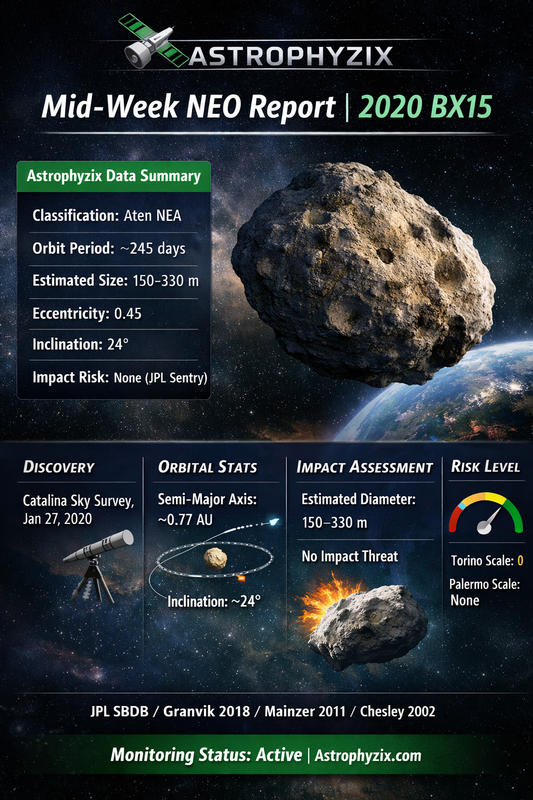
Asteroid 2020 BX15 Near-Earth Asteroid: Planetary Defence Profile

Digital Observatory Planetary Defence NEO Report — Asteroid 2020 BX15


MONITORING ACTIVE

Object: 2020 BX15 (Updated: 2 March 2026) 
Classification: Aten Near-Earth Asteroid (NEA)
Discovery Date: 27 January 2020 (Catalina Sky Survey)
Data Source: NASA JPL Small-Body Database (SBDB) & Minor Planet Center

2020 Bx15

Introduction 

This mid-week technical assessment summarises the orbital state, physical constraints, and planetary defense status of near-Earth asteroid 2020 BX15 using official NASA/JPL orbital solutions and peer-reviewed near-Earth asteroid research. 

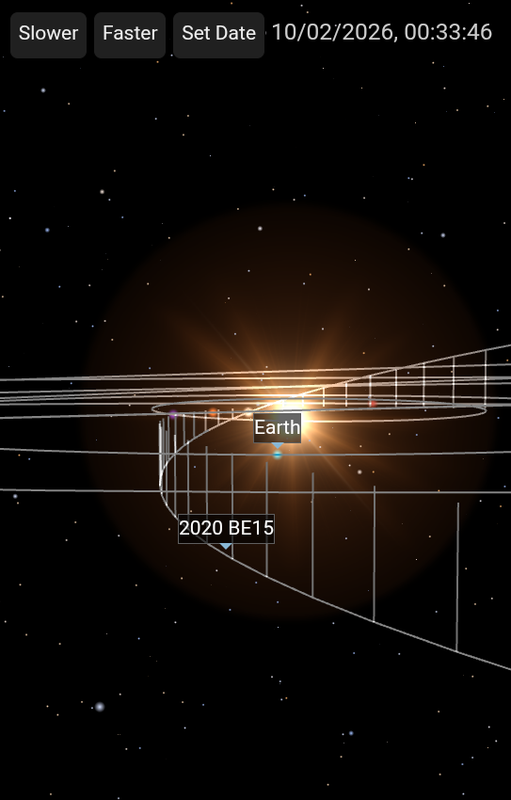
Near Earth Asteroid (2020 BE15) A Safe Close Approach to Earth on 10 February 2026

MONITORING ACTIVE
Astrophyzix Asteroid Close Approach Series
Information and Data Updated: 10 February 2026
Written by: Astrophyzix Science Communication

Close asteroid 10/02/2026


Introduction to Asteroid 2020 BE15


Asteroid 2020 BE15 is a small near-Earth asteroid that belongs to the population of solar system bodies whose orbits bring them into the vicinity of Earth. It is categorized as a near-Earth object (NEO), meaning that its orbital path crosses or approaches the orbit of our planet. 

Objects of this class are scientifically important because they provide insight into the formation and evolution of the early solar system and are also monitored for planetary defense purposes. Asteroid 2020 BE15 is considered a relatively small asteroid compared to many known objects, yet it is still large enough to be studied as part of ongoing research into near-Earth asteroid dynamics. It poses absolutely no risk to planet Earth. 

ℹ️ Sources / Technical / Mathematical / Scientific / Academic / Integrators / Methods
Sources
  • NASA APIs
  • CNEOS Scout
  • JPL CAD
  • NeoWs
  • SBDB
  • Horizons
  • Sentry
Stack
  • IEEE-754 Float64
  • RKN4
  • Yoshida-4
  • Dormand–Prince / DOPRI5
  • DOPRI8 /DOP853
  • Verlet
  • N-Body
  • Einstein–Infeld–Hoffmann
  • DE441
  • ΛCDM
  • J2
  • Meeus
  • Yarkovsky
  • Schwarzschild GR
  • Simon 1994
  • Holsapple–Schmidt
  • Collins / Pierazzo / Ward–Asphaug
  • AIS-Wide
  • Abyssal 4 km
  • WebGPU
  • DOI Registered
  • Academia.edu
  • Zenodo
  • OpenAIRE
Independent Direct Source Verification
Uncompromised Crossref DOI Resolver · Live and direct meta data fetch
Awaiting DOI input