Live Independent Verifiable and reproducible Unpaywalled NASA-sourced

Astrophyzix Digital Observatory

Trusted for Asteroid News, Research, Data & Analysis

Delivering unpaywalled, evidence-driven analysis, public research tools, real-time datasets and monitoring and tracking of all PHA/NEO asteroids, comets and solar system objects.

Every tracking console is designed and engineered here. Systems directly ingest multiple NASA datasets covering over 1.57 million objects, then run live, verifiable probabilistic orbital analysis and deliver an instant deterministic summary of close approaches. Used by students, educators, researchers, and the public. Data provenance is traceable, verifiable and transparent. Original research papers are published on Astrophyzix.academia.edu, registered with official DOIs via Zenodo and academically indexed by OpenAIRE.

  • NASA API'S
  • ✅ CNEOS Scout
  • ✅ JPL CAD
  • ✅ NeoWs
  • ✅ SBDB
  • ✅ Horizons
  • ✅ Sentry
Showing posts with label new discovery. Show all posts

Newly Discovered NEO Asteroid 2026SC Close Approach Report, Analysis and Complete Official Data Profile - Astrophyzix Digital Observatory

Astrophyzix Scientific Close-Approach & Orbital Report NEO 2026SC Official Data

Asteroid 2026 SC — Small Aten NEO Close-Approach & Orbital Profile · JPL CAD confirmed
✅ Data source: JPL Close-Approach Data (CAD) · confirmed solution, 6-day arc
SunPerihelion 0.564 auAphelion 1.10 auEarth · 2026 SCapproach 25 Sep 2026MercuryVenusEarthMars2026 SC

Top-down schematic. Orbit size and shape are drawn from the published elements (a, e, q, Q); the orientation of the orbit and the marked encounter point are approximate. Note how small and Earth-like this orbit is compared with 2026 SY2's — 2026 SC is an Aten, spending most of its time inside Earth's orbit. 

Copyright © 2026 Astrophyzix - All images, original calculations and analysis are the digital property of Astrophyzix. No distribution without proper attribution 

Aten NEO6-Day Data Arc30 ObservationsARI 42 / 100NO IMPACT RISK — Not on Sentry

Key Takeaways of Asteroid 2026 SC

  • Close approach: predicted for 25 Sep 2026 at 13:47 TDB (timing uncertainty ± 4 minutes), confirmed in the JPL CAD record. The miss distance is 1.705 LD (≈ 655,383 km, 0.00438 au).
  • Speed: 7.75 km/s relative to Earth (≈ 27,900 km/h) — much slower than 2026 SY2's 25.1 km/s; v∞ 7.68 km/s.
  • Orbit class: Aten NEO — a = 0.832 au, e = 0.322, i = 4.66°, orbital period ≈ 277 days (0.76 years). Unlike an Apollo, an Aten spends most of its orbit inside Earth's.
  • Earth MOID: 0.0034 au (≈ 509,000 km). This pass, at 0.00438 au, is about 30% farther than the geometric MOID — not the tightest approach this orbit allows.
  • Size estimate: absolute magnitude H = 26.159, giving a diameter of about 21 m (range 15.6–34.9 m, albedo-dependent). The size is H-derived, not measured.
  • Orbit quality: the solution rests on a 6-day data arc with 30 observations — a longer baseline than a 1-day discovery arc, but still short enough that the elements are provisional.
  • Risk context: not a Potentially Hazardous Asteroid (H is above the H ≤ 22 PHA threshold), not on the Sentry watchlist, and no Scout entry.
  • Keep it in proportion: a lunar-distance-class flyby from a ~20 m object is a routine, expected detection for current sky surveys. This one is tracked, confirmed and shows no impact geometry.

Approach Scale

EarthMoon · 1 LD2026 SC · 1.71 LD2 LD1 LD ≈ 384,400 km

Scientific Consensus Snapshot of 2026 SC

ParameterStatus
Orbit classAten NEO (a < 1 au, Q > 0.983 au — Earth-crossing, orbit mostly interior to Earth's)
Semi-major axis (a)0.832 au
Eccentricity (e)0.322
Perihelion distance (q)0.564 au
Aphelion distance (Q)1.10 au
Inclination (i)4.66°
Orbital period≈ 277 days (0.76 years)
Earth MOID0.0034 au (≈ 509,000 km)
Tisserand parameter (TJ)≈ 7.0 † — well above 3, firmly asteroidal
Absolute magnitude (H)26.159 (very small object)
Estimated diameter≈ 21 m (15.6–34.9 m), H-derived
Observations / data arc30 observations over 6 days
Sentry / ScoutNot on Sentry watchlist · no Scout entry
Hazard levelNon-hazardous size; not PHA-class

† Derived by Astrophyzix from a, e and i. All other values are taken from the JPL CAD/SBDB record.

2026 SC Close-Approach Overview

Date/Time (TDB)BodyNominal distanceMin–Max distance (au)Vrel (km/s)
2026-09-25 13:47 ± 00:04Earth0.00438 au
1.705 LD
0.00437 – 0.004407.75

1. Asteroid 2026 SC

Small Aten NEO on a compact, Earth-orbit-hugging path, with a lunar-distance flyby predicted for 25 September 2026 and a tight Earth MOID — a routine, well-characterised approach with no impact geometry in current solutions.

Asteroid 2026 SC Orbital Geometry

ParameterValue
Orbit classAten (ATE) — Earth-crossing NEO
Semi-major axis (a)0.832 au
Eccentricity (e)0.322
Perihelion distance (q)0.564 au
Aphelion distance (Q)1.10 au
Inclination (i)4.66°
Longitude of node (Ω)180°
Argument of perihelion (ω)325°
Mean anomaly (M)103°
Mean motion (n)≈ 1.30 deg/day †
Orbital period≈ 277 days (0.76 years)
Earth MOID0.0034 au (≈ 509,000 km)
Data arc6 days
Observations used30

Physical Characteristics of NEO 2026 SC

ParameterValue
Absolute magnitude (H)26.159
Estimated diameter≈ 15.6–34.9 m (nominal 20.8 m, assuming albedo 0.25–0.05)
Size sourceH-derived (no radar or thermal measurement)
Rotation periodNot published
Spectral typeUnknown (no published taxonomy)
PHA classificationNo — below PHA-class threshold (derived)

2026 SC is a small Aten NEO whose orbit lies almost entirely inside Earth's, ranging from 0.564 au at perihelion (between Mercury's and Venus's distances) out to 1.10 au at aphelion, just beyond Earth's own orbit. That small overshoot at aphelion is what makes it Earth-crossing and gives it a tight MOID of 0.0034 au. At an estimated 15–35 m across, it is in the same general size class as the 2013 Chelyabinsk fireball (about 18–20 m), though it is passing at a safe distance with no impact geometry in current solutions.

Interpretation of the Predicted Approach

The 6-day data arc and 30 observations give a noticeably firmer orbit than a bare 1-day discovery arc, but the elements are still short-arc and will tighten further as more astrometry comes in before and after the 25 September pass.

Because the approach distance (0.00438 au) sits somewhat above the orbit's Earth MOID (0.0034 au), this particular encounter is not the closest geometry the orbit permits — a useful reminder that MOID describes the orbits' closest possible separation, not any single flyby.

Astrophyzix Assessment:

Astrophyzix confirms that it's predicted 25 September 2026 approach is safe, non-hazardous and a good target for follow-up astrometry. Astrophyzix Orbital calculations are consistent with NASA and no impact risk is suggested. Its Aten orbit and short period make it a candidate for early recovery in future apparitions.

Astrophyzix Risk Index (ARI)

42 / 100 for 2026 SC — close to the ARI recorded for 2026 SY2 (43) despite a much slower, more distant pass, reflecting its somewhat larger estimated size.

ARI is an Astrophyzix composite index used to rank close approaches at a glance. It is not an official NASA, ESA or IAU hazard rating; the authoritative impact-risk sources are Sentry and Scout.

Newly discovered NEO Asteroid 2026 HZ3 Close Approach Report and NEO Profile by Astrophyzix Digital Observatory

Asteroid (2026 HZ3) — 2026 NASA-Linked Preliminary Scientific Status Report
NASA JPL SBDB Solution 5 (2026-Apr-28 06:20:37)


Researched, Written and Published by: Astrophyzix Digital Observatory

Original, Timely, Verifiable Asteroid News and Planetary Defence Monitoring by Astrophyzix.com & Astrophyzix.org


📌 Cited by MSN News | Bing Copilot News Image
Reading Time: ~8 min Primary Data: NASA JPL SBDB / CNEOS

Classification: Apollo Near-Earth Object (NEO) SPK-ID: 54613601

Asteroid 2026 HZ3 Key Takeaways

  • Newly discovered NEO: (2026 HZ3) is a recently observed Apollo-class near-Earth asteroid with a short data-arc (4 days) and a relatively high orbital uncertainty (condition code 7).
  • Small object: With an absolute magnitude H ≈ 25.3, (2026 HZ3) is likely a small asteroid, on the order of a few tens of metres in diameter, depending on its surface reflectivity.
  • Close approach in 2026: A nominal close approach to Earth occurs on 1 May 2026 at a distance of about 0.010 au (around 1.5 million km), well outside any impact scenario under current solutions.
  • Earth MOID: The current Minimum Orbit Intersection Distance (MOID) with Earth is about 0.00497 au (~745,000 km), indicating close-approach potential but not an imminent threat.
  • Preliminary orbit: Because the orbit is based on only 38 observations over 4 days, all risk and trajectory assessments are considered preliminary and will be refined as more data are collected.

Scientific consensus snapshot (preliminary)

ParameterStatus (NASA JPL SBDB Solution 5 | 2026-Apr-28 06:20:37)
Impact risk (100-year context)No confirmed impact solution; orbit still under refinement (condition code 7).
Orbital uncertaintyModerate–high (short 4-day data-arc, condition code 7).
2026 close approachNominal miss distance ~0.010 au (~1.5 million km) — a safe flyby under current solutions.
Hazard classificationNEO (Apollo). Not formally classified as a Potentially Hazardous Asteroid (PHA) at this time.
Scientific priorityMonitoring and orbit refinement; representative of small NEOs that frequently pass near Earth.

Potentially Hazardous Asteroid 2026GU Close Approach Report and Asteroid Profile Latest Near Earth Object News

Near-Earth Object (NEO) Close Approach Report & Asteroid Profile Potentially Hazardous Asteroid 2026 GU

Written by: Astrophyzix Digital Observatory

📌 Cited by iAsk Student

Astrophyzix Image
Image Credit: NASA JPL SBDB

Introduction


A Potentially Hazardous Asteroid (PHA)  is a near-Earth object with an absolute magnitude of 22.0 or brighter (typically larger than ~140 metres) and a minimum orbit intersection distance (MOID) of 0.05 AU or less. This classification does not indicate an impact threat, but identifies objects that require precise orbital monitoring.

Asteroid (2026 GU) is an Amor-class near-Earth object (NEO) classified as a Potentially Hazardous Asteroid (PHA) based on its size and orbital proximity to Earth. The object was observed over a short 5-day arc in this week and its orbit is currently defined by the initial JPL solution (Solution 1 on 09 April 2026.) 


Despite its PHA classification, current orbital solutions indicate a relatively distant Earth flyby on 14 April 2026. Continued observations are required to refine its trajectory due to the limited observational baseline and elevated uncertainty level.

Key Takeaways


  • Close approach on 2026-Apr-14 at ~0.09884 AU.
  • Equivalent to approximately 38.4 lunar distances (~14.8 million km).
  • Classified as a Potentially Hazardous Asteroid (PHA).
  • Estimated diameter: ~150–300 meters (based on H magnitude).
  • Orbit currently constrained using 90 observations over 5 days.
  • Condition code 8 indicates high orbital uncertainty.
  • No impact threat identified.


Scientific Consensus Snapshot


The current orbital solution for (2026 GU) is based on a short observational arc and remains subject to refinement. While the object's classification as a PHA reflects its long-term orbital geometry, the 14 April 2026 encounter is well outside any hazardous threshold. Future observations will reduce uncertainties and improve long-term trajectory modelling.


Newly Discovered NEO Asteroid (2026 GD) Exclusive Close Approach Report and Object Profile Astrophyzix Digital Observatory NASA Data

Astrophyzix Near-Earth Object (NEO) Close Approach Report: (2026 GD) Newly Discovered Asteroid Will Pass Closer than the Moon. 

Written by: Astrophyzix Digital Observatory

📌 Cited by DiscoverWildScience 📌 Cited by MSN News 📌 Cited by Bing Copilot News
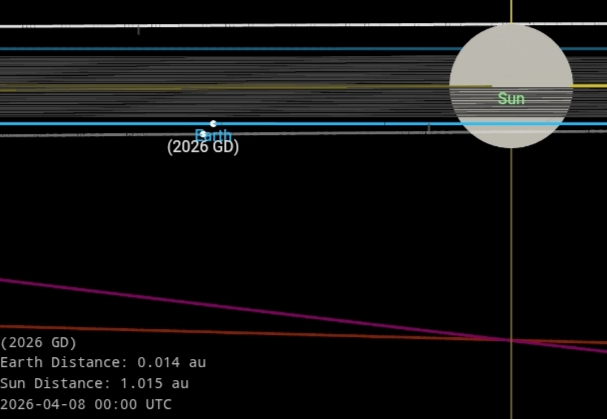
NEO close approach visualisation

Introduction

New updates found in our JPL Solution 2 Report


Asteroid (2026 GD) is a recently observed Apollo-class near-Earth object (NEO) identified in April 2026. With a short observational arc of just 1 day, its orbital solution remains preliminary and subject to refinement. Despite this, current data indicates an exceptionally close Earth approach occurring on 09 April 2026.


The object’s very low Earth Minimum Orbit Intersection Distance (MOID) and near-term encounter geometry place it within the category of close-approach monitoring priority objects, although no confirmed impact risk is currently established based on available solutions at this time. Astrophyzix will update you as new data comes in. 

Key Takeaways


  • Apollo-class near-Earth asteroid with Earth-crossing orbit.
  • Very close Earth approach on 2026-Apr-09 at ~0.00168 AU.
  • Equivalent to approximately 0.65 lunar distances (~251,000 km).
  • Estimated relative velocity: ~12.66 km/s.
  • Small object (~20–30 meters estimated diameter range).
  • Extremely low Earth MOID: 0.000525 AU.
  • Orbit uncertainty remains high (condition code 7).
  • No confirmed impact risk in current datasets at the time of this report. 


Scientific Consensus Snapshot


The orbital parameters for (2026 GD) are based on a limited observational dataset spanning approximately one day. As a result, uncertainties remain significant, reflected in its condition code of 7. (Explanation of Code 7 below) 


Additional observations are required to refine its trajectory and reduce positional uncertainty. Close-approach predictions at this stage should be treated as provisional.


ℹ️ Sources / Technical / Mathematical / Scientific / Academic / Integrators / Methods
Sources
  • NASA APIs
  • CNEOS Scout
  • JPL CAD
  • NeoWs
  • SBDB
  • Horizons
  • Sentry
Stack
  • IEEE-754 Float64
  • RKN4
  • Yoshida-4
  • Dormand–Prince / DOPRI5
  • DOPRI8 /DOP853
  • Verlet
  • N-Body
  • Einstein–Infeld–Hoffmann
  • DE441
  • ΛCDM
  • J2
  • Meeus
  • Yarkovsky
  • Schwarzschild GR
  • Simon 1994
  • Holsapple–Schmidt
  • Collins / Pierazzo / Ward–Asphaug
  • AIS-Wide
  • Abyssal 4 km
  • WebGPU
  • DOI Registered
  • Academia.edu
  • Zenodo
  • OpenAIRE
Independent Direct Source Verification
Uncompromised Crossref DOI Resolver · Live and direct meta data fetch
Awaiting DOI input