
Live Independent Verifiable and reproducible Unpaywalled NASA-sourced

Astrophyzix Digital Observatory

Trusted for Asteroid News, Research, Data & Analysis

Astrophyzix Observatory — Unpaywalled, evidence-driven analysis, public research tools, real-time datasets, monitoring and tracking of all PHA/NEO asteroids and comets.

Every tracking console is designed and engineered here. Systems ingest official NASA datasets, then run live, verifiable probabilistic orbital analysis and deliver an instant deterministic summary of close approaches. Used by students, educators, researchers, and the public. Traceable, verifiable and transparent data provenance. Original research papers are published on Astrophyzix.academia.edu with registered DOIs.

  • NASA API'S
  • CNEOS Scout
  • JPL CAD
  • NeoWs
  • SBDB
  • Horizons
  • Sentry

  • Standards
  • IEEE-754 Float64
  • RKN4
  • Yoshida-4
  • Dormand–Prince / DOPRI5
  • Verlet
  • N-Body
  • DE441
  • ΛCDM
  • Meeus
  • Schwarzschild GR
  • Simon 1994
  • Holsapple–Schmidt
  • Collins / Pierazzo / Ward–Asphaug
  • AIS-Wide
  • Abyssal 4 km
  • WebGPU
  • DOI Registered
Showing posts with label march 2026. Show all posts

Interstellar Object 3I/ATLAS: Evidence-Based Analysis of Its Mass, Composition, and Physical Properties Using Peer Reviewed Papers, No Hype, No Sensationalism

📌 Cited

Interstellar Object 3I/ATLAS: Evidence-Based Analysis of Its Mass, Composition, and Physical Properties

Written by: Astrophyzix Science Communication
Article Type: Peer-Reviewed Sourced, Explainer, Evidence-First 

3I/ATLAS

 
Key Takeaways
  • 3I/ATLAS is the third confirmed interstellar object detected passing through the Solar System.
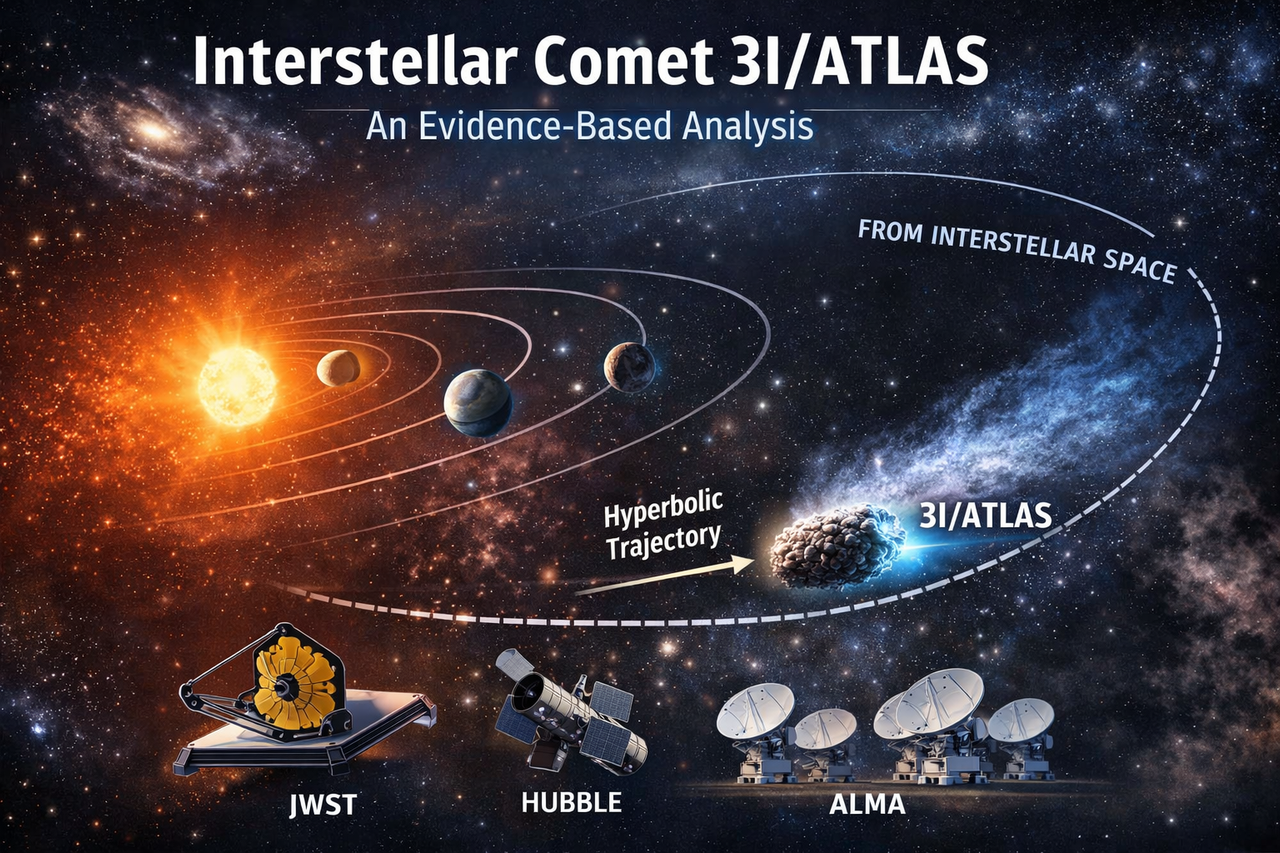
  • Observations from JWST, Hubble, and ALMA confirm that the object displays typical cometary activity.
  • Spectroscopy shows a carbon-dioxide-dominated coma with additional water, carbon monoxide, and organic molecules.
  • Current models suggest a nucleus diameter likely near the kilometre scale.
  • Estimated mass is likely on the order of billions of metric tons, consistent with other comet nuclei.
  • Isotopic measurements indicate formation in an extremely cold protoplanetary environment billions of years ago.

Introduction

Interstellar objects are small bodies that formed around other stars before being gravitationally ejected from their original planetary systems. After drifting through interstellar space for millions or billions of years, some eventually pass through the Solar System where they can be observed by modern telescopes.

Independent Direct Source Verification
Uncompromised Crossref DOI Resolver · Live and direct meta data fetch
Awaiting DOI input