
Near‑Earth Object Report – Week of March 4, 2026
Near‑Earth objects (NEOs) — asteroids and comets whose orbits bring them into the Earth’s orbital neighborhood — remain a central focus of planetary science and defense. This report synthesizes the latest state of the NEO population, recent close approaches, tracking and discovery statistics, risk assessment frameworks, observational campaigns, and planetary defense strategies as of early March 2026. All figures and operational descriptions derive from official NASA science and NASA Jet Propulsion Laboratory (JPL) data streams.
NEO Population Status: What We Know and Why It Matters
NEOs are defined as small Solar System bodies with orbits that bring them within about 1.3 astronomical units (AU) of the Sun — meaning their paths cross or approach Earth’s orbital zone. This category includes both asteroids and comets.
According to statistics maintained by the Center for Near‑Earth Object Studies (CNEOS) and aggregated by NASA and global astronomers:
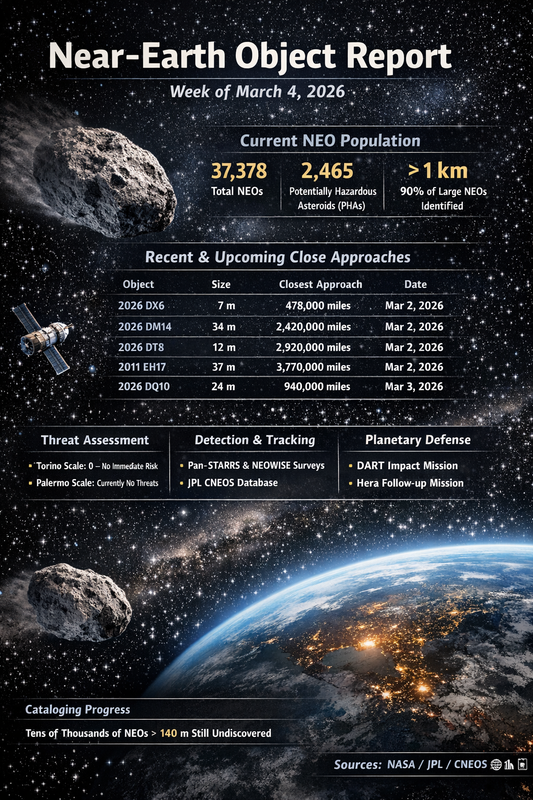
- ~37,378 NEOs have been catalogued as of late 2025, with ~99.67% classified as asteroids and the remainder as comets.
- ~2,465 objects meet criteria to be designated as potentially hazardous asteroids (PHAs) — meaning they approach within 4.6 million miles (0.05 AU) of Earth and exceed ~140 meters in size.
- Roughly 90% of NEOs larger than 1 km have been found; however, smaller bodies remain incomplete in inventory.
Discovery and Tracking: Tools and Techniques
NASA’s planetary defense infrastructure and global cooperation underpin modern NEO survey and tracking efforts. Key components include:
1. Telescopic Surveys
- Pan‑STARRS, Catalina Sky Survey, and ATLAS are major ground‑based systems scanning the sky for new NEOs.
- Follow-up observations refine candidate orbits once detected.
2. Space‑Based Assets
- NEOWISE uses infrared to characterize asteroids, improving size and albedo estimates.
- Future NEO Surveyor mission will detect dimmest objects that evade ground surveys.
3. JPL’s Small‑Body Databases and CNEOS
- The Asteroid Watch dashboard provides continuously updated ephemerides and close approach predictions.
Real‑Time Close Approaches: Recent and Upcoming
NEO close approaches, defined as objects passing within ~4.6 million miles of Earth, provide opportunities for observation and orbital refinement.
| Object Designation | Approx Size | Closest Approach | Date |
|---|---|---|---|
| 2026 DX6 | ~7 m (~23 ft) | ~478,000 miles | March 2, 2026 |
| 2026 DM14 | ~34 m (~110 ft) | ~2,420,000 miles | March 2, 2026 |
| 2026 DT8 | ~12 m (~41 ft) | ~2,920,000 miles | March 2, 2026 |
| 2011 EH17 | ~37 m (~120 ft) | ~3,770,000 miles | March 2, 2026 |
| 2026 DQ10 | ~24 m (~79 ft) | ~940,000 miles | March 3, 2026 |
Hazard Assessment: Scales, Criteria, and Risk
NEO hazards are assessed using standardized scales and metrics, primarily:
Minimum Orbital Intersection Distance (MOID)
Computes how close an object’s orbit comes to Earth’s orbit. A small MOID can flag potential hazard but does not alone imply risk.
Torino Scale
A logarithmic scale (0–10) for impact risk. 0 indicates no risk; most catalogued NEOs have Torino 0. (Torino scale ref)
Palermo Technical Impact Hazard Scale
Technical metric combining impact probability with potential energy. No NEO currently exceeds 0. (Palermo scale ref)
Catalog Completion Status and Ongoing Gaps
- Significant numbers of NEOs >140m remain undetected.
- 90% completion goal for NEOs >140m not yet met.
- Detection biases, survey limitations, and resource constraints contribute to incomplete cataloging.
Characterization: Physical and Dynamical Properties
Size, spin, composition, and orbit refinement are critical for risk assessment. Recent studies on 2025 FA22 and 2024 YR4 have improved models using optical and infrared data. (FA22 study, YR4 study)
Planetary Defense: Technologies and Readiness
- DART mission successfully demonstrated kinetic impact as a viable deflection technique. (NASA DART)
- ESA’s Hera mission will survey DART’s impact on Dimorphos.
- Gravity tractor methods considered for long-duration deflection.
Public Misconceptions vs. Scientific Reality
- No large NEOs on credible impact trajectories in the near future.
- Close passes, even extremely close ones, are natural orbital phenomena.
- Probabilities decrease with continuous observations.