
Article type: Myth Correction, Peer Reviewed sources, Fact-Check, Evidence-First
Debunking the 3I/ATLAS 'NASA was Wrong' Myth: What the Science Really Says and how Obital Refinement Works.
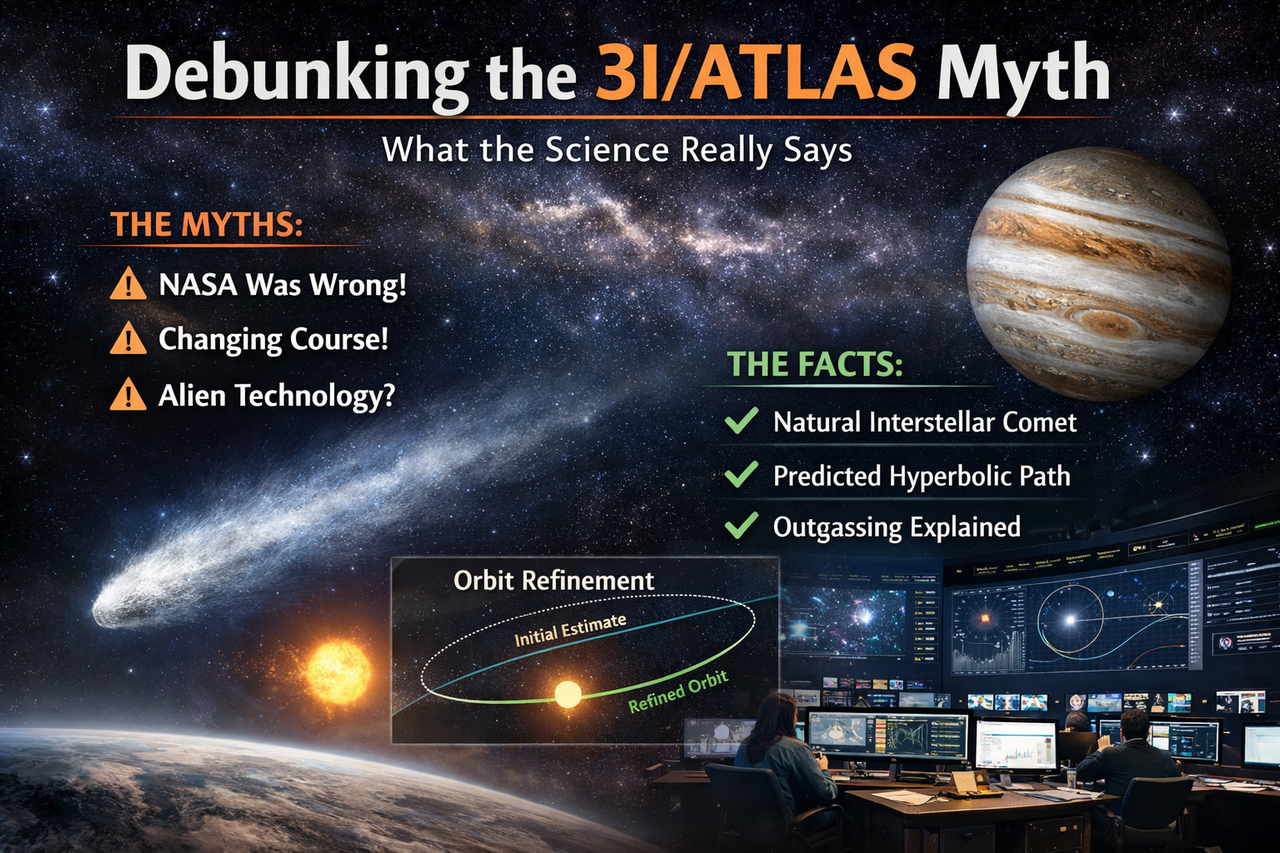
In late 2025, the interstellar visitor 3I/ATLAS captured worldwide attention—not just from astronomers, but from social media, sensational headlines, and speculation about its origin and behaviour. Some videos and posts claimed that NASA was “wrong” about the object’s trajectory, implying dramatic course changes, artificial propulsion, or even extraterrestrial technology. This article corrects those myths with clear, evidence‑based science from credible observational campaigns and peer‑reviewed research.
What Is 3I/ATLAS?
3I/ATLAS (officially designated C/2025 N1) is an interstellar comet—only the third such object confirmed to have passed through our Solar System. It was discovered in July 2025, by the Asteroid Terrestrial‑impact Last Alert System (ATLAS) survey in Chile. Its orbit is strongly hyperbolic, meaning it is not gravitationally bound to the Sun and will continue outward after its brief visit, never to return. The comet’s trajectory and velocity clearly indicate an origin outside our Solar System.
Understanding Orbital Predictions and Refinement
Early orbit determinations for newly discovered objects always include a degree of uncertainty. Astronomers use astrometric measurements—precise positions of the object against background stars—to fit trajectories by applying gravitational mechanics and, when necessary, small additional forces like outgassing. As more data points accumulate, these orbital fits are refined, reducing uncertainty and improving predictions.
Importantly, refinement does not mean that initial estimates are fundamentally wrong; rather, it reflects the normal process of updating models with better data. Even professional tracking of ordinary comets and asteroids follows this evolution. Claims suggesting that changes in 3I/ATLAS’s predicted path indicate that NASA was “wrong” misunderstand this process.
Non‑Gravitational Forces Explained
One natural mechanism that affects comet trajectories is non‑gravitational acceleration caused by outgassing. As cometary ices heat up near the Sun, volatile molecules sublimate (turn directly from solid to gas), producing jets that exert tiny forces on the nucleus. These forces are measurable and are included in detailed orbital models, but they are always consistent with physical laws and do not imply artificial propulsion.
Recent modeling demonstrates that the non‑gravitational acceleration observed in 3I/ATLAS is fully compatible with anisotropic outgassing of conventional volatiles such as carbon monoxide (CO) and carbon dioxide (CO₂). Thermophysical and Monte Carlo simulations show these effects can reproduce the magnitude and direction of the measured acceleration without invoking exotic physics.
Another study focusing on systematic and statistical uncertainties in non‑gravitational acceleration parameters confirms that while there are modelling uncertainties, the overall trajectory is consistent with expected cometary physics. These rigorous orbital solutions align with those published by major databases like NASA’s Jet Propulsion Laboratory.
Composition and Structure of 3I/ATLAS
Interstellar comets can exhibit compositions that differ from typical Solar System comets. Observations using the James Webb Space Telescope (JWST) revealed that 3I/ATLAS’s coma (the cloud of gas and dust around the nucleus) is dominated by carbon dioxide (CO₂), with a significantly higher CO₂/H₂O ratio than is common in comets from this system. This suggests that the object formed in a colder region of its parent star’s protoplanetary disk, where volatile ices like CO₂ are more abundant, or that its surface has been altered by cosmic radiation over billions of years.
Other spectroscopic studies also detected water ice, carbon monoxide, water vapor, and trace molecules, indicating that—while unusual—its composition is well within the realm of natural small bodies. There is no spectral evidence of manufactured materials or structures.
What NASA and Professional Observations Show
A suite of spacecraft and telescopes—including NASA’s STEREO, SOHO, PUNCH, and Hubble Space Telescope, as well as ESA missions—have observed 3I/ATLAS throughout its passage. These observations confirm its hyperbolic trajectory, its CO₂‑rich outgassing, and the absence of any sudden course changes inconsistent with physical models. Multiple space missions recorded the comet as it passed behind the Sun and continued outward toward Jupiter’s orbit in early 2026.
NASA officials and scientists have explicitly stated that 3I/ATLAS poses no threat to Earth and that its behavior is consistent with natural comet dynamics. There has never been an official scientific statement indicating that NASA’s understanding of the object’s path was fundamentally incorrect.
Myths and Misinterpretations Explained
Below are some common misconceptions about 3I/ATLAS—and the factual corrections based on scientific data:
- "NASA WAS WRONG" about the trajectory.” Incorrect! Orbital models are refined as more observations become available; this is normal, its always been this way. Observed adjustments are consistent with physical forces like outgassing and do not indicate error, aliens, probes or amything else exotic or sensationalised.
- “Non‑gravitational acceleration implies alien technology.”
Wrong, Outgassing from volatile comet ices produces measurable forces. Models show this can fully account for the observed acceleration without requiring artificial mechanisms. This is nothing new or anything unexplainable.
- “The object is hiding behind the Sun or changing course mysteriously.”
Wrong! Multiple spacecraft from seperate agencies observed the comet even during solar conjunction, and its path remains consistent with a hyperbolic trajectory. All seperate data set and observations consistently match.
- “Composition suggests non‑natural material.”
Wrong! Ive said this countless times. It suggests nothing of the sort. The truth is spectroscopy shows typical cometary molecules; unusual ratios reflect its interstellar origin, not artificiality.
The Real Scientific Importance of 3I/ATLAS
Even without sensational claims, 3I/ATLAS is an extraordinary object. Its interstellar origin offers a rare opportunity to study material that formed around another star. The CO₂ dominance and trace molecule detections provide insights into the diversity of protoplanetary environments across the galaxy. These data contribute to comparative planetology—understanding how planetary systems form and evolve in different stellar neighborhoods.
It also represents one of the most intensively observed interstellar visitors, with coordinated efforts across spacecraft and telescopes yielding a comprehensive dataset. This collaborative science—ranging from ultraviolet and infrared spectroscopy to long‑term tracking—is the real legacy of 3I/ATLAS.
Summary: Evidence Over Exaggeration
The circulating narratives claiming that NASA was “wrong” about 3I/ATLAS or that the object behaves anomalously in a way that defies physics are not supported by the available evidence. The scientific observations and orbital analyses show a coherent picture of a natural interstellar comet with characteristics that challenge us to expand our understanding, not to discard well‑tested physical laws.
In science, “mystery” does not equate to “miracle”—it means that the universe still has surprises for us to explore using rigorous observation and careful analysis.
Key Sources
- JWST detection of a carbon dioxide dominated gas coma surrounding interstellar object 3I/ATLAS — Demonstrates unusual but natural composition.
- Non‑Gravitational Acceleration in 3I ATLAS — Models outgassing effects on orbit.
- Systematic and Statistical Uncertainties in the Non‑Gravitational Acceleration of 3I/ATLAS — Quantifies orbital uncertainties.
- NASA’s STEREO Observes Interstellar Comet 3I/ATLAS — Official observation summary.
- NASA issues final verdict — Confirmation of natural origin and trajectory.
STAY INFORMED - NOT INFLUENCED
- ASTROPHYZIX Digital Observatory and Planetary Defence Research Console - Supporting Evidence-First Science
