

Titan, Saturn’s Surreal Moon: What We Know, What Webb Is Revealing, and What Remains Unknown
A source-based review of the only moon with a thick atmosphere and seas of liquid methane, from Cassini and Huygens to the latest James Webb Space Telescope results.
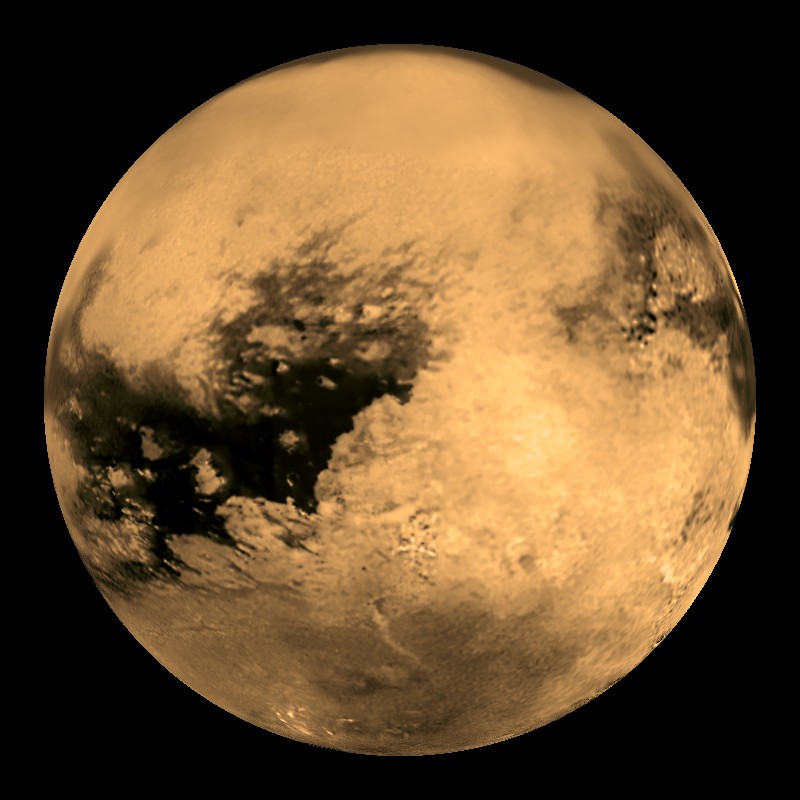
Titan, Saturn’s largest moon, is the only moon with a substantial atmosphere and the only world besides Earth with stable liquid on its surface. This review summarises what the Cassini–Huygens mission, ground-based telescopes and the James Webb Space Telescope (JWST) have established about Titan’s atmosphere, weather, hydrocarbon seas, surface and interior, and it separates measurements from model predictions. Recent JWST results include the first detection of the methyl radical, evidence of convective clouds above the northern seas, and an unidentified 5.11 µm absorption band shared with Pluto. The “slow-motion” waves predicted for Titan’s seas are model results, not observations, and Cassini measured very calm seas. We list the open questions and the mission, Dragonfly, designed to answer some of them.
Keywords: Titan; JWST; Cassini–Huygens; methane cycle; hydrocarbon seas; wave modelling; organic chemistry; Dragonfly
Why Titan Matters
Titan is the only moon in the Solar System with a substantial atmosphere, and the only other world known to have stable liquid on its surface (Hörst, 2017; Stofan et al., 2007). The liquid is not water. At about −179 °C, methane and ethane are liquid, while water ice is as hard as rock.
That makes Titan a natural laboratory for chemistry and weather that follow different rules from Earth’s. It is also a favourite subject of headlines about “surreal” discoveries. This review sticks to what has been measured, flags what is only modelled, and says plainly what is unknown.
Titan at a Glance
A Thick, Hazy, Organic-Rich Atmosphere
Sunlight and energetic particles from Saturn’s magnetosphere split methane apart. The fragments recombine into ethane and heavier organic molecules, which build the orange haze that hides the surface and eventually settle onto it (Hörst, 2017). Titan’s low gravity lets the atmosphere puff up: the lowest layer, the troposphere, reaches about 45 km, compared with about 12 km on Earth.
Laboratory experiments that simulate Titan’s atmosphere have produced amino acids and nucleotide bases, the building blocks of proteins and DNA (Hörst et al., 2012). That shows the chemistry is capable of making prebiotic molecules. It is not evidence that anything alive is on Titan.
Weather and Seasons
On Titan, methane plays the role that water plays on Earth. It evaporates from the surface, condenses into clouds and falls as rain. Cassini mapped this cycle for most of two northern seasons, but late northern summer had been little studied until JWST and the Keck II telescope observed it in November 2022 and July 2023. They saw methane clouds at mid and high northern latitudes rising to higher altitudes over several days, which is evidence of convection above the region of lakes and seas (Nixon et al., 2025). The team did not directly see rain reach the ground.
Titan also has dust storms. Cassini detected intense, short-lived brightenings around the 2009 equinox that were interpreted as organic dust lifted from the dunes by strong downdrafts (Rodriguez et al., 2018).
Lakes and Seas of Liquid Hydrocarbon
Cassini’s radar provided definitive evidence of lakes of liquid hydrocarbon (Stofan et al., 2007). Most lie near the poles. Kraken Mare is about 1,200 km across, Ligeia Mare about 500 km and Punga Mare about 390 km. Radar altimetry found Ligeia to be up to about 160 m deep along the measured track (Mastrogiuseppe et al., 2014), and flooded canyons connected to it are 240–570 m deep (Poggiali et al., 2016).
The seas differ in composition. Ligeia appears more methane-rich and Kraken more ethane-rich, which hydrological modelling attributes to rain, evaporation and restricted exchange through straits (Lorenz, 2014). Radio reflections measured by Cassini support that picture (Poggiali et al., 2024).
The “Slow-Motion” Waves: Models Versus Observations
The most striking recent headline is that Titan’s seas could host towering waves that move in slow motion. It is important to be clear about where that comes from: computer models, not JWST and not direct observation.
Reading the numbers correctly: an RMS roughness of 3.3 mm describes typical variation in surface height at radio wavelengths. It is not a maximum wave height, and it does not mean the seas are permanently still. Dragonfly will not visit the northern seas, so settling this question needs a future orbiter, floating probe or boat.
Dunes, Rivers and a Young Surface
Dunes. Cassini radar revealed vast fields of linear dunes across Titan’s equatorial regions, up to about 100 m high, about 1 km wide and tens to hundreds of kilometres long (Lorenz et al., 2006). The grains are thought to be organic or ice-and-organic material, though their exact composition is debated.
Rivers. Titan has extensive river networks, but only about 1.3% of the large rivers that reach a coast form a delta, compared with almost all comparable rivers on Earth (Birch et al., 2025). Why is unresolved, and tides, currents and shifting shorelines are among the proposed explanations.
Craters and volcanoes. Cassini found few impact craters, which points to a surface that is eroded, buried or resurfaced (Wood et al., 2010). Possible cryovolcanic features have been reported (Sotin et al., 2005; Wood and Radebaugh, 2020), but none has been unambiguously confirmed, and the question remains debated.
What Is Inside Titan?
For years, Cassini measurements of Titan’s tidal flexing were taken to show a global ocean of liquid water under an icy shell (Mitri et al., 2014). A 2025 reanalysis of Cassini radio-tracking data challenges that. The tidal response lags Saturn’s pull and loses more energy than a global ocean would allow, which fits a thick layer of slushy high-pressure ice with small pockets of melt (Petricca et al., 2025). If correct, Titan is not an ocean world in the classic sense, though liquid water pockets may still exist. A seismometer on Dragonfly could help test this.
What JWST Has Found So Far
JWST’s infrared instruments cannot photograph Titan’s surface through the haze, but they identify chemicals and track clouds. Three results stand out.
1. The Methyl Radical: Chemistry in Action
Using its Mid-Infrared Instrument (MIRI), JWST made the first definitive detection of the methyl radical (CH3) in Titan’s atmosphere. It is the primary product of methane break-up and the key to forming ethane and heavier molecules, so detecting it means scientists can see the chemistry underway rather than only the ingredients and the end products. The same study produced the first complete profile of carbon monoxide in Titan’s atmosphere (Nixon et al., 2025).
2. Convective Clouds Over the Northern Seas
As described above, JWST and Keck saw clouds climbing in altitude over the region with most of Titan’s lakes. Evaporation from the seas is a major potential methane source, so this helps connect the liquid on the surface to the weather above it.
3. An Unidentified Spectral Signature Shared With Pluto
The most intriguing result is a mystery. Using NIRSpec and MIRI, a team led by researchers at the Paris Observatory found an absorption band centred at 5.11 µm on the surfaces of both Titan and Pluto. It is absent from current models and laboratory spectral databases, appears to come directly from the surface, and is narrower on Titan than on Pluto (Bézard, Lellouch et al., 2026, pre-published 1 July 2026).
- An absorption band at 5.11 µm is present in JWST spectra of both bodies.
- It does not match any ice spectra the team tested, including ethane, ethylene, acetylene, propane, benzene and hydrogen cyanide.
- It cannot be explained by residual methane absorption.
- The identity of the compound.
- Whether it is one molecule, a family of related molecules, or a known molecule whose spectrum is altered inside an ice mixture.
- Where on Titan it is concentrated, which future JWST mapping may show.
The authors favour a poorly characterised compound or family of compounds, or a molecule whose spectral properties are strongly changed by its physical environment. Allenes, a family of hydrocarbons, are among the few organic materials known to absorb strongly near this wavelength, and ketene and some products of irradiated methanol ice also have bands nearby, but none reproduces the observation. Laboratory experiments that replicate Titan’s and Pluto’s temperatures and ice mixtures are needed.
Does it “defy organic chemistry”? No. It exposes a gap in laboratory spectral libraries, which have rarely been measured for the cold, mixed ices of the outer Solar System. An unidentified band is an open question, not evidence that known chemistry is wrong. Dragonfly’s mass spectrometer may help narrow the candidates, but a final identification may require new laboratory work.
Is Titan Habitable?
Titan has abundant organic molecules, energy from sunlight and radiation, and liquid in two forms: methane and ethane at the surface, and possibly water in pockets below. Whether life could use hydrocarbons as a solvent is entirely hypothetical. No biosignature has been detected, and nothing in current data suggests life. Titan’s value is as a laboratory for the chemistry that precedes life, which is why NASA’s Dragonfly mission is designed to study prebiotic chemical processes.
Dragonfly: The Next Step
Dragonfly is a car-sized, nuclear-powered rotorcraft being built for NASA’s New Frontiers programme. NASA confirmed it in 2024 with a launch in July 2028 and arrival in 2034, and reports from 2026 say it is on track for a launch no earlier than July 2028 and arrival in late 2034. After a cruise of about six years it will operate on Titan for more than three years, making a series of flights to sample the dunes and the Selk impact structure. Its instruments include a mass spectrometer, a gamma-ray and neutron spectrometer, a geophysics and meteorology package and cameras. It is not designed to visit the northern seas.
What We Know and What We Do Not
- Titan has seas of liquid methane, ethane and nitrogen.
- The atmosphere is mostly nitrogen with methane and an organic haze.
- JWST detected the methyl radical and convective clouds.
- Open seas were very smooth when Cassini measured them.
- A 5.11 µm absorption band exists on Titan and Pluto.
- Gentle winds could raise waves of about 3 m in the seas.
- Waves would be largest in spring and summer.
- Methane is slowly being destroyed and must be resupplied to persist.
- Whether cryovolcanism is active.
- Why Titan’s rivers rarely form deltas.
- The exact composition of the dune grains.
- How much liquid water remains inside.
- The identity of the 5.11 µm material.
- Whether tall waves exist.
- The source that resupplies Titan’s methane.
- Whether any biology, however exotic, exists.
Headlines Versus Evidence
Frequently Asked Questions (FAQ)
1. What is Titan?
2. Are Titan’s lakes made of water?
3. Did the James Webb Space Telescope discover giant waves on Titan?
4. How tall could waves on Titan get?
5. What is the unknown substance JWST found?
6. Does that discovery defy organic chemistry?
7. What is the methyl radical, and why does it matter?
8. Does Titan have a subsurface ocean?
9. Is there life on Titan?
10. Why does Titan have so few craters?
11. Will Titan’s methane run out?
12. What is Dragonfly?
13. Can I see Titan from Earth?
Conclusion: A Moon Full of Open Questions
Titan has weather, seas, rivers, dunes and a chemistry that builds complex organic molecules from methane. JWST is now watching that chemistry in action, tracking clouds over the northern seas and finding a spectral signature no one can yet identify. The tallest claims, giant waves and chemistry that breaks the rules, are not supported by the evidence so far.
What is true is more interesting: a moon where basic questions, from the shape of its waves to the source of its methane, remain open, and where the next mission arrives within a decade.
JWST has found real surprises on Titan, but the monster waves are a model prediction, and the mystery compound is an unidentified band, not a violation of chemistry.
Sources and DOIs
Scientific claims are drawn from the peer-reviewed papers below. Agency and press pages are listed separately and used only for mission status and publication details.
Peer-reviewed papers
- Bézard B, Lellouch E, et al. (2026) An unidentified absorption feature at 5.11 µm on the surfaces of Titan and Pluto from JWST spectroscopy. Astronomy & Astrophysics. doi:10.1051/0004-6361/202660810
- Birch SPD, Palermo RV, Schneck UG, et al. (2025) Detectability of coastal landforms on Titan with the Cassini RADAR. Journal of Geophysical Research: Planets 130(3):e2024JE008737. doi:10.1029/2024JE008737
- Detelich C, et al. (2026) Modeling the seasonality of wind-driven hydrocarbon waves in Titan’s polar lakes. Journal of Geophysical Research: Planets. doi:10.1029/2026JE009693
- Grima C, et al. (2017) Surface roughness of Titan’s hydrocarbon seas. Earth and Planetary Science Letters. doi:10.1016/j.epsl.2017.06.007
- Hörst SM (2017) Titan’s atmosphere and climate. Journal of Geophysical Research: Planets 122(3):432–482. doi:10.1002/2016JE005240
- Hörst SM, et al. (2012) Formation of amino acids and nucleotide bases in a Titan atmosphere simulation experiment. Astrobiology 12(9). doi:10.1089/ast.2011.0623
- Lorenz RD (2014) The flushing of Ligeia: composition variations across Titan’s seas in a simple hydrological model. Geophysical Research Letters. doi:10.1002/2014GL061133
- Lorenz RD, et al. (2006) The sand seas of Titan: Cassini RADAR observations of longitudinal dunes. Science 312(5774):724–727. doi:10.1126/science.1123257
- Mastrogiuseppe M, et al. (2014) The bathymetry of a Titan sea. Geophysical Research Letters. doi:10.1002/2013GL058618
- Mitri G, et al. (2014) Shape, topography, gravity anomalies and tidal deformation of Titan. Icarus 236:169–177. doi:10.1016/j.icarus.2014.03.018
- Nixon CA, et al. (2025) The atmosphere of Titan in late northern summer from JWST and Keck observations. Nature Astronomy, published online 14 May 2025. doi:10.1038/s41550-025-02537-3
- Petricca F, et al. (2025) Titan’s strong tidal dissipation precludes a subsurface ocean. Nature 648:556–561. doi:10.1038/s41586-025-09818-x
- Poggiali V, et al. (2016) Liquid-filled canyons on Titan. Geophysical Research Letters 43(15):7887–7894. doi:10.1002/2016GL069679
- Poggiali V, et al. (2024) Surface properties of the seas of Titan as revealed by Cassini mission bistatic radar experiments. Nature Communications. doi:10.1038/s41467-024-49837-2
- Rodriguez S, et al. (2018) Observational evidence for active dust storms on Titan at equinox. Nature Geoscience 11:727–732. doi:10.1038/s41561-018-0233-2
- Schneck UG, et al. (2026) Modeling wind-driven waves on other planets: applications to Mars, Titan, and exoplanets. Journal of Geophysical Research: Planets 131(4):e2025JE009490. doi:10.1029/2025JE009490
- Sotin C, et al. (2005) Release of volatiles from a possible cryovolcano from near-infrared imaging of Titan. Nature 435:786–789. doi:10.1038/nature03596
- Stofan ER, et al. (2007) The lakes of Titan. Nature 445:61–64. doi:10.1038/nature05438
- Wood CA, Radebaugh J (2020) Morphologic evidence for volcanic craters near Titan’s north polar region. Journal of Geophysical Research: Planets 125(8):e2019JE006036. doi:10.1029/2019JE006036
- Wood CA, et al. (2010) Impact craters on Titan. Icarus 206(1):334–344. doi:10.1016/j.icarus.2009.08.021
Agency and press sources
- NASA Science (2025, updated 2026) Webb’s Titan forecast: partly cloudy with occasional methane showers. science.nasa.gov
- Observatoire de Paris – PSL (2026) An unknown spectral signature detected on the surfaces of Titan and Pluto. observatoiredeparis.psl.eu
- Space.com (2026) Scientists discover mystery molecule on Pluto and Saturn’s moon Titan. space.com
- Space.com (2026) ‘Tall waves moving in slow motion’: how oily oceans on Titan may behave. space.com
- Cartier KMS (2026) What winds whip up otherworldly waves? Eos 107. doi:10.1029/2026EO260165
- University of Washington (2025) Saturn’s biggest moon might not have a global ocean. washington.edu
- NASA Science. Dragonfly mission page. science.nasa.gov/mission/dragonfly
- Space.com (2024) NASA greenlights 2028 launch for Dragonfly. space.com; Aviation Week (2026) NASA embraces challenges of Saturn moon mission. aviationweek.com
Attribution & Usage
All images and original, evidence-backed analysis in this report are the property of Astrophyzix. If referenced, cited, or used as a source elsewhere, correct attribution to Astrophyzix Observatory with a direct, clickable link to www.astrophyzix.com is legally required – without exception.
To protect the scientific integrity and rigorous standards of the service and data we publish – this content is officially copyright registered, timestamped, monitored and protected by copyrighted.com on behalf of Astrophyzix. Legal action will be taken against websites, AI scrapers and AI Answer Systems who modify/use/redistribute this content in part or full without transparent details of any modifications made and/or linked attribution. Real people dedicate countless hours of hard work to provide Astrophyzix for free. We don't serve AI Slop so please respect these terms if you use our content.
© Registration number: NIFXI5589ncD892z.