

Cleared for Release Is Not Proof: Understanding the Claims Behind the UFO Hearings
What a Pentagon security review actually means, what congressional testimony establishes, and how the public can distinguish allegations from verified evidence.
Written by: Astrophyzix — Published: 19 October 2026
Why This Distinction Matters
When a former intelligence official makes extraordinary claims about unidentified anomalous phenomena (UAP), alleged recovered spacecraft or non-human biological material, the setting can lend those claims considerable authority.
If the person has worked in intelligence, testifies before Congress and says their material has passed a Pentagon security review, audiences may reasonably wonder whether the government has confirmed what they are saying.
But these are separate things.
Permission to publish information is not confirmation that the information is true. Understanding that distinction is essential to interpreting the claims made during US congressional hearings about UAP.
This article does not attempt to determine whether any individual is lying. It explains what the relevant processes establish, what they do not establish, and what evidence would be needed to support extraordinary claims.
1. What Does Pentagon Prepublication Clearance Mean?
Current and former US Department of Defense personnel may be required to submit certain material for prepublication review because of their access to government information and their continuing confidentiality obligations.
The Defense Office of Prepublication and Security Review (DOPSR) explains that the process examines material intended for public release to determine whether it contains classified or other protected information, including information subject to restrictions on disclosure.
In plain English, the purpose is to help prevent people from inadvertently disclosing information they are not authorised to make public.
The review is not, by itself, a scientific investigation into the truth of the claims being made. Nor is it an independent verification of the events described by an author.
Consider the difference:
These are three different propositions. One does not automatically establish either of the others.
2. What Did the Pentagon Actually Say About David Grusch’s Material?
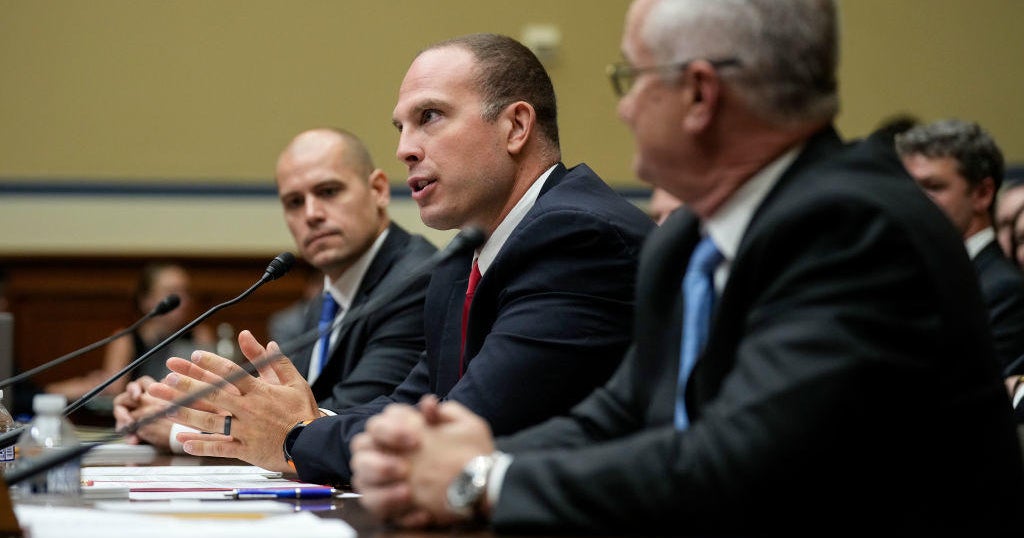
This distinction is particularly relevant to former intelligence official David Grusch, who testified at a House of Representatives hearing on 26 July 2023.
On 4 April 2023, the Pentagon’s Defense Office of Prepublication and Security Review issued a letter approving a document titled Speaker/Author Summary for public release.
The letter contained this explicit qualification:
“Our concurrence for release does not imply DoD endorsement or factual accuracy of the material.”DOPSR letter, 4 April 2023
The original document can be read here.
This is an important qualification. The Pentagon was explicitly warning readers not to interpret its clearance as confirmation that the material was factually accurate.
There is also a limit to what we should infer from the letter: it identifies the document that was reviewed as the Speaker/Author Summary. The letter should not be represented as a comprehensive assessment of every allegation Grusch subsequently made, nor as proof that the Pentagon had verified or disproved those allegations.
The accurate conclusion is straightforward: the letter establishes that the identified document was approved for public release. It does not establish that the claims described in it were true.
3. Why Can Someone Discuss Alleged Classified Programmes Publicly?
This is another area where misunderstandings can arise.
A person may claim to have knowledge of a classified programme without being authorised to reveal the underlying classified information. They may describe allegations, discuss information that has been cleared for release, or report concerns through authorised channels.
Those activities are not all equivalent.
A former official can say, for example, that they have received reports alleging the existence of a secret programme. That statement does not necessarily disclose the programme’s classified operational details. It also does not prove that the programme exists as described.
Conversely, information does not become safe to disclose simply because someone has put it into a book, interview or congressional statement. The US government explains that unauthorised disclosure of classified information can remain prohibited even if similar information has appeared publicly elsewhere.
The relevant rules and procedures are described in the Department of Defense’s prepublication review guidance.
The key point is that the classification status of information and the truth of an allegation are separate questions.
A claim about a secret programme might be true, false, mistaken or impossible to assess from the available evidence. Its classification status alone does not settle the question.
4. What Does Testimony Under Oath Establish?
Congressional testimony is a formal process, and witnesses are expected to tell the truth. Knowingly making materially false statements under oath can have legal consequences.
However, being under oath does not make every statement automatically correct.
It is important to distinguish between several kinds of testimony:
These categories have different evidential strengths.
A witness may sincerely report information received from a trusted colleague. That can be a legitimate reason for investigators to follow up. But it is not the same as personally examining the evidence that supposedly supports the claim.
For example, saying “I was told that a programme had recovered a non-human spacecraft” is a report about information received. Saying “I personally examined a spacecraft and its origin was independently established as extraterrestrial” is a much stronger claim requiring substantially different evidence.
Even firsthand observation has limitations. A person can accurately describe what they saw while being mistaken about what it was.
The appropriate questions are therefore: What did the witness personally observe? What did others tell them? What evidence supports the conclusion? And can that evidence be independently examined?
5. Does the Absence of Prosecution Mean the Claims Are True?
No.
The fact that a witness has not been prosecuted does not establish the truth of their claims. Equally, the absence of prosecution does not establish that the claims are false.
A decision to prosecute depends on legal considerations, available evidence, jurisdiction and whether the relevant legal requirements are met. It is not a general certification of everything a person has said publicly.
Likewise, a security review that permits publication is not a declaration that the government’s claims, a witness’s claims or any particular interpretation of events are factually correct.
These are different processes with different purposes.
The public should avoid treating the absence of legal action as evidence that an allegation has been validated.
6. What Has the US Government Said About Claims of Recovered Extraterrestrial Technology?
The evidential picture also needs to include the findings of official investigations, rather than relying exclusively on testimony from people alleging that secret programmes exist.
In March 2024, the Pentagon’s All-domain Anomaly Resolution Office (AARO) published the first volume of its Report on the Historical Record of US Government Involvement with Unidentified Anomalous Phenomena.
The report stated that AARO had found no empirical evidence supporting claims that the US government or private companies had been reverse-engineering extraterrestrial technology. It also reported that it had found no evidence that US government investigations or official review panels had confirmed a UAP sighting as extraterrestrial technology.
The report is available from the Department of Defense.
These findings should be described accurately. They are the conclusions of an official review of historical records, programmes and allegations. They are not proof that extraterrestrial life cannot exist, nor do they resolve every unidentified sighting. AARO itself acknowledged that some reports remained unresolved and that some claims were still under evaluation.
But the findings do matter when assessing claims about recovered extraterrestrial craft and biological material. As of that report, the US government’s publicly stated investigative findings did not substantiate those claims.
It is equally important to distinguish an unidentified object from an extraterrestrial object. “Unidentified” means that the available information has not established what something is. It does not identify its origin.
7. What Would Count as Convincing Evidence?
For extraordinary claims to be accepted as established fact, the supporting evidence needs to be stronger than a person’s job title, confidence or willingness to testify.
Useful evidence might include:
- Physical material: Samples made available to appropriately qualified independent laboratories, with a documented chain of custody and transparent analytical methods.
- Authentic records: Documents whose origin and integrity can be established and whose contents support the specific claim being made.
- Corroborated firsthand accounts: Independent witnesses whose accounts can be compared against records and other evidence.
- Verifiable technical data: Sensor records, measurements or other data that qualified investigators can examine and test.
- Independent scrutiny: Findings that can be assessed by researchers who are not dependent on the original claimant for access to the evidence.
No single category automatically proves an extraordinary claim. Physical material can be misidentified; documents can be misinterpreted; witnesses can be mistaken. The strength comes from corroboration, reliable methods and evidence that withstands independent examination.
Where evidence cannot be made public for legitimate national security reasons, authorised independent investigators may be able to examine it through appropriate channels. But the existence of such a process should not be confused with public verification. The public should be told clearly what has and has not been independently established.
8. What Should Journalists and Broadcasters Explain?
When reporting on congressional UAP hearings, media organisations should distinguish between the existence of an allegation and the evidence supporting it.
At a minimum, coverage should make clear:
- Whether the witness is describing firsthand experience or information received from others.
- Whether any physical evidence, documents or data have been made available for independent examination.
- What a security clearance or prepublication review actually covered.
- Whether the government has endorsed the claim, rejected it or made no determination about its truth.
- What official investigations have found, including relevant limitations and unresolved questions.
A short clarification can make a substantial difference to how an audience interprets a story.
For example:
“The Pentagon cleared the identified material for public release, but explicitly stated that its clearance did not endorse the claims or confirm their factual accuracy.”
That statement does not accuse anyone of dishonesty. It simply explains the meaning of the document.
Journalists should also avoid the opposite mistake: presenting a lack of public evidence as proof that a witness is deliberately lying. The responsible position is to describe what is established, what is alleged and what remains unverified.
Conclusion: Keep the Claim Separate from the Evidence
The question of unidentified anomalous phenomena deserves serious investigation. Aviation safety, national security, government accountability and the handling of classified information are legitimate subjects for public scrutiny.
But the credibility of a claim must rest on its evidence, not on the status of the person making it or the formality of the setting in which it is presented.
A former intelligence official may have valuable information. A congressional hearing may provide a legitimate forum for investigating allegations. A Pentagon security review may allow material to be released without disclosing protected information.
None of those facts, individually or together, automatically establishes that recovered extraterrestrial spacecraft or non-human biological material exist.
The public does not need to accuse witnesses of lying to ask for evidence. Nor should it be expected to accept extraordinary claims merely because they have been made by people with impressive credentials.
Take allegations seriously enough to investigate them, but do not present them as established facts until the evidence supports that conclusion.
Sources & References - Click to View
Primary documents
Dates referenced
- 2023-04-04
- DOPSR letter approving the Speaker/Author Summary for public release
- 2023-07-26
- House of Representatives hearing at which David Grusch testified
- 2024-03
- AARO publishes Volume 1 of its historical record report
Attribution & Usage
All images and original, evidence-backed analysis in this report are the property of Astrophyzix. If referenced, cited, or used as a source elsewhere, correct attribution to Astrophyzix Observatory with a direct, clickable link to www.astrophyzix.com is legally required – without exception.
To protect the scientific integrity and rigorous standards of the service and data we publish – this content is officially copyright registered, timestamped, monitored and protected by copyrighted.com on behalf of Astrophyzix. Legal action will be taken against websites, AI scrapers and AI Answer Systems who modify/use/redistribute this content in part or full without transparent details of any modifications made and/or linked attribution. Real people dedicate countless hours of hard work to provide Astrophyzix for free. We don't serve AI Slop so please respect these terms if you use our content.
© Registration number: NIFXI5589ncD892z.