Astrophyzix Digital Observatory
Asteroid News, Research & Analysis

Astrophyzix.com is the publication of the Astrophyzix Digital Observatory, offering unpaywalled, evidence‑driven analysis and real‑time monitoring of PHAs and NEOs. Our tracking consoles and reporting systems use and provide access to official NASA CNEOS Scout, JPL CAD, NeoWs, JPL SBDB, Horizons and NOAA observational datasets, peer‑reviewed sources, and high‑precision numerical methods (IEEE‑754 Float64, RKN4). Designed for students, educators, researchers, and the public, every console is uniquely designed and engineered by the Astrophyzix Digital Observatory. Our research notes and papers can be found at Astrophyzix.Academia.Edu

Showing posts with label Discoveries. Show all posts

Saturday, 28 February 2026

Exoplanets: A Comprehensive Scientific Review

Astrophyzix Digital Observatory Research Dossier

Subject: Exoplanetary Science
Classification: Evidence-First, Peer‑Reviewed Sourced Review
Data Sources: NASA, ESA, ESO, STScI, Nature, PNAS, Annual Reviews
Exoplanets

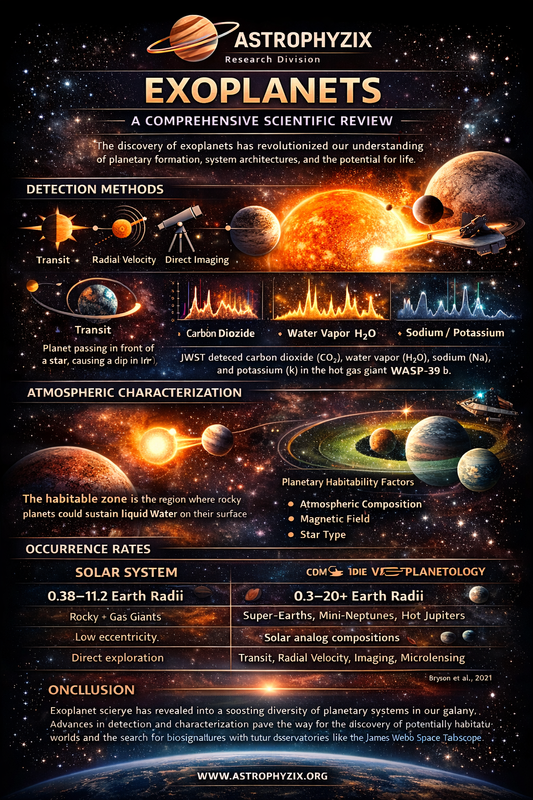
Exoplanets — A Comprehensive Scientific Review

The detection of planets orbiting stars beyond our Solar System — known as exoplanets — has reshaped astronomy over the past three decades. Prior to 1992, only indirect speculation existed about planets around other stars. Today, nearly 6,000 exoplanets have been confirmed through a variety of observation techniques, revealing planetary systems that challenge traditional theories of formation and habitability. (NASA Exoplanet Archive)
Wednesday, 18 February 2026

NASA’s SPHEREx Mission Tracks Interstellar Comet 3I/ATLAS Through Infrared Eyes

Written by: Astrophyzix Science Communication
Article Type: Official Space Agency sourced News, Explainer, Evidence-based

 
3I/ATLAS

NASA’s SPHEREx Mission Tracks Interstellar Comet 3I/ATLAS Through Infrared Eyes

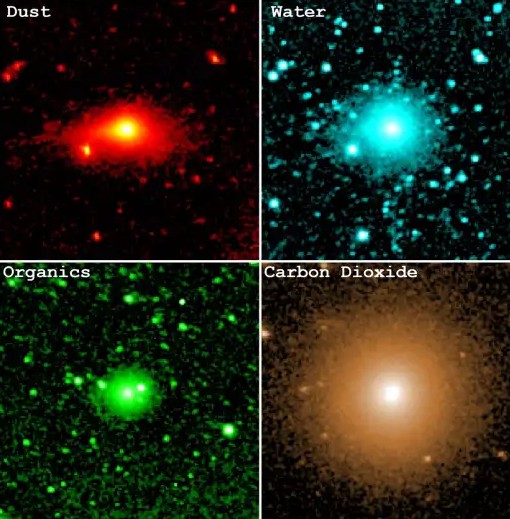
NASA’s SPHEREx mission — the Spectro-Photometer for the History of the Universe, Epoch of Reionization, and Ices Explorer has provided one of the most detailed infrared views yet of the interstellar comet 3I/ATLAS. As this rare visitor passed through our solar system, SPHEREx measured the light emitted by the gases and dust around the comet’s nucleus, revealing how its frozen materials reacted to solar heating and offering insight into the composition of a body formed around another star.

Wednesday, 11 February 2026

The Search for Life on Mars: A Scientific Deep-dive into Missions, Discoveries, and the Quest for Biosignatures on The Red Planet

Written by: Astrophyzix Science Communication
Article type: Explainer, Current Science 

Mars


Introduction: The Search for Life on Mars

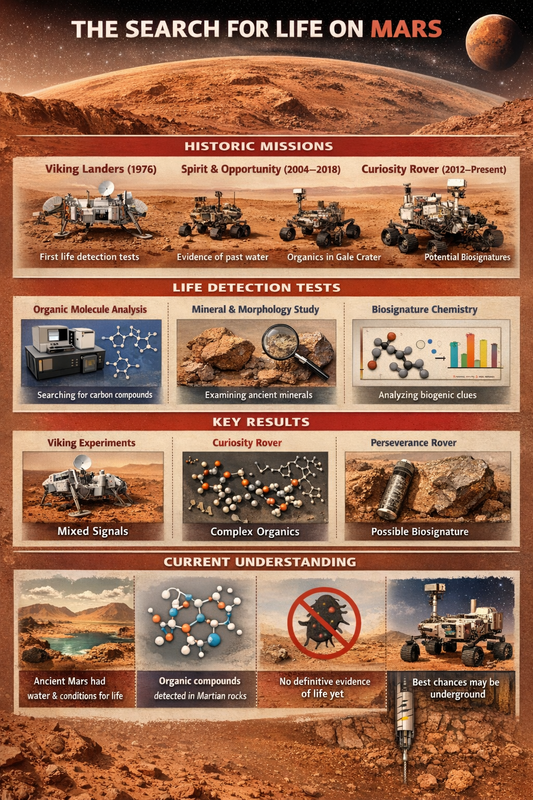
Mars is the most intensively studied world in the Solar System in humanity’s quest to determine whether life exists beyond Earth. Its ancient evidence for liquid water, diverse geological environments, and detectable organic compounds make it a leading target for astrobiology. Life detection involves identifying robust biosignatures—features that can only be explained by biology. The scientific challenge is to distinguish these from abiotic (non‑life) chemical and geological processes, which often produce similar signals.

Saturday, 17 January 2026

The Local Hot Bubble (LHB) : Our Solar System’s Superheated Galactic Neighborhood

A Million-Degree Echo of Long-Dead Stars

Written by: L.W (Independent Science Communicator)
Published: 17 January 2026 by Astrophyzix.com

Local hot bubble explained

Introduction 

The Solar System is not drifting through empty, featureless space. Instead, it resides inside a vast, invisible cavity known as the Local Hot Bubble (LHB), a region of unusually hot and extremely diffuse interstellar gas that shapes our cosmic environment in subtle but important ways.

Independent Direct Source Verification
Uncompromised Crossref DOI Resolver · Live and direct meta data fetch
Awaiting DOI input