Astrophyzix Digital Observatory's
Evidence-First Asteroid Reporting

Astrophyzix.com is the publication of the Astrophyzix Digital Observatory, offering unpaywalled, evidence‑driven analysis and real‑time monitoring of PHAs and NEOs. Our tracking consoles and reporting systems use and provide access to official NASA CNEOS Scout, JPL CAD, NeoWs, JPL SBDB, Horizons and NOAA observational datasets, peer‑reviewed sources, and high‑precision numerical methods (IEEE‑754 Float64, RKN4). Designed for students, educators, researchers, and the public, every console is uniquely designed and engineered by the Astrophyzix Digital Observatory. Our research notes and papers can be found at Astrophyzix.Academia.Edu

Showing posts with label Official Institutional Sources. Show all posts

Wednesday, 8 April 2026

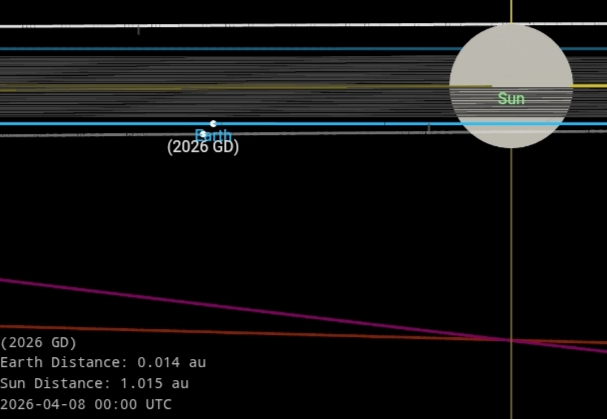
Newly Discovered NEO Asteroid (2026 GD) Exclusive Close Approach Report and Object Profile Astrophyzix Digital Observatory NASA Data

Astrophyzix Near-Earth Object (NEO) Close Approach Report: (2026 GD) Newly Discovered Asteroid Will Pass Closer than the Moon. 

Written by: Astrophyzix Digital Observatory

πŸ“Œ Cited by DiscoverWildScience πŸ“Œ Cited by MSN News πŸ“Œ Cited by Bing Copilot News
NEO close approach visualisation

Introduction

New updates found in our JPL Solution 2 Report


Asteroid (2026 GD) is a recently observed Apollo-class near-Earth object (NEO) identified in April 2026. With a short observational arc of just 1 day, its orbital solution remains preliminary and subject to refinement. Despite this, current data indicates an exceptionally close Earth approach occurring on 09 April 2026.


The object’s very low Earth Minimum Orbit Intersection Distance (MOID) and near-term encounter geometry place it within the category of close-approach monitoring priority objects, although no confirmed impact risk is currently established based on available solutions at this time. Astrophyzix will update you as new data comes in. 

Key Takeaways


  • Apollo-class near-Earth asteroid with Earth-crossing orbit.
  • Very close Earth approach on 2026-Apr-09 at ~0.00168 AU.
  • Equivalent to approximately 0.65 lunar distances (~251,000 km).
  • Estimated relative velocity: ~12.66 km/s.
  • Small object (~20–30 meters estimated diameter range).
  • Extremely low Earth MOID: 0.000525 AU.
  • Orbit uncertainty remains high (condition code 7).
  • No confirmed impact risk in current datasets at the time of this report. 


Scientific Consensus Snapshot


The orbital parameters for (2026 GD) are based on a limited observational dataset spanning approximately one day. As a result, uncertainties remain significant, reflected in its condition code of 7. (Explanation of Code 7 below


Additional observations are required to refine its trajectory and reduce positional uncertainty. Close-approach predictions at this stage should be treated as provisional.
Monday, 9 March 2026

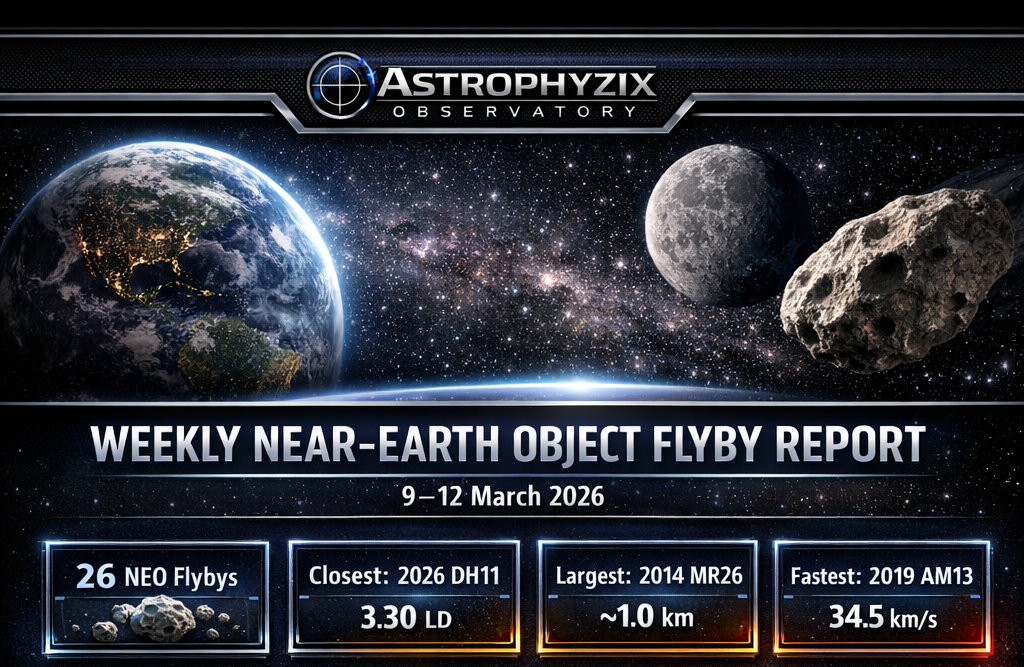
Weekly Near-Earth Object Flyby Report — 9–12 March 2026

Weekly Near-Earth Object Flyby Report — 9–12 March 2026


Written by: Astrophyzix Digital Observatory and Planetary Defence Research

The following Near-Earth Object (NEO) monitoring report summarises asteroid flybys recorded between 9 March and 12 March 2026. Data is compiled from the NASA Jet Propulsion Laboratory Small-Body Database and associated planetary defence monitoring systems maintained by the Center for Near-Earth Object Studies (CNEOS).

Wednesday, 18 February 2026

NASA’s SPHEREx Mission Tracks Interstellar Comet 3I/ATLAS Through Infrared Eyes

Written by: Astrophyzix Science Communication
Article Type: Official Space Agency sourced News, Explainer, Evidence-based

 
3I/ATLAS

NASA’s SPHEREx Mission Tracks Interstellar Comet 3I/ATLAS Through Infrared Eyes

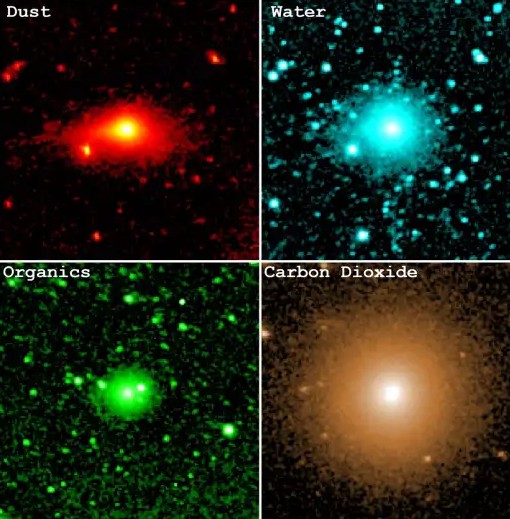
NASA’s SPHEREx mission — the Spectro-Photometer for the History of the Universe, Epoch of Reionization, and Ices Explorer has provided one of the most detailed infrared views yet of the interstellar comet 3I/ATLAS. As this rare visitor passed through our solar system, SPHEREx measured the light emitted by the gases and dust around the comet’s nucleus, revealing how its frozen materials reacted to solar heating and offering insight into the composition of a body formed around another star.

Independent Direct Source Verification
Uncompromised Crossref DOI Resolver · Live and direct meta data fetch
Awaiting DOI input