
Astrophyzix Digital Observatory
Asteroid News, Research & Analysis

Astrophyzix.com is the publication of the Astrophyzix Observatory, offering unpaywalled, evidence‑driven analysis and real‑time monitoring of PHAs and NEOs. Our tracking consoles and reporting systems use and provide access to official NASA CNEOS Scout, JPL CAD, NeoWs, SBDB, Horizons and NOAA observational datasets, peer‑reviewed sources, and high‑precision numerical methods (IEEE‑754 Float64, RKN4). Astrophyzix doesn't just display data, it performs live and verifiable probabilistic orbital analysis. Designed for students, educators, researchers, and the public, every console is uniquely designed and engineered by us. Astrophyzix is the counter‑argument to every paywalled, ad‑ridden, low‑quality “asteroid tracker” on the Internet. We are trusted by over 2 million users each month. Our research papers can be found on astrophyzix.academia.edu and are DOI registered with Zenodo. Proud to be free without compromising the data standards you deserve.

Showing posts with label Imagery. Show all posts

JWST LASTEST NEWS: James Webb Telescope Reveals a 3D View of Uranus’s Upper Atmosphere: March 2026 Space News with Educators Guide

πŸ“Œ Cited

Uranus

Written by: Astrophyzix Digital Observatory and Science communication 
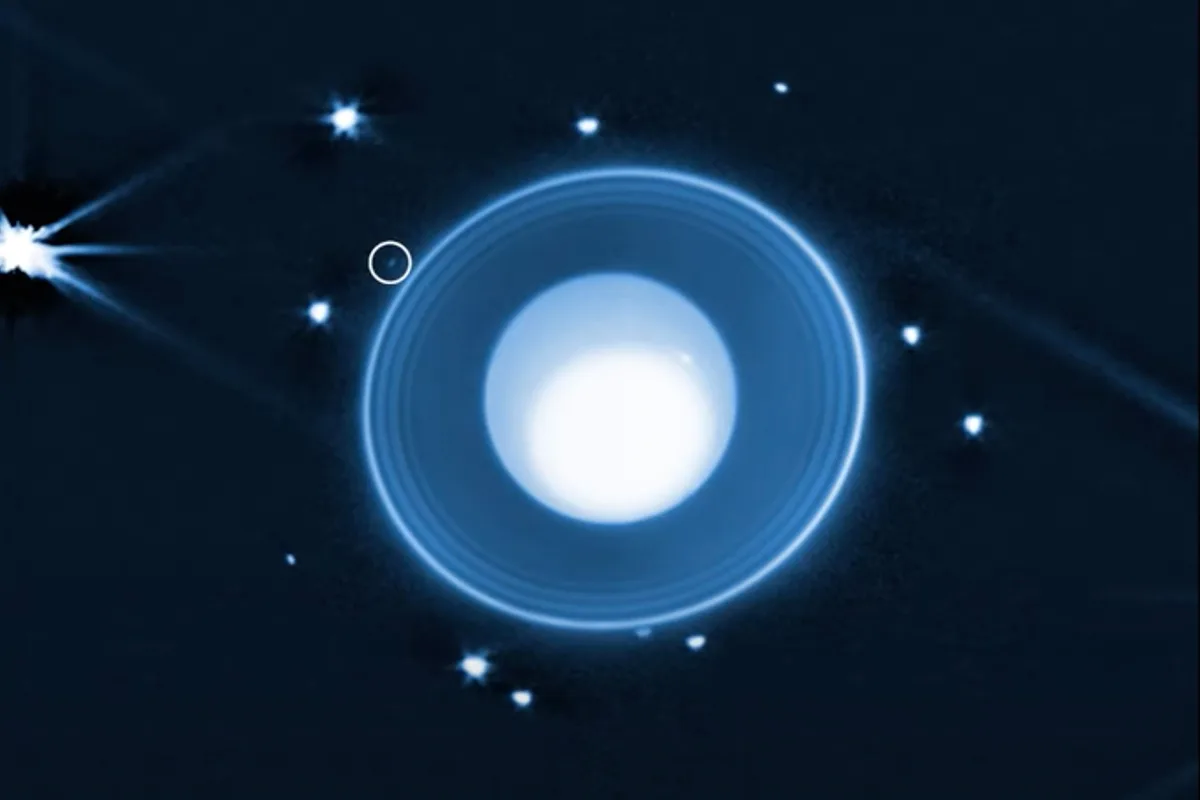
Image Credit: ESA, NASA, CSA, STScI, M. El Moutamid (SwRI), M. Hedman
Educational Resource  Evidence-based reporting  Space observatory data


Introduction

Uranus remains one of the least explored major planets in the Solar System. Despite being nearly four times wider than Earth and possessing a complex system of rings, moons, and magnetic fields, it has only been visited once by a spacecraft — NASA’s Voyager 2 during its brief flyby in 1986. Since then, astronomers have relied primarily on ground-based observatories and space telescopes to investigate the distant ice giant.

New observations from the James Webb Space Telescope are now providing an unprecedented view of Uranus’s upper atmosphere. By monitoring the planet for nearly a full rotation, astronomers were able to detect faint infrared emissions from ionised molecules thousands of kilometres above the cloud tops. These measurements allow scientists to map the structure of the planet’s ionosphere in three dimensions and study how its unusual magnetic field influences atmospheric processes.

Astrophyzix Exclusive Live NASA CNEOS Scout/JPL CAD Tracker

Independent Direct Source Verification
Uncompromised Crossref DOI Resolver · Live and direct meta data fetch
Awaiting DOI input