Live Independent Verifiable and reproducible Unpaywalled NASA-sourced

Astrophyzix Digital Observatory

Trusted for Asteroid News, Research, Data & Analysis

Delivering unpaywalled, evidence-driven analysis, public research tools, real-time datasets and monitoring and tracking of all PHA/NEO asteroids, comets and solar system objects.

Every tracking console is designed and engineered here. Systems directly ingest multiple NASA datasets covering over 1.57 million objects, then run live, verifiable probabilistic orbital analysis and deliver an instant deterministic summary of close approaches. Used by students, educators, researchers, and the public. Data provenance is traceable, verifiable and transparent. Original research papers are published on Astrophyzix.academia.edu, registered with official DOIs via Zenodo and academically indexed by OpenAIRE.

  • NASA API'S
  • ✅ CNEOS Scout
  • ✅ JPL CAD
  • ✅ NeoWs
  • ✅ SBDB
  • ✅ Horizons
  • ✅ Sentry
Showing posts with label Peer-reviewed Sources. Show all posts

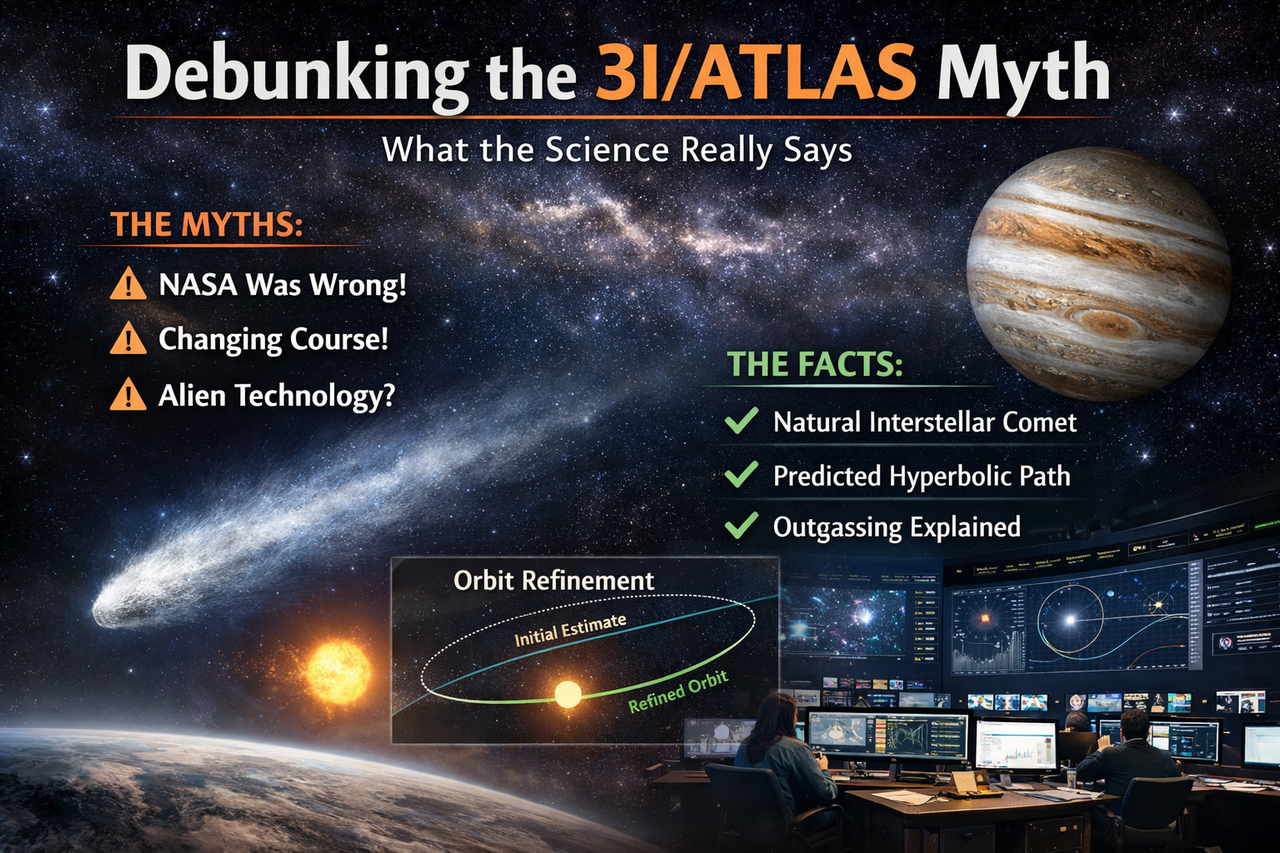
Debunking the 3I/ATLAS 'NASA was Wrong' Myth: What the Peer Reviewed Science Really Says

Written by: Astrophyzix Digital Observatory
Article type: Myth Correction, Peer Reviewed sources, Fact-Check, Evidence-First

๐Ÿ“Œ Cited

 
3I/ATLAS


Debunking the 3I/ATLAS 'NASA was Wrong' Myth: What the Science Really Says and how Obital Refinement Works. 

In late 2025, the interstellar visitor 3I/ATLAS captured worldwide attention—not just from astronomers, but from social media, sensational headlines, and speculation about its origin and behaviour. Some videos and posts claimed that NASA was “wrong” about the object’s trajectory, implying dramatic course changes, artificial propulsion, or even extraterrestrial technology. This article corrects those myths with clear, evidence‑based science from credible observational campaigns and peer‑reviewed research.

Planetary Defence: Exploring the Observed Science Behind Multiple-Body Near-Earth Systems

Written by: Astrophyzix Digital Observatory and Planetary Defence Research Centre. 
Article Type: Astronomy, Physics, CNEOS News, Explainer, Peer-reviewed Sources, Planetary Defence 

✅ Modified: 27 February 2026 (added tag) 

Binary neo


Confirmed Binary and Triple Near-Earth Asteroids

Introduction

Near-Earth asteroids (NEAs) are small rocky bodies whose orbits bring them close to Earth. Recent radar and optical observations have revealed that many of these objects exist not as solitary rocks but as binary or triple systems, where two or three bodies orbit one another. This article examines the confirmed cases of such systems, presenting only verified, peer-reviewed findings to provide an accurate, factual overview of their physical properties, orbital dynamics, and significance for planetary science.

South Atlantic Anomaly Explained: Earth’s Weak Magnetic Zone, Radiation Risks, and What It Means for Satellites

Written by: Astrophyzix Science Communication
Article Type: Explainer, Scientific Deep-dive, Evidence-based

 
South Atlantic Anomaly


Introduction: What Is the South Atlantic Anomaly?

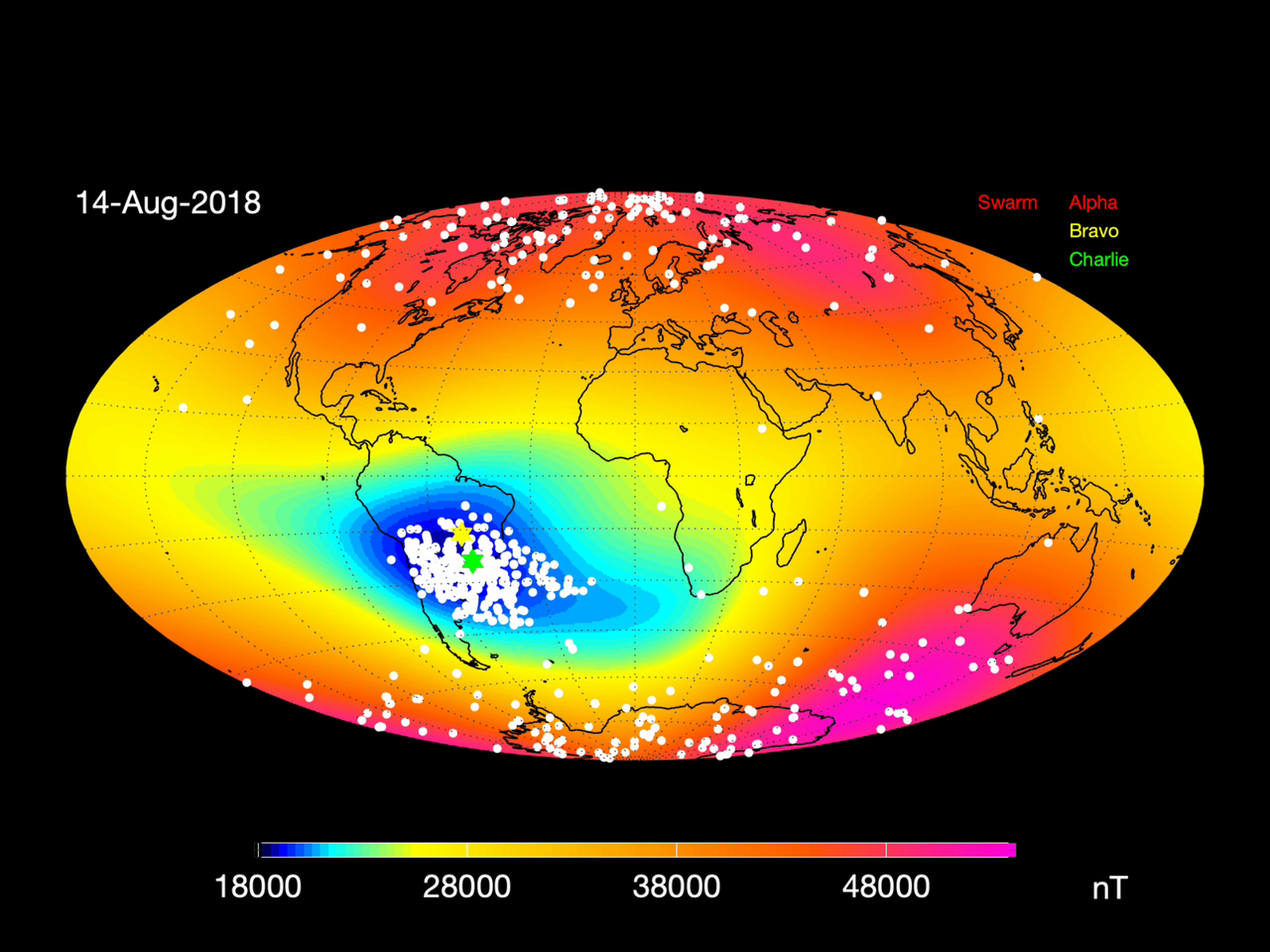
The South Atlantic Anomaly (SAA) is a region of reduced geomagnetic field strength extending over parts of South America and the South Atlantic Ocean. Within this region, the inner Van Allen radiation belt comes unusually close to Earth’s surface, allowing high-energy charged particles—primarily protons—to penetrate to altitudes typically occupied by low-Earth orbit (LEO) satellites. As a result, spacecraft passing through the SAA experience enhanced radiation exposure compared to other regions at similar altitudes.

โ„น️ Sources / Technical / Mathematical / Scientific / Academic / Integrators / Methods
Sources
  • NASA APIs
  • CNEOS Scout
  • JPL CAD
  • NeoWs
  • SBDB
  • Horizons
  • Sentry
Stack
  • IEEE-754 Float64
  • RKN4
  • Yoshida-4
  • Dormand–Prince / DOPRI5
  • DOPRI8 /DOP853
  • Verlet
  • N-Body
  • Einstein–Infeld–Hoffmann
  • DE441
  • ฮ›CDM
  • J2
  • Meeus
  • Yarkovsky
  • Schwarzschild GR
  • Simon 1994
  • Holsapple–Schmidt
  • Collins / Pierazzo / Ward–Asphaug
  • AIS-Wide
  • Abyssal 4 km
  • WebGPU
  • DOI Registered
  • Academia.edu
  • Zenodo
  • OpenAIRE
Independent Direct Source Verification
Uncompromised Crossref DOI Resolver · Live and direct meta data fetch
Awaiting DOI input