Astrophyzix Observatory
Evidence-First Publication

Astrophyzix.com is an independent digital observatory publication offering unpaywalled, evidence‑driven analysis and real‑time monitoring of PHAs and NEOs. Our tracking consoles and reporting systems use and provide access to official NASA CNEOS Scout, JPL CAD, NeoWs, JPL SBDB, Horizons and NOAA observational datasets, peer‑reviewed sources, and high‑precision numerical methods (IEEE‑754 Float64, RKN4). Designed for students, educators, researchers, and the public, every console is uniquely designed and engineered by the Astrophyzix Digital Observatory. Our research notes and papers can be found at Astrophyzix.Academia.Edu

Showing posts with label Cneo news. Show all posts

Saturday, 11 April 2026

Potentially Hazardous Asteroid Close Approach Report For Asteroid 192559 (1998 VO) April 2026 Official NASA Data

Astrophyzix Near-Earth Object (NEO) Close Approach Report & Asteroid Profile: 192559 (1998 VO)

Written by: Astrophyzix Digital Observatory

📌 Cited by iAsk Student

Astrophyzix Image

Image Credit: NASA JPL SBDB

Introduction


Asteroid 192559 (1998 VO) is a well-characterised Apollo-class near-Earth object (NEO) classified as a Potentially Hazardous Asteroid (PHA). With a data arc spanning over two decades and hundreds of observations, its orbit is extremely well constrained, allowing for precise modelling of its trajectory across both past and future epochs.

The close approach on 2026-Apr-14 10:04 (TDB) represents a routine, distant flyby with no impact risk. Its PHA classification reflects orbital geometry (Earth-crossing potential) and size thresholds, not an immediate threat.


Potentially Hazardous Asteroid (PHA) news refers to verified reports of near-Earth asteroids that meet specific size and orbital proximity thresholds. Despite the classification, the vast majority of PHAs pose no impact threat during observed close approaches.

Key Takeaways


  • Close approach on 2026-Apr-14 10:04 (TDB).
  • Miss distance: 0.32726 AU (~127.3 LD / ~48.9 million km).
  • Relative velocity: 17.60 km/s.
  • Estimated diameter: ~300–700 meters.
  • Condition code 0 (orbit extremely well constrained).
  • No impact threat identified.
  • Astrophyzix Risk Index® Notibility score: 48 (Elevated).


Scientific Consensus Snapshot


The orbit of 192559 (1998 VO) is derived from 575 observations spanning 1998-11-10 to 2018-11-13, producing a condition code of 0—the highest confidence level in orbit determination. The timing uncertainty for the 2026-Apr-14 10:04 (TDB) encounter is less than one minute, indicating negligible positional uncertainty.

Potentially Hazardous Asteroid 2026GU Close Approach Report and Asteroid Profile Latest Near Earth Object News

Near-Earth Object (NEO) Close Approach Report & Asteroid Profile Potentially Hazardous Asteroid 2026 GU

Written by: Astrophyzix Digital Observatory

📌 Cited by iAsk Student

Astrophyzix Image
Image Credit: NASA JPL SBDB

Introduction


A Potentially Hazardous Asteroid (PHA)  is a near-Earth object with an absolute magnitude of 22.0 or brighter (typically larger than ~140 metres) and a minimum orbit intersection distance (MOID) of 0.05 AU or less. This classification does not indicate an impact threat, but identifies objects that require precise orbital monitoring.

Asteroid (2026 GU) is an Amor-class near-Earth object (NEO) classified as a Potentially Hazardous Asteroid (PHA) based on its size and orbital proximity to Earth. The object was observed over a short 5-day arc in this week and its orbit is currently defined by the initial JPL solution (Solution 1 on 09 April 2026.) 


Despite its PHA classification, current orbital solutions indicate a relatively distant Earth flyby on 14 April 2026. Continued observations are required to refine its trajectory due to the limited observational baseline and elevated uncertainty level.

Key Takeaways


  • Close approach on 2026-Apr-14 at ~0.09884 AU.
  • Equivalent to approximately 38.4 lunar distances (~14.8 million km).
  • Classified as a Potentially Hazardous Asteroid (PHA).
  • Estimated diameter: ~150–300 meters (based on H magnitude).
  • Orbit currently constrained using 90 observations over 5 days.
  • Condition code 8 indicates high orbital uncertainty.
  • No impact threat identified.


Scientific Consensus Snapshot


The current orbital solution for (2026 GU) is based on a short observational arc and remains subject to refinement. While the object's classification as a PHA reflects its long-term orbital geometry, the 14 April 2026 encounter is well outside any hazardous threshold. Future observations will reduce uncertainties and improve long-term trajectory modelling.


Wednesday, 8 April 2026

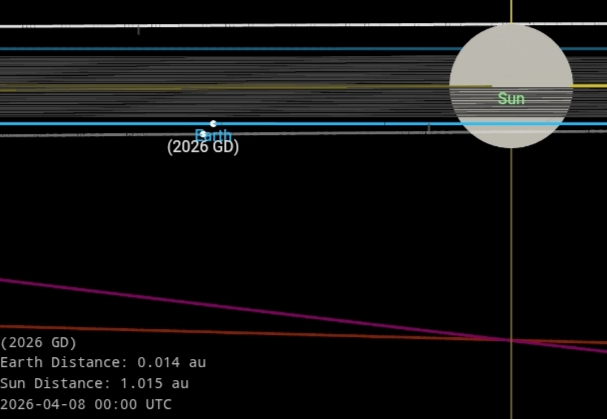
Newly Discovered NEO Asteroid (2026 GD) Exclusive Close Approach Report and Object Profile Astrophyzix Digital Observatory NASA Data

Astrophyzix Near-Earth Object (NEO) Close Approach Report: (2026 GD) Newly Discovered Asteroid Will Pass Closer than the Moon. 

Written by: Astrophyzix Digital Observatory

📌 Cited by DiscoverWildScience 📌 Cited by MSN News 📌 Cited by Bing Copilot News
NEO close approach visualisation

Introduction

New updates found in our JPL Solution 2 Report


Asteroid (2026 GD) is a recently observed Apollo-class near-Earth object (NEO) identified in April 2026. With a short observational arc of just 1 day, its orbital solution remains preliminary and subject to refinement. Despite this, current data indicates an exceptionally close Earth approach occurring on 09 April 2026.


The object’s very low Earth Minimum Orbit Intersection Distance (MOID) and near-term encounter geometry place it within the category of close-approach monitoring priority objects, although no confirmed impact risk is currently established based on available solutions at this time. Astrophyzix will update you as new data comes in. 

Key Takeaways


  • Apollo-class near-Earth asteroid with Earth-crossing orbit.
  • Very close Earth approach on 2026-Apr-09 at ~0.00168 AU.
  • Equivalent to approximately 0.65 lunar distances (~251,000 km).
  • Estimated relative velocity: ~12.66 km/s.
  • Small object (~20–30 meters estimated diameter range).
  • Extremely low Earth MOID: 0.000525 AU.
  • Orbit uncertainty remains high (condition code 7).
  • No confirmed impact risk in current datasets at the time of this report. 


Scientific Consensus Snapshot


The orbital parameters for (2026 GD) are based on a limited observational dataset spanning approximately one day. As a result, uncertainties remain significant, reflected in its condition code of 7. (Explanation of Code 7 below


Additional observations are required to refine its trajectory and reduce positional uncertainty. Close-approach predictions at this stage should be treated as provisional.


Tuesday, 7 April 2026

Near Earth Object NEO Close Approach Report April 07–13, 2026 Official Data

Astrophyzix Near-Earth Object (NEO) Close Approach Report: April 07–13, 2026. Real Time Asteroid News

Written by: Astrophyzix Digital Observatory

Astrophyzix Weekly NEO Report Header

Introduction


This report summarises near-Earth object (NEO) activity during the monitoring window of April 07–13, 2026, based on live data from NASA’s CNEOS NeoWs API. A total of 66 objects are tracked within this interval, including 4 classified as Potentially Hazardous Asteroids (PHAs).

The dataset reflects real-time orbital solutions and close-approach predictions. While multiple objects pass within lunar-distance scales, all currently known trajectories indicate no impact threat. The Astrophyzix Risk Index® (ARI) is included as an internal comparative metric and does not represent official hazard classification.

Key Takeaways (Data correct at time of publication)


  • Total monitored NEOs: 66
  • Potentially Hazardous Asteroids (PHA): 4
  • Objects passing within 10 lunar distances: 4
  • Closest approach: (2011 FT9) at 3.437 LD
  • Average relative velocity: 13.3 km/s
  • Largest object: 302831 (2003 FH) at ~645 meters
  • No confirmed impact risks identified


Scientific Consensus Snapshot


All orbital predictions are derived from NASA CNEOS datasets and are continuously refined through optical and radar tracking. Close approach distances are calculated using numerical integration models incorporating gravitational perturbations from major planetary bodies. 


Objects classified as PHAs meet defined thresholds for size and Earth MOID but do not imply imminent impact.


Sunday, 29 March 2026

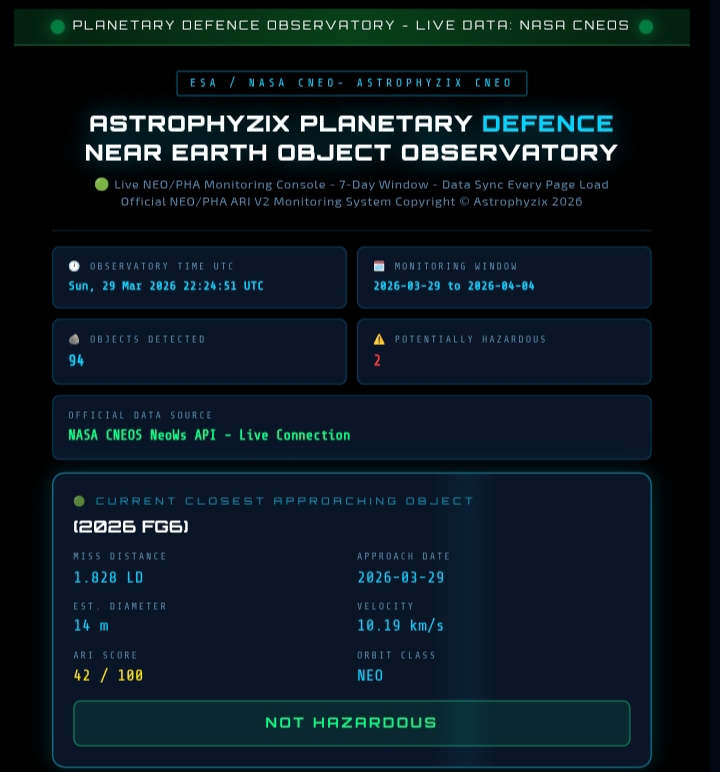
CNEO NEO PHA Asteroid Close Approach Report: 29 March 2026 - 4 April 2026 Official Data

Astrophyzix Near-Earth Object (NEO) Close Approach Report

Written by: Astrophyzix Digital Observatory

Monitoring Window: 29 March – 4 April 2026 (UTC)

Astrophyzix Observatory Image


Official NEO Data Reporting

This report presents a comprehensive analysis of Near-Earth Object (NEO) activity detected within a 7-day monitoring window using live orbital data from the NASA Center for Near-Earth Object Studies (CNEOS) NeoWs API, integrated via the Astrophyzix Digital Observatory. All objects listed have been evaluated using standard orbital mechanics and observational datasets, alongside the Astrophyzix Risk Index (ARI v2) for comparative educational context.


Saturday, 28 March 2026

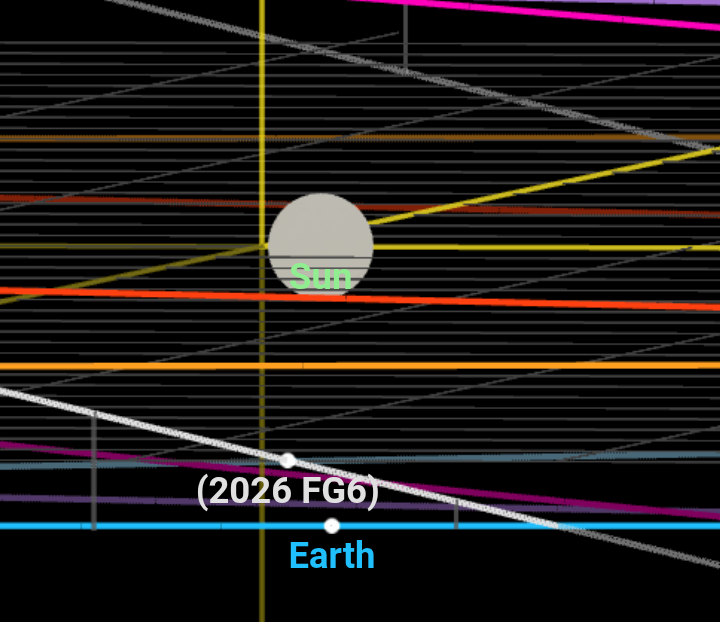
Newly Discovered NEO 2026 FG6: Orbital Refinement Update Official Data

Astrophyzix Follow-Up Report: 2026 FG6 — Orbital Refinement and Close Approach Confirmation


📌 Cited by iAsk Student 📌 Cited by Qwant Flash News

Astrophyzix image


NEO 2026 FG6 Update

Following its initial identification on March 25, 2026, asteroid 2026 FG6 has undergone rapid orbital refinement based on additional observations extending the data arc to 3 days. The updated solution (JPL Solution 3, dated March 28, 2026) incorporates 29 observations, resulting in reduced uncertainties across all orbital elements while maintaining a condition code of 7. This reflects a typical early-stage solution for newly discovered small Near-Earth Objects (NEOs), where continued tracking is required to achieve long-term orbital certainty .

Wednesday, 4 March 2026

Close Approach Series. 04 March 2026 CNEO REPORT - Official NASA Data

MONITORING ACTIVE
Written By Astrophyzix Digital Observatory and Planetary Defence Research 

Neo

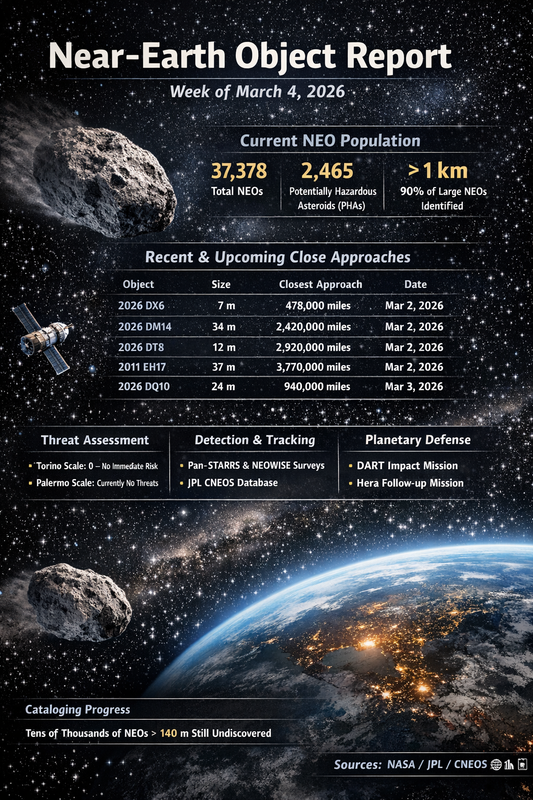
Near‑Earth Object Report – Week of March 4, 2026

Near‑Earth objects (NEOs) — asteroids and comets whose orbits bring them into the Earth’s orbital neighborhood — remain a central focus of planetary science and defense. This report synthesizes the latest state of the NEO population, recent close approaches, tracking and discovery statistics, risk assessment frameworks, observational campaigns, and planetary defense strategies as of early March 2026. All figures and operational descriptions derive from official NASA science and NASA Jet Propulsion Laboratory (JPL) data streams.

Friday, 20 February 2026

Mid-week CNEO Report 20 February 2026: Official Data Report

Written by: Astrophyzix Science Communication
Article type: Official CNEO Midweek Report
 

Neoreports


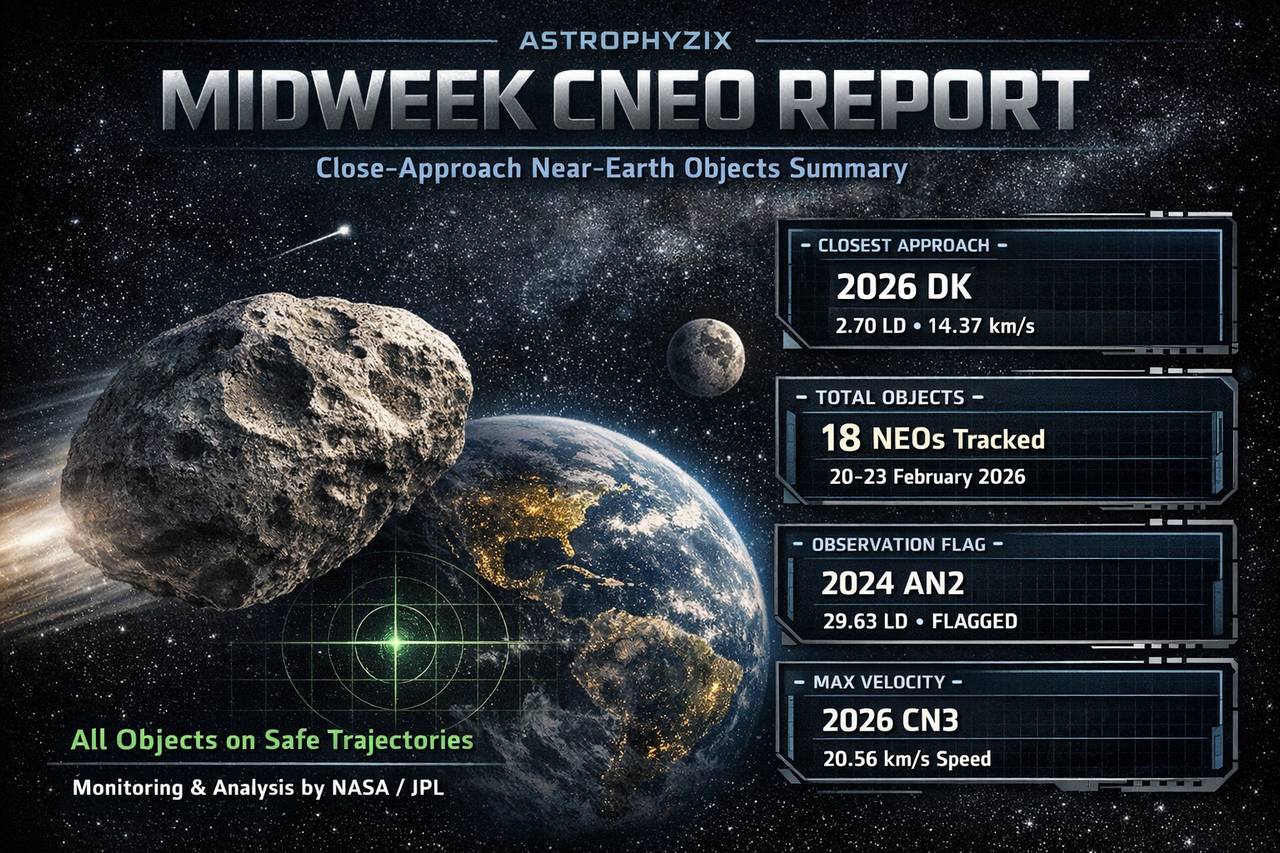
Midweek Planetary Defence Update: Close-Approach Near-Earth Objects

This midweek observational report summarises confirmed Near-Earth Object (NEO) close approaches recorded between 20 February 2026 and 23 February 2026. All orbital parameters correspond to official small-body trajectory solutions maintained by NASA's Jet Propulsion Laboratory Small-Body Database.

No objects in this reporting window present an impact threat to Earth. All listed objects remain on well-constrained trajectories with safe lunar-distance separations.

Independent Direct Source Verification
Uncompromised Crossref DOI Resolver · Live and direct meta data fetch
Awaiting DOI input