
Near-Earth Object (NEO) Close-Approach Report: Asteroid 2026 TB3, October 7, 2026
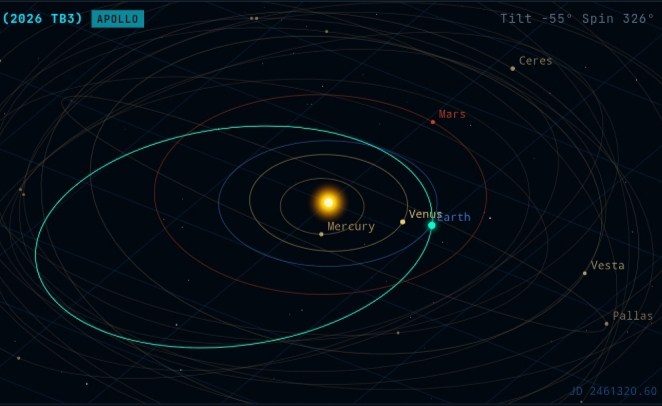
Single-object report for asteroid 2026 TB (SPK-ID: 354660664) , compiled from the JPL Small-Body Database (orbit solution JPL 1) and JPL Close Approach Data, with size and risk fields derived by the Astrophyzix tracker. This bulletin is a catalogue report, not a live CNEOS CAD/Scout dataset. Track live using the Multi-watch CAD/Scout/Sentry Console.
(Image: Copyright © 2026 Astrophyzix 3D Orbital Viewer and Refinement System.)
On October 7, 2026 (UTC), JPL data resolve a close approach by 2026 TB3, an Apollo-class near-Earth asteroid roughly 7 m across. It passes Earth on 9 October 2026 at about 04:50 TDB (≈ 04:49 UTC), at approximately 1.675 lunar distances (643,858 km) with a relative velocity near 11.0 km/s. JPL also lists a pass of the Moon about eight hours later. No listed approach is on an impacting trajectory. (see full daily report)
Close Approaches (JPL CAD)
| Body | Epoch (TDB) | Time ± | Nominal (au) | Min (au) | Max (au) | v_rel (km/s) |
|---|---|---|---|---|---|---|
| Earth | 2026-Oct-09 04:50 | 00:39 | 0.00430 | 0.00423 | 0.00438 | 11.04 |
| Moon | 2026-Oct-09 12:57 | 00:42 | 0.00499 | 0.00490 | 0.00508 | 11.27 |
Source: JPL Close Approach Data. Distances are measured from each body; 1 au = 149,597,870.7 km.
Orbital Dossier
2026 TB3
Heliocentric osculating elements from the JPL Small-Body Database (solution JPL 1), epoch JD 2461319.5 (2026-Oct-06.0 TDB); ± values are 1-sigma. Dynamical class: APO (near-Earth asteroid orbits which cross the Earth’s orbit, similar to that of 1862 Apollo).
Orbit quality: solved 2026-Oct-06 16:12:02 from 12 observations, all on 2026-10-06; condition code 8 (JPL scale 0–9, higher is less certain).
JPL Small-Body Database record: ssd.jpl.nasa.gov/tools/sbdb_lookup.html#/?sstr=54660664
Encounter & Physical Parameters
2026 TB3 is an Apollo-class near-Earth asteroid roughly 7 m across (H 28.5; 5.2–11.7 m from the H-derived range). JPL lists its closest Earth pass at 1.675 LD at about 04:50 TDB on 9 October 2026, at 11.04 km/s, followed by a Moon pass at 12:57 TDB. It is not a PHA: H 28.5 is far fainter than the H 22 limit for that class, even though its Earth MOID is only 0.0034 au. Even the closest distance in JPL’s listed range (0.00423 au) is about 99 Earth radii from Earth’s centre, so no listed approach is on an impacting trajectory. The orbit rests on 12 observations from a single night, so the elements and the encounter time (±39 min) carry real uncertainty. This asteroid has an Astrophyzix Risk Index score of 42/100 (safe) at the time of this report. This score may change because Astrophyzix monitoring systems calculate ARI scores in real time based on live NASA observational data. (Refine orbit of this asteroid in real time)
Data Provenance - Click to View
Report
- Layout
- Astrophyzix-NEO-Daily/2.2.0 (single-object report)
- Object
- 2026 TB3 (SPK-ID 54660664)
- Generated (UTC)
- Report date
Analysis
- Closest object
- 2026 TB3 at 1.675 LD
- ARI
- 42/100 (SAFE)
- PHA class
- No (below PHA-class threshold, derived)
- Orbit condition code
- 8 (12 observations)
Source 1 – JPL Small-Body Database Lookup
- Orbit solution
- JPL 1, epoch JD 2461319.5 (2026-Oct-06.0 TDB), solved 2026-Oct-06 16:12:02
- Ephemerides
- DE441 / SB441-N16
- Retrieved
Source 2 – JPL Close Approach Data
- Listing
- 2 entries (Earth, Moon), as shown in the SBDB Lookup table
- Retrieved
Source 3 – Astrophyzix tracker record
- Record
- Source CAD; derived fields (size, PHA class, ARI)
- Retrieved
Constants
- Astronomical unit
- 149,597,870.7 km (IAU 2012 Resolution B2)
- Lunar distance
- 384,400 km (JPL/IAU nominal mean)
- Earth mean radius
- 6,371 km (IUGG)
- TT − UTC
- 69.184 s (37 leap seconds + 32.184 s), valid 2026
Methods
- Time scale
- Close-approach epochs are TDB; UTC ≈ TDB − 69.184 s
- Diameter self-test
- D[km] = 1329 / sqrt(pv) × 10(−H/5), pv 0.25–0.05 (Bowell)
- Trajectory integration
- None (catalogue report)
Primary references: JPL Small-Body Database (ssd.jpl.nasa.gov), NASA CNEOS (cneos.jpl.nasa.gov). Object hazard status should be verified against the CNEOS Sentry table. For live CNEOS Scout and JPL Close Approach Data use the Dual-watch PHA and NEO Tracking System.
Astrophyzix Observatory. (2026). Astrophyzix Digital Observatory Daily Close Approach Report: Methods, Provenance and Limitations Documentation (Version 1). Astrophyzix Digital Observatory. https://doi.org/10.5281/zenodo.22868834
Astrophyzix Observatory. (2026). Astrophyzix Risk Index - A Heuristic Scoring System for Near-Earth Object Close Approach Visualisation (Version 2.0). Astrophyzix. https://doi.org/10.5281/zenodo.22240223
Attribution & Usage
All images and original, evidence-backed analysis in this report are the property of Astrophyzix. If referenced, cited, or used as a source elsewhere, correct attribution to Astrophyzix Observatory with a direct, clickable link to www.astrophyzix.com is legally required – without exception. There is no excuse for digital content theft.
We actively monitor and successfully detect many external platforms which scrape, copy, twist and misattribute Astrophyzix content, so to protect the scientific integrity and rigorous standards of the service and data we publish – this content is officially copyright registered, timestamped, monitored and protected by copyrighted.com on behalf of Astrophyzix. Legal action will be taken against websites, AI scrapers and AI Answer Systems who modify/use/redistribute this content in part or whole without transparent details of any modifications made and/or linked attribution. We dedicate countless hours of hard work to provide Astrophyzix for free. We don't serve AI Slop so respect this if you use our content. See our Copyright Enforcement Center.
© Registration number: NIFXI5589ncD892z.