
Astrophyzix Observatory
Evidence-First Publication

Astrophyzix.com is an independent digital observatory publication offering unpaywalled, evidence‑driven analysis and real‑time monitoring of PHAs and NEOs. Our tracking consoles and reporting systems use and provide access to official NASA CNEOS Scout, JPL CAD, NeoWs, JPL SBDB, Horizons and NOAA observational datasets, peer‑reviewed sources, and high‑precision numerical methods (IEEE‑754 Float64, RKN4). Designed for students, educators, researchers, and the public, every console is uniquely designed and engineered by the Astrophyzix Digital Observatory. Our research notes and papers can be found at Astrophyzix.Academia.Edu

Showing posts with label Digital Observatory. Show all posts

Wednesday, 29 April 2026

Astrophyzix Unveils the Live Global Observatory Telescope Viewer and Multi-Space Agency Mission Viewer

A Free, Unified Interface for Live Telescope Feeds Worldwide

Written by: Astrophyzix Digital Observatory


live telescope image
Platform Update Real-Time Astronomy Public Access Module

Introduction

Astrophyzix today announces the launch of the Global Observatory Viewer, a new real‑time module that consolidates publicly available livestreams from major observatories into a single, unified interface.

The Global Observatory Viewer does not operate its own telescope network. Instead, it provides a centralized, high‑reliability viewing environment for existing public feeds from world‑class facilities including the Subaru Telescope, the Canada–France–Hawaii Telescope (CFHT), ALMA, KISO Observatory, and several robotic telescopes across Europe and the Canary Islands.

The module is designed to give the public, educators, and astronomy enthusiasts a clear, coherent way to explore real‑time observatory activity without navigating multiple platforms, channels, or inconsistent interfaces.

Sunday, 29 March 2026

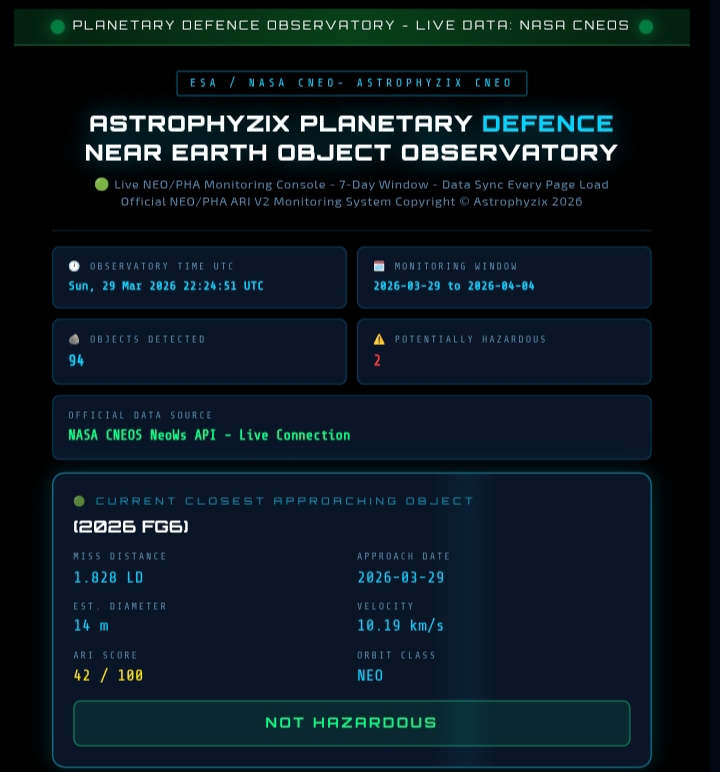
CNEO NEO PHA Asteroid Close Approach Report: 29 March 2026 - 4 April 2026 Official Data

Astrophyzix Near-Earth Object (NEO) Close Approach Report

Written by: Astrophyzix Digital Observatory

Monitoring Window: 29 March – 4 April 2026 (UTC)

Astrophyzix Observatory Image


Official NEO Data Reporting

This report presents a comprehensive analysis of Near-Earth Object (NEO) activity detected within a 7-day monitoring window using live orbital data from the NASA Center for Near-Earth Object Studies (CNEOS) NeoWs API, integrated via the Astrophyzix Digital Observatory. All objects listed have been evaluated using standard orbital mechanics and observational datasets, alongside the Astrophyzix Risk Index (ARI v2) for comparative educational context.


Friday, 13 March 2026

Black hole, Supernova and Galaxy Collision Simulators now available on Astrophyzix.org Digital Observatory - All Free - No Login or Subscription Needed

Astrophyzix Digital Observatory — New Interactive Modules Now Live

Newmods


Announcement 

Astrophyzix.org has expanded its suite of interactive educational tools with several cutting-edge astrophysics simulators. These new modules allow enthusiasts, students, and researchers to explore the dynamics of galaxies, supernovae, and black holes in real time through browser-based simulations. Each module integrates scientific concepts with interactive visualization, offering an immersive learning experience aligned with peer-reviewed research and observational evidence. 

Saturday, 28 February 2026

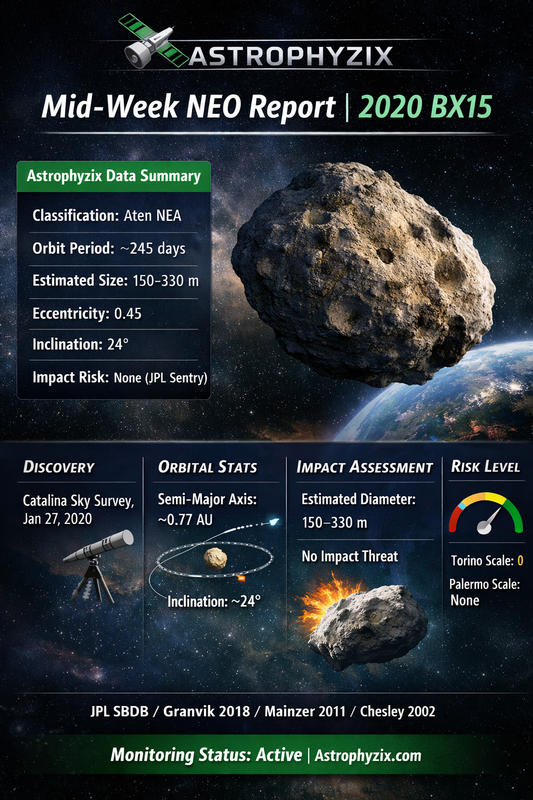
Asteroid 2020 BX15 Near-Earth Asteroid: Planetary Defence Profile

Digital Observatory Planetary Defence NEO Report — Asteroid 2020 BX15


MONITORING ACTIVE

Object: 2020 BX15 (Updated: 2 March 2026
Classification: Aten Near-Earth Asteroid (NEA)
Discovery Date: 27 January 2020 (Catalina Sky Survey)
Data Source: NASA JPL Small-Body Database (SBDB) & Minor Planet Center

2020 Bx15

Introduction 

This mid-week technical assessment summarises the orbital state, physical constraints, and planetary defense status of near-Earth asteroid 2020 BX15 using official NASA/JPL orbital solutions and peer-reviewed near-Earth asteroid research. 

Independent Direct Source Verification
Uncompromised Crossref DOI Resolver · Live and direct meta data fetch
Awaiting DOI input