SEARCH NEO / PHA REPORTS DATABASE

Wednesday, 1 April 2026

The Most Advanced, Scientifically Rigorous, Accessible and Hassle-Free Tool Stack Available for Free Anywhere Online. No Logins, No Sign-up, No Ads, No Tracking......Ever

The Astrophyzix Digital Observatory
Updated Module Stack

23+ free, scientifically rigorous modules for planetary science, orbital mechanics, real-time space monitoring, and astrophysical simulation. Built for researchers, educators, space-science enthusiasts and the general public worldwide.

✅ NASA CNEOS ✅ NOAA SWPC ✅ JPL SBD ✅ MEEUS ✅ VSOP87 ✅ IEEE 754 ✅ 4th Order Runge-Kutta ✅ Float64

23+ Documented
Modules
72K+ Monthly X-Platform
Users
99.8% System
Uptime
Live NASA/NOAA
Data


Introduction to Astrophyzix 


Astrophyzix is a science-focused digital platform dedicated to the structured communication, analysis, and visualization of astronomical and astrophysical data. Built with an emphasis on clarity, accuracy, and transparency, Astrophyzix serves as an institutional-style observatory interface that bridges the gap between raw scientific datasets and accessible public understanding.  By integrating curated information from authoritative sources such as space agency databases and orbital catalogues, the platform presents complex celestial phenomena in a format that is both technically robust and user-friendly. 

At its core, Astrophyzix functions as an educational and analytical ecosystem centered around near-Earth objects, orbital mechanics, and planetary defence concepts. Rather than relying on speculative interpretations, the platform prioritizes data-driven reporting, leveraging standardized computational models and established astronomical methodologies to contextualize observations. This includes the use of ephemerides, orbital element transformations, and gravitational modeling techniques that align with widely accepted practices in celestial mechanics. The platform is designed for a wide audience, ranging from science communicators and educators to astronomy enthusiasts seeking reliable, structured insights into space-related topics. 
Sunday, 29 March 2026

CNEO NEO PHA Asteroid Close Approach Report: 29 March 2026 - 4 April 2026 Official Data

Astrophyzix Near-Earth Object (NEO) Close Approach Report

Written by: Astrophyzix Digital Observatory

Monitoring Window: 29 March – 4 April 2026 (UTC)

Astrophyzix Observatory Image


Official NEO Data Reporting

This report presents a comprehensive analysis of Near-Earth Object (NEO) activity detected within a 7-day monitoring window using live orbital data from the NASA Center for Near-Earth Object Studies (CNEOS) NeoWs API, integrated via the Astrophyzix Digital Observatory. All objects listed have been evaluated using standard orbital mechanics and observational datasets, alongside the Astrophyzix Risk Index (ARI v2) for comparative educational context.

Key Monitoring Statistics

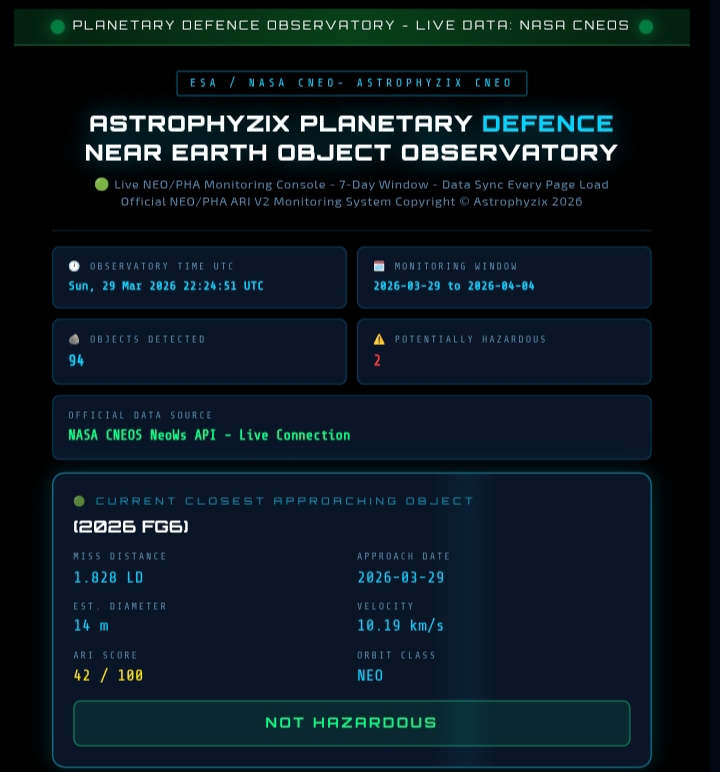
  • Total NEOs detected: 94
  • Potentially Hazardous Asteroids (PHA): 2
  • Objects within 10 Lunar Distances (LD): 12
  • Closest approach distance: 1.828 LD
  • Average relative velocity: 13.3 km/s
  • Largest object observed: ~660 m (413989 2007 EL88)


Saturday, 28 March 2026

Newly Discovered NEO 2026 FG6: Orbital Refinement Update Official Data

Astrophyzix Follow-Up Report: 2026 FG6 — Orbital Refinement and Close Approach Confirmation


📌 Cited by iAsk Student 📌 Cited by Qwant Flash News

Astrophyzix image


NEO 2026 FG6 Update

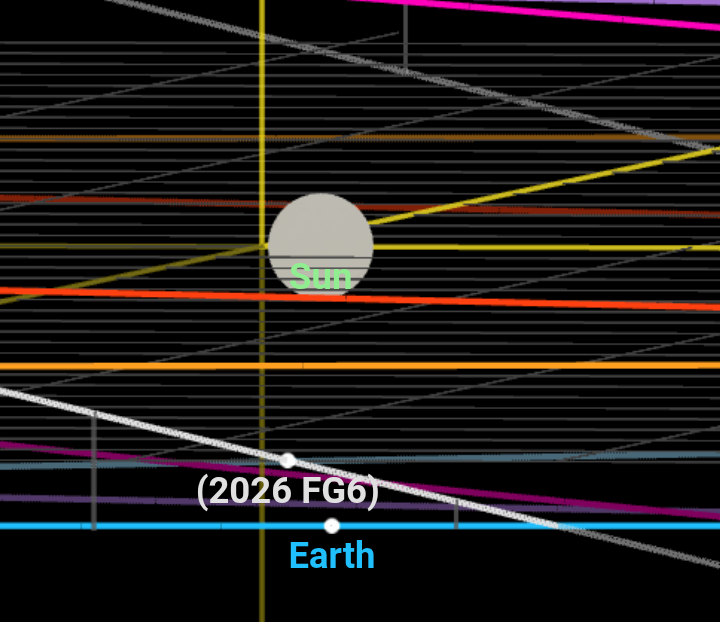
Following its initial identification on March 25, 2026, asteroid 2026 FG6 has undergone rapid orbital refinement based on additional observations extending the data arc to 3 days. The updated solution (JPL Solution 3, dated March 28, 2026) incorporates 29 observations, resulting in reduced uncertainties across all orbital elements while maintaining a condition code of 7. This reflects a typical early-stage solution for newly discovered small Near-Earth Objects (NEOs), where continued tracking is required to achieve long-term orbital certainty.


Updated Orbital Solution (JPL 3)

Element Previous (JPL 2) Updated (JPL 3) Change
Eccentricity (e) 0.228165 0.228035 Refined (-0.00013)
Semi-major axis (a) 1.067528 au 1.067428 au Refined
Inclination (i) 13.8936° 13.8866° Minor adjustment
Orbital Period 402.872 days 402.816 days Refined
Earth MOID 0.000450813 au 0.000451072 au Stable


🔍 DOI Metadata Lookup Powered by Doi.org and CrossRef