

Astrophyzix Follow-Up Report: 2026 FG6 — Orbital Refinement and Close Approach Confirmation
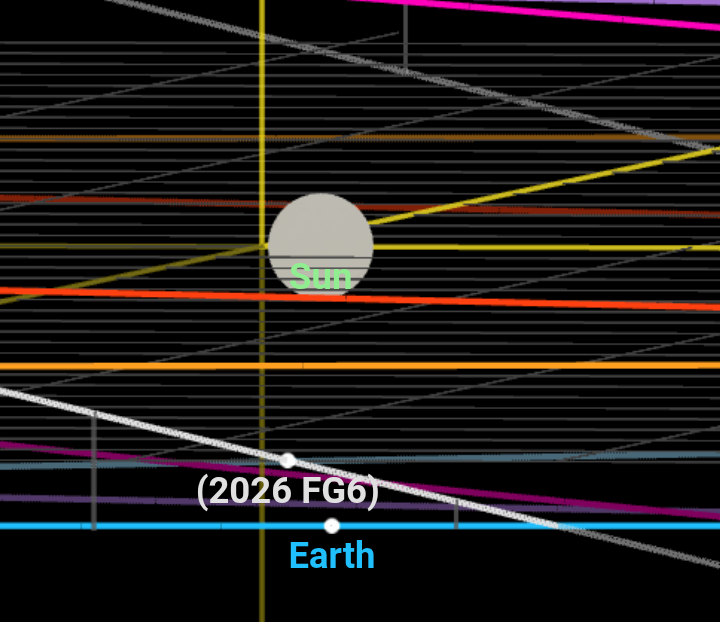
NEO 2026 FG6 Update
Following its initial identification on March 25, 2026, asteroid 2026 FG6 has undergone rapid orbital refinement based on additional observations extending the data arc to 3 days. The updated solution (JPL Solution 3, dated March 28, 2026) incorporates 29 observations, resulting in reduced uncertainties across all orbital elements while maintaining a condition code of 7. This reflects a typical early-stage solution for newly discovered small Near-Earth Objects (NEOs), where continued tracking is required to achieve long-term orbital certainty .
Updated Orbital Solution (JPL 3)(ADO)
| Element | Previous (JPL 2) | Updated (JPL 3) | Change |
|---|---|---|---|
| Eccentricity (e) | 0.228165 | 0.228035 | Refined (-0.00013) |
| Semi-major axis (a) | 1.067528 au | 1.067428 au | Refined |
| Inclination (i) | 13.8936° | 13.8866° | Minor adjustment |
| Orbital Period | 402.872 days | 402.816 days | Refined |
| Earth MOID | 0.000450813 au | 0.000451072 au | Stable |
Observation Arc Improvement (ADO)
| Metric | Initial | Updated |
|---|---|---|
| Observation Arc | 2 days | 3 days |
| Observations | 23 | 29 |
| RMS Residual | 0.46523 | 0.4281 |
The extension of the observational arc has resulted in measurable improvements in orbital precision, reflected in reduced residuals and tighter uncertainties. However, the object remains in a high-uncertainty classification regime due to the still-limited temporal coverage.
Confirmed Close Approach — 29 March 2026 (ADO)
Updated trajectory solutions confirm that 2026 FG6 will undergo a close approach to the Earth–Moon system on 29 March 2026, including a notably close lunar pass followed by an Earth flyby.
| Target | Date (TDB) | Distance (au) | Distance (km) | Velocity (km/s) |
|---|---|---|---|---|
| Moon | 2026-Mar-29 04:35 | 0.00286 | ~428,000 km | 10.74 |
| Earth | 2026-Mar-29 10:09 | 0.00470 | ~703,000 km | 10.19 |
The Earth flyby distance of approximately 0.00470 au (~1.83 lunar distances) places this event within the category of a close, but entirely non-hazardous, encounter. The preceding lunar pass provides an additional gravitational interaction point within the Earth–Moon system, though no significant trajectory perturbation is expected at this scale.
Physical Interpretation (ADO)
With an updated absolute magnitude of H = 27.438, 2026 FG6 remains firmly within the meter-scale size regime. Objects of this size are incapable of surviving atmospheric entry intact and would be expected to produce airburst phenomena rather than ground impact events.
Operational Assessment (ADO)
| Metric | Assessment |
|---|---|
| Impact Risk | None |
| Approach Category | Close (within 2 LD) |
| Orbit Confidence | Low (early-stage solution) |
| Monitoring Priority | High (active refinement phase) |
Conclusion
The updated solution for 2026 FG6 demonstrates the rapid evolution of orbital knowledge in the immediate aftermath of discovery. While uncertainties remain, the current trajectory is well constrained for short-term prediction, confirming a close but safe passage through the Earth–Moon system on 29 March 2026. Continued observations over the coming days will be critical in transitioning this object from preliminary to fully constrained orbital status.
Source: NASA JPL Small-Body Database (Solution 3)
Data sources: MPC, JPL SBDB, ground‑based follow‑up observations.
