

Astrophyzix Near-Earth Object (NEO) Close Approach Report
Monitoring Window: 29 March – 4 April 2026 (UTC)
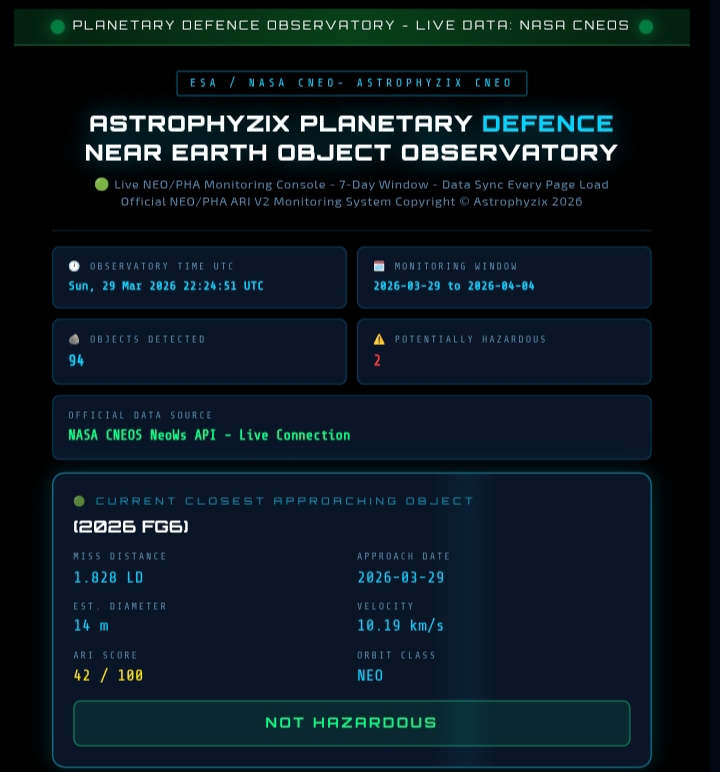
Official NEO Data Reporting
This report presents a comprehensive analysis of Near-Earth Object (NEO) activity detected within a 7-day monitoring window using live orbital data from the NASA Center for Near-Earth Object Studies (CNEOS) NeoWs API, integrated via the Astrophyzix Digital Observatory. All objects listed have been evaluated using standard orbital mechanics and observational datasets, alongside the Astrophyzix Risk Index (ARI v2) for comparative educational context.
Key Monitoring Statistics
- Total NEOs detected: 94
- Potentially Hazardous Asteroids (PHA): 2
- Objects within 10 Lunar Distances (LD): 12
- Closest approach distance: 1.828 LD
- Average relative velocity: 13.3 km/s
- Largest object observed: ~660 m (413989 2007 EL88)
Closest Approach Analysis
The closest recorded flyby during this monitoring interval was asteroid (2026 FG6), which passed Earth at a distance of 1.828 Lunar Distances (~702,000 km) on 29 March 2026. With an estimated diameter of approximately 14 metres and a relative velocity of 10.19 km/s, this object falls within the lower size regime typically associated with atmospheric disintegration events rather than surface impact hazards.
The ARI score of 42/100 reflects its relatively close proximity combined with moderate velocity. However, it is critical to emphasise that this object posed no impact risk, and its trajectory remained well outside Earth’s gravitational capture corridor.
Significant Close Approaches (< 5 LD)
| Object | Date | Miss Distance (LD) | Velocity (km/s) | Size (m) | ARI |
|---|---|---|---|---|---|
| 2026 FG6 | Mar 29 | 1.828 | 10.19 | 14 | 42 |
| 2026 FH7 | Apr 1 | 1.871 | 8.27 | 19 | 41 |
| 2023 DZ2 | Apr 4 | 2.634 | 7.24 | 60 | 39 |
| 2026 FF7 | Apr 4 | 4.608 | 13.07 | 14 | 33 |
Objects Within 10 Lunar Distances
A total of 12 objects passed within 10 LD during this observation window. These objects represent routine near-Earth traffic and are consistent with expected detection rates from modern survey systems such as Pan-STARRS and Catalina Sky Survey.
Notable entries include:
- 2026 FF6: 7.685 LD, 43 m, 19.81 km/s (higher velocity profile)
- 2026 FQ8: 8.022 LD, 28 m, 8.08 km/s
- 2026 FN1: 8.439 LD, 22 m, 9.90 km/s
- 2019 FQ1: 9.551 LD, 16 m, 10.10 km/s
Larger Objects and Distant Passes
While proximity often draws attention, size remains a critical parameter in hazard assessment. The largest object recorded in this dataset was 413989 (2007 EL88), with an estimated diameter of approximately 660 metres. Despite its size, its orbital path remained at a safe distance well beyond any risk threshold.
Additional large bodies include:
- 674942 (2015 TX143): ~489 m, 44.44 LD
- 2026 FL5: ~167 m, 39.19 LD
- 2026 FZ5: ~125 m, 37.98 LD
Potentially Hazardous Asteroids (PHA)
Two objects within this monitoring window meet NASA’s criteria for Potentially Hazardous Asteroids (PHA), defined by a Minimum Orbit Intersection Distance (MOID) of ≤0.05 AU and an absolute magnitude corresponding to diameters typically greater than ~140 metres.
It is essential to clarify that PHA classification does not imply an imminent impact threat. All PHAs identified in this dataset remained at safe distances with well-constrained orbital solutions.
Scientific Context and Risk Interpretation
The observed distribution of NEOs within this timeframe aligns with established statistical models of near-Earth object populations. Objects in the 10–50 metre range are detected frequently and are typically only capable of producing airburst events if atmospheric entry occurs, similar in scale to the Chelyabinsk event (~20 m).
The Astrophyzix Risk Index (ARI v2) provides a comparative metric incorporating miss distance, velocity, and estimated diameter. However, ARI is explicitly a non-predictive, educational tool and does not account for orbital uncertainties, covariance matrices, or gravitational perturbations.
Conclusion
The 29 March – 4 April 2026 monitoring window demonstrates a typical pattern of near-Earth object activity, with multiple close approaches occurring at safe distances. The closest object, (2026 FG6), passed at under 2 Lunar Distances but posed no threat due to its trajectory and small size.
No objects within this dataset present any impact risk to Earth. All trajectories are well-characterised and remain under continuous monitoring by NASA CNEOS and international planetary defence networks.
Astrophyzix Observatory will continue real-time monitoring and analysis of all near-Earth objects to support public understanding and promote evidence-based planetary defence awareness.
Data Sources
- NASA CNEOS Near-Earth Object Web Service (NeoWs)
- NASA JPL Small-Body Database (SBDB)
- Astrophyzix Digital Observatory (ARI v2 Processing Layer)