
Voyager 1: A Light-Day After More Than 49 Years
“Voyager 1: A Tiny Human Messenger in an Incomprehensibly Vast Universe”
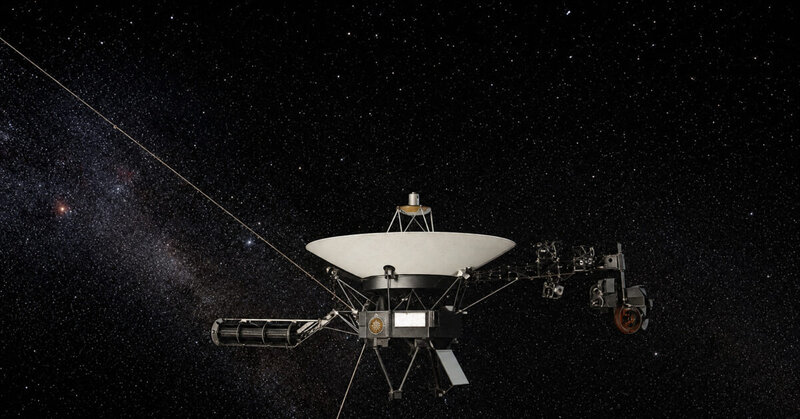
Image credit: NASA
A Milestone No Human-Made Object Has Reached
Imagine sending a spacecraft into space and asking it to travel as far as it possibly can. Almost five decades later, that little machine is still moving away from us, carrying the story of our planet into the darkness. On 18 November 2026, NASA’s Voyager 1 reached a remarkable milestone: it became the first human-made object to travel one light-day away from Earth. In simple terms, a radio signal travelling at the speed of light now needs a full 24 hours to cover the distance between us and the spacecraft. Think about that for a moment.
Launched in 1977: The Grand Tour
Voyager 1 was launched by NASA on 5 September 1977, with an original mission to explore the outer planets. Its twin, Voyager 2, had been launched a few weeks earlier, on 20 August. The spacecraft were sent on carefully planned trajectories that would take them close to Jupiter and Saturn, allowing scientists to study these distant worlds and their moons from close range. What began as a planetary exploration mission would eventually become one of the most extraordinary journeys in the history of space exploration.
Voyager 1 reached Jupiter in March 1979. The images and measurements it returned revealed a world far more dynamic than scientists had imagined. It studied Jupiter’s enormous Great Red Spot, its complex cloud patterns and its powerful magnetic environment. One of the most exciting discoveries came from Io, one of Jupiter’s large moons. Voyager observed active volcanoes there, providing the first direct evidence of active volcanism beyond Earth. It also examined Europa, Ganymede and Callisto, giving scientists a much closer look at the remarkable diversity of the Jovian system. Voyager even detected a faint ring around Jupiter, something that had not been seen before.
In November 1980, Voyager 1 made its closest approach to Saturn. The planet’s magnificent rings were studied in much greater detail, revealing intricate structures and features shaped by the gravitational influence of nearby moons. The spacecraft also examined several of Saturn’s moons, but its encounter with Titan was especially important. Titan’s thick, hazy atmosphere prevented Voyager from seeing its surface clearly, yet measurements showed that the atmosphere was largely nitrogen, with methane and other hydrocarbons. These observations helped lay the foundation for later exploration by the Cassini-Huygens mission, which would eventually reveal Titan as one of the most fascinating worlds in our Solar System.
Heading for the Edge of the Sun’s Influence
After completing its close encounters with Jupiter and Saturn, Voyager 1 continued outward. Its path past Saturn and Titan sent it northward, away from the plane in which most planets orbit the Sun. The spacecraft’s mission was extended beyond its original planetary objectives. It was now heading towards the outer limits of the Sun’s influence, a region that no spacecraft had explored directly before.
To understand what Voyager was looking for, we need to understand the heliosphere. The Sun is not simply a bright object shining at the centre of our Solar System. It continuously releases a stream of charged particles known as the solar wind, along with a magnetic field carried outward through space. This creates an enormous bubble around the Sun called the heliosphere. It extends far beyond the orbit of the planets and acts as a protective region that helps shield the Solar System from a portion of the energetic particles arriving from interstellar space.
As the solar wind travels outward, it eventually encounters resistance from the material and pressure of the surrounding interstellar environment. At a boundary called the termination shock, the solar wind slows down dramatically. Beyond it lies the heliosheath, a broad and turbulent outer region where solar particles and magnetic fields are still influential. The outer boundary of the heliosphere is called the heliopause. This is the region where the outward influence of the solar wind is balanced by the pressure of the interstellar medium. Crossing the heliopause means entering interstellar space—but it does not mean leaving the Milky Way, or even travelling anywhere close to another star.
Entering Interstellar Space
Voyager 1 crossed the termination shock in December 2004, at roughly 94 astronomical units from the Sun. It then travelled through the heliosheath before crossing the heliopause on 25 August 2012, at a distance of about 122 astronomical units from the Sun. It became the first human-made spacecraft to enter interstellar space. This was a historic achievement because, for the first time, a spacecraft was able to make direct measurements of the environment beyond the Sun’s protective bubble.
The change in the measurements was significant. Voyager detected a sharp reduction in particles associated with the solar wind and an increase in the density of the surrounding plasma. Its instruments also measured cosmic rays and magnetic fields in this new environment. The observations have taught scientists that the boundary between the heliosphere and interstellar space is not a simple wall. It is a complex region, and the Sun’s influence continues to leave its signature even beyond the heliopause. Voyager 2 crossed the same boundary in 2018, giving scientists a second set of observations from a different direction.
How Has Voyager 1 Survived for So Long?
How has Voyager 1 managed to survive for so long? The spacecraft does not depend on solar panels, which would become increasingly ineffective so far from the Sun. Instead, it uses radioisotope thermoelectric generators, which produce electricity from the heat released as plutonium-238 decays. The available power decreases gradually with time. Engineers have therefore had to make difficult decisions, switching off heaters and scientific instruments that are no longer essential, and finding ways to reduce the spacecraft’s energy consumption. The mission is an extraordinary example of engineering ingenuity: a machine designed in the 1970s continues to function in an environment for which it was never expected to operate for this long.
One Light-Day in Perspective
And now comes the milestone that puts the scale of space into perspective. A light-day is the distance light travels in 24 hours. Light moves at approximately 300,000 kilometres per second, covering nearly 25.9 billion kilometres in a day. NASA’s trajectory calculations placed Voyager 1 at this distance from Earth on 18 November 2026, at 2:16 a.m. Pacific Standard Time. The spacecraft had taken more than 49 years to reach a distance that light covers in just one day. Its speed is approximately 61,000 kilometres per hour. That is astonishingly fast by human standards, yet incredibly slow when measured against the distances between stars.
Let us take this comparison a little further. A light-year is the distance light travels in one year—approximately 9.46 trillion kilometres. At a constant speed of around 61,000 kilometres per hour, Voyager 1 would need roughly 17,700 years to travel one light-year. The nearest star to our Sun, Proxima Centauri, is about 4.24 light-years away. At the same speed, a journey across that distance would take around 75,000 years. This is not a practical travel forecast; it is simply a way of understanding the scale of the distances involved. Even our closest stellar neighbour is unimaginably far away.
Now consider this: Voyager 1 is the farthest human-made object from Earth. It has travelled through the outer Solar System, crossed the heliopause and entered interstellar space. Yet, after more than 49 years of travelling at tens of thousands of kilometres per hour, it has covered only about one light-day. Compared with the distance to even the nearest star, that is a tiny step. The spacecraft has not reached another star system, and it will not do so in any foreseeable human timescale.
If we extend the thought experiment to the observable universe, the numbers become almost impossible to imagine. The observable universe is about 93 billion light-years across. If we naively divided that distance by Voyager’s speed, the result would be around 1.6 quadrillion years. This is only an illustrative calculation, not a realistic route or travel-time prediction. The universe is expanding, and its large-scale distances do not behave like a fixed road that a spacecraft could simply cross. Still, the comparison gives us a sense of just how extraordinary the scale of the cosmos really is.
A Message From Earth: The Golden Record
Voyager 1 has also carried something more personal than scientific instruments. Each Voyager spacecraft carries a Golden Record: a message from Earth containing sounds, music, greetings in different languages and images intended to represent life and civilisation on our planet. It was never a message designed for a quick reply. Rather, it was a symbolic gesture—a small introduction to humanity, placed aboard a spacecraft travelling into the unknown. In a way, Voyager is not just a machine exploring space; it is also a time capsule from a civilisation that wanted to say, “We were here.”
An Important Update: Silence From Voyager 1
Status update: NASA reported that Voyager 1 reached the one-light-day milestone on 18 November 2026. The agency also said that the spacecraft had stopped returning science and engineering data on 14 November, although the Deep Space Network was receiving its carrier signal while engineers investigated the issue.
There is one important update to the story as this article is being written. NASA reported that Voyager 1 reached the one-light-day milestone on 18 November 2026. The agency also said that the spacecraft had stopped returning science and engineering data on 14 November, although the Deep Space Network was receiving its carrier signal while engineers investigated the issue. This means the milestone is confirmed by its trajectory, but the spacecraft’s ability to resume sending usable data remains a separate engineering challenge. After nearly half a century, even a brief silence from Voyager reminds us how remarkable—and fragile—this continuing connection is.
Conclusion: How Small Our Neighbourhood Is
Sometimes, when we look up at the night sky, we see thousands of stars and feel that the universe is within our reach. But when we put these distances and numbers into perspective, we begin to realise how small our neighbourhood really is. The planets that once seemed like distant destinations are only the beginning. Beyond them lies the heliosphere, then the interstellar medium, then the vast distances between stars, and finally a universe whose scale challenges our imagination.
Voyager 1’s journey is not simply a story about how far a spacecraft can travel. It is a story about curiosity, patience, scientific ambition and human ingenuity. A machine launched in 1977 has taken us to a place no human has ever visited, and its journey has helped us understand the boundary between our Solar System and the space beyond. Yet the most humbling fact remains this: it took Voyager more than 49 years to travel one light-day. The universe is fascinating, beautiful and, at the same time, a little frightening. It makes you realise just how small our little world is in the grand scheme of things.
It took Voyager 1 more than 49 years to travel one light-day, a tiny step compared with the distance to even the nearest star.
Sources and Further Reading
- NASA – Voyager 1: The Farthest Spacecraft. science.nasa.gov/mission/voyager/voyager-1
- NASA – Where Are Voyager 1 and 2 Now? science.nasa.gov/mission/voyager/where-are-voyager-1-and-voyager-2-now
- NASA – Voyager 1: What Is a Light-Day? science.nasa.gov/mission/voyager/voyager-1/voyager-1-what-is-a-light-day
- NASA – Interstellar Mission. science.nasa.gov/mission/voyager/interstellar-mission
- NASA – Planetary Voyage. science.nasa.gov/mission/voyager/planetary-voyage
- NASA – Fact Sheet. science.nasa.gov/mission/voyager/fact-sheet
- NASA – Voyager 1 Engineers Analyze Data Issue, Ready to Confirm Light-day (18 November 2026). science.nasa.gov/blogs/voyager
- NASA – Voyager 1 Makes History Reaching One Light-Day From Earth (19 November 2026). nasa.gov/news-release
Author’s note: Travel-time comparisons are approximate calculations using a constant speed of about 61,000 km/h. Actual spacecraft trajectories, reference frames and distances vary. The comparison with the observable universe is a thought experiment only; cosmic expansion means that the present-day observable universe is not a fixed destination that a spacecraft could cross at a constant speed.
Originality declaration: This article is an original, independently written work. Research facts and mission details have been checked by the Astrophyzix Editorial Team against the sources listed above before publication.
Attribution & Usage
All images and original, evidence-backed analysis in this report are the property of Astrophyzix and/or the author. If this page is referenced, cited, or used as a source elsewhere, correct attribution to V. Srinivasan via Astrophyzix Observatory with a direct, clickable link to www.astrophyzix.com is legally required – without exception.
To protect the scientific integrity and rigorous standards of the service and data we publish – this content is officially copyright registered, timestamped, monitored and protected by copyrighted.com on behalf of Astrophyzix. Legal action will be taken against websites, AI scrapers and AI Answer Systems who modify/use/redistribute this content in part or full without transparent details of any modifications made and/or linked attribution. Real people dedicate countless hours of hard work to provide Astrophyzix for free. We don't serve AI Slop so please respect these terms if you use our content.
© Registration number: NIFXI5589ncD892z.