
Astrophyzix Digital Observatory's
Evidence-First Asteroid Reporting

Astrophyzix.com is the publication of the Astrophyzix Digital Observatory, offering unpaywalled, evidence‑driven analysis and real‑time monitoring of PHAs and NEOs. Our tracking consoles and reporting systems use and provide access to official NASA CNEOS Scout, JPL CAD, NeoWs, JPL SBDB, Horizons and NOAA observational datasets, peer‑reviewed sources, and high‑precision numerical methods (IEEE‑754 Float64, RKN4). Designed for students, educators, researchers, and the public, every console is uniquely designed and engineered by the Astrophyzix Digital Observatory. Our research notes and papers can be found at Astrophyzix.Academia.Edu

Showing posts with label Latest Data. Show all posts

Wednesday, 8 April 2026

Near Earth Object NEO Close Approach Report: Asteroid (2026 GD) Updated Solution JPL 2

Astrophyzix Near-Earth Object (NEO) Close Approach Report: (2026 GD) — Updated Solution (JPL 2) - Real Time NEO News

Written by: Astrophyzix Digital Observatory

📌 Cited by DiscoverWildScience 📌 Cited by MSN News 📌 Cited by Bing Copilot News
Astrophyzix Image
Image Credit: NASA JPL SBDB

Introduction


Asteroid (2026 GD) is an Apollo-class near-Earth object (NEO) currently undergoing rapid orbital refinement following its recent discovery in April 2026. This report is a follow-up of our initial report and is based on the updated JPL solution (Solution 2), incorporating an expanded observational dataset and improved orbital constraints.


The object is notable for an exceptionally close Earth flyby occurring on April 9, 2026, within lunar distance. Although the orbit remains classified with moderate uncertainty, current data provides a consistent and stable close-approach solution with no indication of impact risk.

Key Takeaways


  • Very close Earth approach on 2026-Apr-09 at 22:59 (TBD) at ~0.00168 AU.
  • Equivalent to approximately 0.65 lunar distances (~251,000 km).
  • Relative velocity: ~12.66 km/s.
  • Small object (~20–30 meters estimated diameter).
  • Earth MOID: 0.000525 AU (very low orbital intersection distance).
  • Orbit refined using 117 observations over 2 days.
  • Condition code remains 7 (moderate uncertainty).
  • No impact threat identified. 


Scientific Consensus Snapshot


The updated orbital solution reflects improved constraint quality due to an increased number of observations and an extended data arc. While uncertainties have decreased across all orbital parameters, the orbit remains in an early refinement stage. 


Close approach predictions are now more precise, particularly in timing, but continued observation is required to fully stabilise the solution.

Tuesday, 7 April 2026

Near Earth Object NEO Close Approach Report April 07–13, 2026 Official Data

Astrophyzix Near-Earth Object (NEO) Close Approach Report: April 07–13, 2026. Real Time Asteroid News

Written by: Astrophyzix Digital Observatory

Astrophyzix Weekly NEO Report Header

Introduction


This report summarises near-Earth object (NEO) activity during the monitoring window of April 07–13, 2026, based on live data from NASA’s CNEOS NeoWs API. A total of 66 objects are tracked within this interval, including 4 classified as Potentially Hazardous Asteroids (PHAs).

The dataset reflects real-time orbital solutions and close-approach predictions. While multiple objects pass within lunar-distance scales, all currently known trajectories indicate no impact threat. The Astrophyzix Risk Index® (ARI) is included as an internal comparative metric and does not represent official hazard classification.

Key Takeaways (Data correct at time of publication)


  • Total monitored NEOs: 66
  • Potentially Hazardous Asteroids (PHA): 4
  • Objects passing within 10 lunar distances: 4
  • Closest approach: (2011 FT9) at 3.437 LD
  • Average relative velocity: 13.3 km/s
  • Largest object: 302831 (2003 FH) at ~645 meters
  • No confirmed impact risks identified


Scientific Consensus Snapshot


All orbital predictions are derived from NASA CNEOS datasets and are continuously refined through optical and radar tracking. Close approach distances are calculated using numerical integration models incorporating gravitational perturbations from major planetary bodies. 


Objects classified as PHAs meet defined thresholds for size and Earth MOID but do not imply imminent impact.


Sunday, 15 March 2026

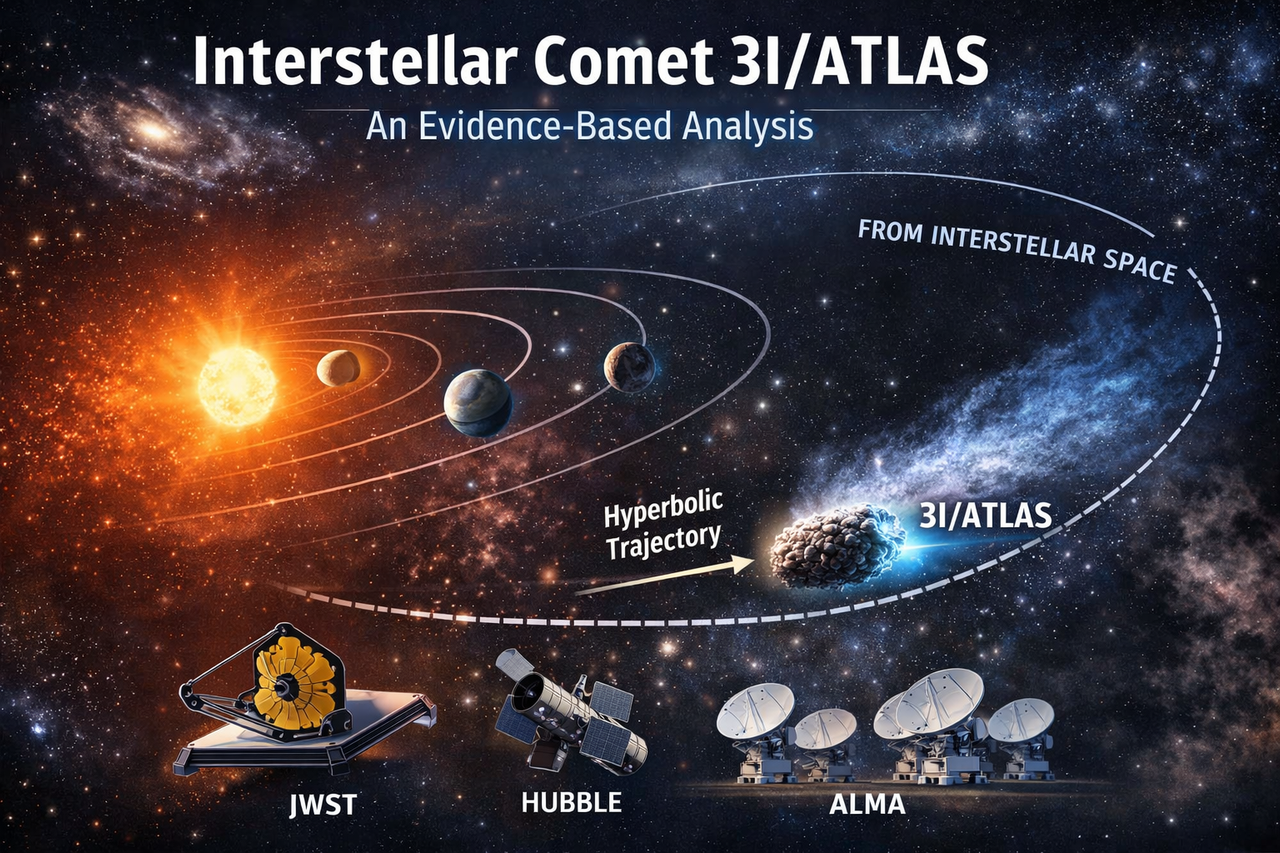
Interstellar Object 3I/ATLAS: Evidence-Based Analysis of Its Mass, Composition, and Physical Properties Using Peer Reviewed Papers, No Hype, No Sensationalism

📌 Cited

Interstellar Object 3I/ATLAS: Evidence-Based Analysis of Its Mass, Composition, and Physical Properties

Written by: Astrophyzix Science Communication
Article Type: Peer-Reviewed Sourced, Explainer, Evidence-First 

3I/ATLAS

 
Key Takeaways
  • 3I/ATLAS is the third confirmed interstellar object detected passing through the Solar System.
  • Observations from JWST, Hubble, and ALMA confirm that the object displays typical cometary activity.
  • Spectroscopy shows a carbon-dioxide-dominated coma with additional water, carbon monoxide, and organic molecules.
  • Current models suggest a nucleus diameter likely near the kilometre scale.
  • Estimated mass is likely on the order of billions of metric tons, consistent with other comet nuclei.
  • Isotopic measurements indicate formation in an extremely cold protoplanetary environment billions of years ago.

Introduction

Interstellar objects are small bodies that formed around other stars before being gravitationally ejected from their original planetary systems. After drifting through interstellar space for millions or billions of years, some eventually pass through the Solar System where they can be observed by modern telescopes.

Friday, 16 January 2026

Close Approach of Potentially Hazardous Apollo-class Small Asteroid 2018 UY on 20th January 2026

MONITORING ACTIVE
Written by: L.W - Independent Science Communicator
Published: 16 January 2026 by Astrophyzix.com
Read time: 9 minutes


2026 Close approach chart asteroid 2018 UY


Abstract

The near-Earth asteroid (2018 UY) will make a close but non-threatening passage of Earth on 20 January 2026 as part of its regular sequence of planetary encounters. Classified as an Apollo-type Near-Earth Asteroid and a Potentially Hazardous Asteroid due to its orbital geometry, 2018 UY poses no impact risk during this flyby. 

Independent Direct Source Verification
Uncompromised Crossref DOI Resolver · Live and direct meta data fetch
Awaiting DOI input