

Astrophyzix Near-Earth Object (NEO) Close Approach Report: (2026 GD) Newly Discovered Asteroid Will Pass Closer than the Moon.
Written by: Astrophyzix Digital Observatory
📌 Cited by DiscoverWildScience 📌 Cited by MSN News 📌 Cited by Bing Copilot News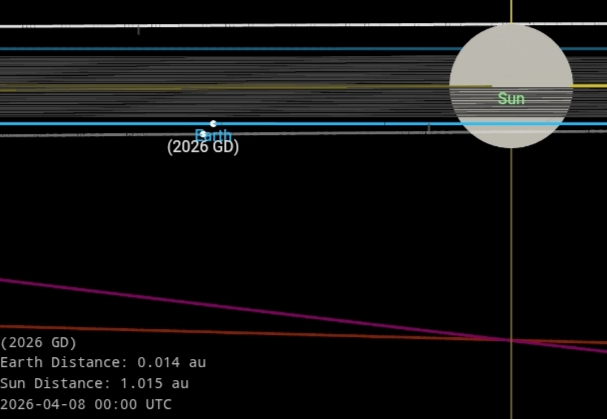
Introduction
Asteroid (2026 GD) is a recently observed Apollo-class near-Earth object (NEO) identified in April 2026. With a short observational arc of just 1 day, its orbital solution remains preliminary and subject to refinement. Despite this, current data indicates an exceptionally close Earth approach occurring on 09 April 2026.
The object’s very low Earth Minimum Orbit Intersection Distance (MOID) and near-term encounter geometry place it within the category of close-approach monitoring priority objects, although no confirmed impact risk is currently established based on available solutions at this time. Astrophyzix will update you as new data comes in.
Key Takeaways
- Apollo-class near-Earth asteroid with Earth-crossing orbit.
- Very close Earth approach on 2026-Apr-09 at ~0.00168 AU.
- Equivalent to approximately 0.65 lunar distances (~251,000 km).
- Estimated relative velocity: ~12.66 km/s.
- Small object (~20–30 meters estimated diameter range).
- Extremely low Earth MOID: 0.000525 AU.
- Orbit uncertainty remains high (condition code 7).
- No confirmed impact risk in current datasets at the time of this report.
Scientific Consensus Snapshot
The orbital parameters for (2026 GD) are based on a limited observational dataset spanning approximately one day. As a result, uncertainties remain significant, reflected in its condition code of 7. (Explanation of Code 7 below)
Additional observations are required to refine its trajectory and reduce positional uncertainty. Close-approach predictions at this stage should be treated as provisional.
Orbital Profile Based on Available Data
- Orbit Type: Apollo-class (Earth-crossing)
- Semi-major axis (a): 1.461 AU
- Eccentricity (e): 0.454
- Inclination (i): 0.35° (very low inclination orbit)
- Perihelion (q): 0.798 AU
- Aphelion (Q): 2.124 AU
- Orbital Period: ~645 days (~1.77 years)
- Earth MOID: 0.000525 AU (~78,600 km)
- Tisserand Parameter (Jupiter): 4.506
Physical Characteristics
- Absolute Magnitude (H): 26.56
- Estimated Diameter: ~20–30 meters (approximate, based on H)
- Surface Properties: Unknown (no albedo constraint available)
Given its small size, (2026 GD) would not represent a global hazard in the event of atmospheric entry, but objects in this size range are capable of producing significant airburst events depending on composition and entry angle.
Close Approach Analysis
| Date (TDB) | Body | Distance (AU) | Distance (LD) | Velocity (km/s) |
|---|---|---|---|---|
| 2026-Apr-09 | Earth | 0.00168 | ~0.65 LD | 12.66 |
| 2026-Apr-10 | Moon | 0.00109 | ~0.42 LD | 11.69 |
2026 Close Approach Context
Orbit Condition Code 7 — Interpretation
The orbit condition code is a numerical indicator used by NASA’s JPL Small-Body Database to describe the level of uncertainty in an asteroid’s orbital solution. Values range from 0 (highly reliable) to 9 (highly uncertain).
A condition code of 7 indicates a poorly constrained orbit, typically associated with newly discovered objects that have been observed over a very short time span (often hours to a few days). In this state, the orbital parameters are preliminary and subject to potentially significant revision.
Key Characteristics of Code 7 Objects
- Short observational arc (often less than a few days)
- Limited number of observations available
- Higher uncertainty in predicted position and trajectory
- Close approach distances may shift as new data is added
- Impact probabilities (if any) are highly provisional
Implications for Close Approach Analysis
For objects with condition code 7, reported close approach distances and timing should be interpreted with caution. While initial solutions may indicate a very close pass, these values can change as additional observations refine the orbit.
This does not imply increased danger. Instead, it reflects insufficient data at the time of calculation. In many cases, follow-up observations rapidly reduce the condition code (e.g., from 7 to 2 or lower), significantly improving confidence in trajectory predictions.
Operational Context
Objects assigned condition code 7 are prioritised for follow-up observations by global survey networks. Rapid refinement is critical for:
- Reducing orbital uncertainty
- Confirming or ruling out Earth-impact scenarios
- Improving long-term trajectory modelling
Once sufficient data is collected, the orbit is recalculated and the condition code is updated accordingly. Most newly discovered near-Earth objects quickly transition to lower uncertainty classifications within days.
The April 2026 Earth encounter represents a sub-lunar-distance close approach, placing (2026 GD) among the closer known flybys for this observation period. The object passes inside the Moon’s orbital distance before subsequently approaching the lunar vicinity approximately one day later.
Such encounters are not uncommon for small NEOs but are of high observational interest due to their proximity and potential for radar tracking, which can significantly refine orbital solutions.
Dynamical Context
The orbit of (2026 GD) is characterised by low inclination and moderate eccentricity, resulting in frequent crossings of Earth’s orbital plane. This geometry increases the likelihood of periodic close approaches over time.
The extremely small MOID indicates that the orbital paths of Earth and the asteroid intersect very closely in three-dimensional space, although temporal alignment is required for an actual encounter.
Risk Assessment
- No confirmed impact risk based on current JPL and CNEOS datasets.
- Orbit uncertainty remains elevated due to short observational arc.
- Close approach distance is well constrained within current solution bounds.
- Further observations are required to fully validate trajectory.
It is critical to note that newly discovered objects with short data arcs often undergo rapid orbital refinement. Any changes to predicted trajectories will be reflected in updated solutions as additional observations are collected.
Conclusion
Asteroid (2026 GD) represents a typical example of a small, newly detected near-Earth object undergoing rapid observational refinement. Its April 2026 close approach is notable for occurring within lunar distance, making it a priority for follow-up observations.
While its orbital geometry warrants continued monitoring, there is currently no evidence of impact risk. Ongoing tracking efforts will significantly improve orbital certainty in the coming days.
Sources
- NASA JPL Small-Body Database – (2026 GD)
- JPL Horizons Ephemeris (SPKID: 54607483)
- NASA Sentry Impact Risk Table
- NASA CNEOS Close Approach Data
- Image Credit: NASA JPL SBDB