Live Independent Verifiable and reproducible Unpaywalled NASA-sourced

Astrophyzix Digital Observatory

Trusted for Asteroid News, Research, Data & Analysis

Delivering unpaywalled, evidence-driven analysis, public research tools, real-time datasets and monitoring and tracking of all PHA/NEO asteroids, comets and solar system objects.

Every tracking console is designed and engineered here. Systems directly ingest multiple NASA datasets covering over 1.57 million objects, then run live, verifiable probabilistic orbital analysis and deliver an instant deterministic summary of close approaches. Used by students, educators, researchers, and the public. Data provenance is traceable, verifiable and transparent. Original research papers are published on Astrophyzix.academia.edu, registered with official DOIs via Zenodo and academically indexed by OpenAIRE.

  • NASA API'S
  • ✅ CNEOS Scout
  • ✅ JPL CAD
  • ✅ NeoWs
  • ✅ SBDB
  • ✅ Horizons
  • ✅ Sentry
Showing posts with label Official NASA JPL Data. Show all posts

NEO Asteroid 2021 KN2 Close Approach Report, Official Data, Risk Analysis and Asteroid Profile - Latest Asteroid News

NASA SBDB Data · Astrophyzix Scientific Close‑Approach & Orbital Report

Asteroid 2021 KN2 — Elite‑Tier NEO Close‑Approach & Orbital Profile · JPL SBDB Solution JPL 3
✅ Data aligned with: JPL SBDB, CNEOS CAD, NASA Horizons - Last verified against JPL SBDB: 31 May 2026 13:42 UTC

Asteroid 2021 KN2 orbit
Apollo NEO Condition Code 6 1‑Day Data Arc NO IMPACT RISK — See JPL Solution

Key Takeaways of Asteroid 2021 KN2

  • NASA JPL Solution: Solution JPL 3 · Epoch 2461000.5 (2025‑Nov‑21.0 TDB) · SPK‑ID 54149826 · Producer: Otto Matic
  • Orbit class: Apollo NEO — a = 1.4064 au, e = 0.3718, i = 3.77°, orbital period 609.23 days (1.67 years).
  • Earth MOID: 0.001331 au (~199,000 km), placing the nominal orbit well inside the Earth–Moon system, but with no impact solutions in current JPL or CNEOS catalogues.
  • Size estimate: Absolute magnitude H = 28.63 → approximate diameter ~5–12 m (albedo‑dependent), firmly in the small NEO regime.
  • Rotation: Extremely fast rotation period of 0.021007 h (~75.6 seconds), based on LCDB data, suggesting a cohesive or monolithic body rather than a loose rubble pile.
  • Orbit quality: Condition code 6, based on 65 observations over a 1‑day data arc (2021‑05‑30 to 2021‑05‑31), with a normalised RMS of 0.23451 — a short‑arc, moderately uncertain orbit.
  • Recent close approach: On 2021‑05‑31, 2021 KN2 passed Earth at a nominal distance of 0.00097 au (~145,000 km) and the Moon at 0.00306 au, a close but non‑impacting flyby.
  • Risk context: Not a Potentially Hazardous Asteroid — too small (H > 22) and no impact geometry in current solutions.
  • Ignore clickbait and sensational claims about “mystery asteroids nearly hitting Earth” — the official data show 2021 KN2 as a small, well‑tracked, non‑hazardous NEO.

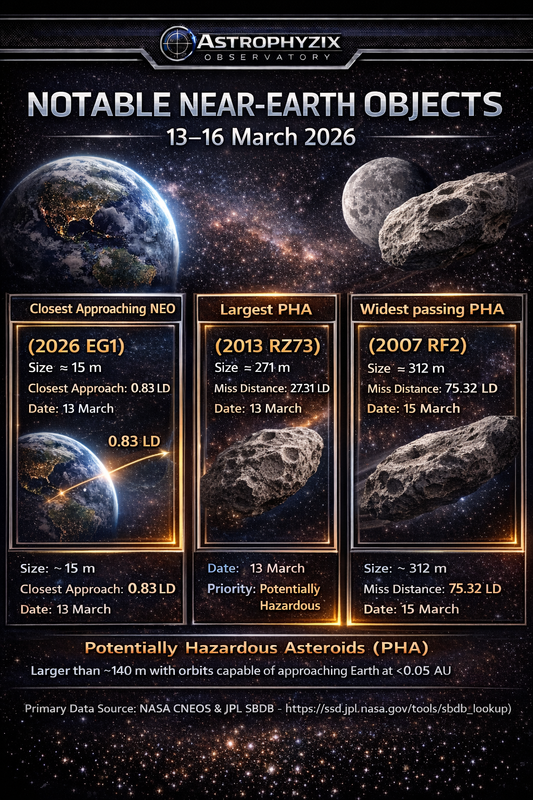
Astrophyzix Digital Observatory NEO Asteroid Close Approach Report 13-16 March 2026 - Official Data

Written by: Astrophyzix Digital Observatory

Near-Earth Object Close Approach Report — 13–16 March 2026

📌 Cited by Innovatopia News

Neoreport

Your Reliable Weekly NEO Report 

The following Near-Earth Object (NEO) monitoring report summarises asteroid flybys occurring between 13 March and 16 March 2026. Data is compiled from the NASA Jet Propulsion Laboratory Small-Body Database and associated planetary defence monitoring systems.

Distances are expressed in Lunar Distances (LD), where 1 LD = 384,400 km. This unit provides an intuitive scale for evaluating asteroid flybys relative to the Earth–Moon system.

During this monitoring interval 25 catalogued Near-Earth Objects make relatively close approaches to Earth. None of the objects present any impact risk. Several larger asteroids are formally classified as Potentially Hazardous Asteroids (PHAs), however all remain safely tens of lunar distances from Earth.

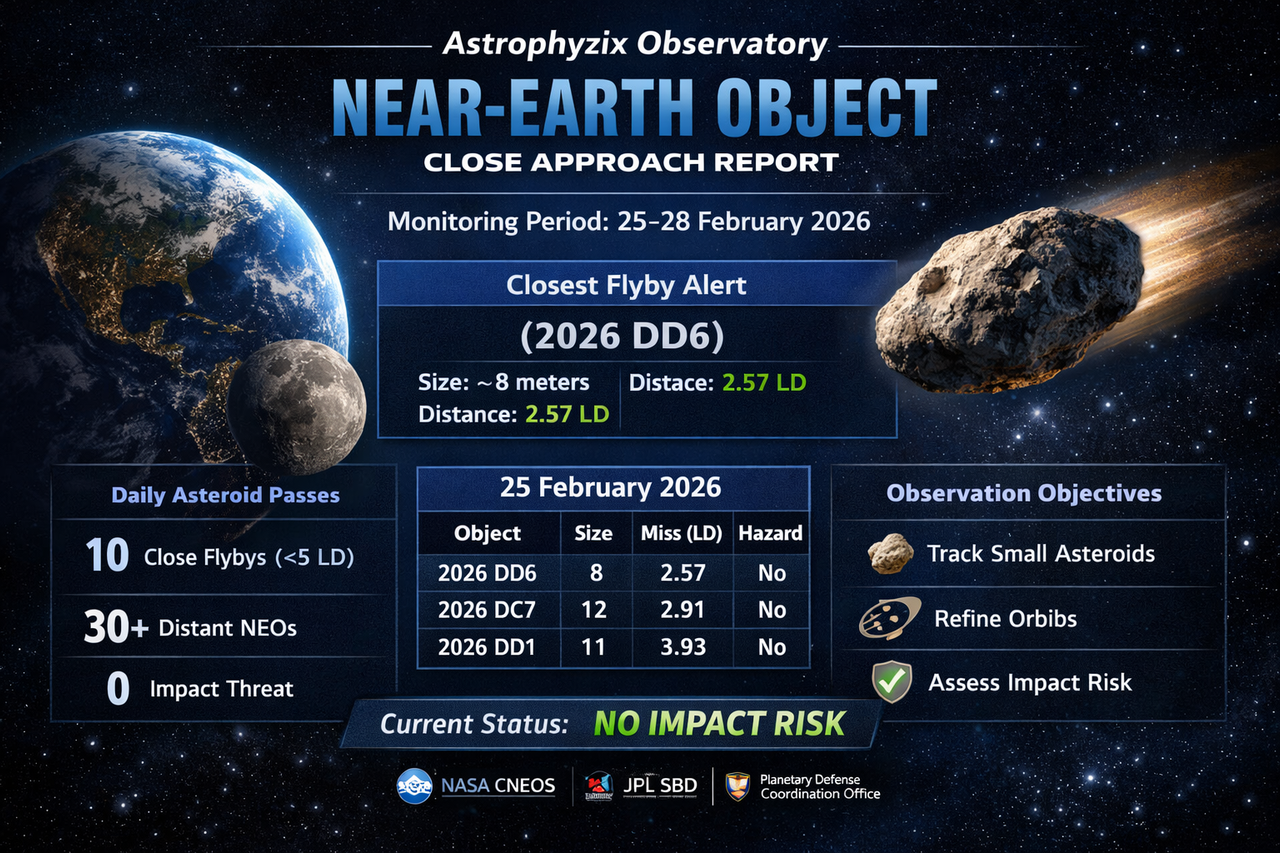
Midweek Asteroid NEO Close Approach Report: 25 February 2026

MONITORING ACTIVE

Astrophyzix Digital Observatory Planetary Defence: Near-Earth Object Close Approach Briefing

Monitoring Window: 25–28 February 2026
Written by: Astrophyzix Digital Observatory and Planetary Defence Centre
✅ Modified New Data: 27 February 2026
Closest Confirmed Flyby: 2026 DD6
Estimated size: ~8 m
Closest distance: 2.57 Lunar Distances (~0.99 million km)
Status: NO HAZARD

Observatory briefing

Routine orbital surveillance for the final week of February 2026 shows a sequence of small Near-Earth Objects safely transiting the Earth–Moon orbital region. Such passages occur continuously due to the large population of minor bodies whose solar orbits intersect Earth’s neighbourhood.

ℹ️ Sources / Technical / Mathematical / Scientific / Academic / Integrators / Methods
Sources
  • NASA APIs
  • CNEOS Scout
  • JPL CAD
  • NeoWs
  • SBDB
  • Horizons
  • Sentry
Stack
  • IEEE-754 Float64
  • RKN4
  • Yoshida-4
  • Dormand–Prince / DOPRI5
  • DOPRI8 /DOP853
  • Verlet
  • N-Body
  • Einstein–Infeld–Hoffmann
  • DE441
  • ΛCDM
  • J2
  • Meeus
  • Yarkovsky
  • Schwarzschild GR
  • Simon 1994
  • Holsapple–Schmidt
  • Collins / Pierazzo / Ward–Asphaug
  • AIS-Wide
  • Abyssal 4 km
  • WebGPU
  • DOI Registered
  • Academia.edu
  • Zenodo
  • OpenAIRE
Independent Direct Source Verification
Uncompromised Crossref DOI Resolver · Live and direct meta data fetch
Awaiting DOI input