

Astrophyzix Observatory PHA & NEO Asteroid News
Monthly close-approach summary · JPL SBDB CAD · September 2026
Near-Earth Object (NEO) and PHA Asteroid Close-Approach Summary: Looking back at September 2026
Earth close-approaches from 1–30 September 2026 inside 0.05 au (about 19.5 lunar distances), from the NASA/JPL SBDB Close Approach Data API. This is a month catalogue, not a live CNEOS Scout or Sentry stream. Live Multi-watch CAD/Scout/Sentry tracker.
In September 2026, the JPL close-approach catalogue records 165 Earth encounters inside the 0.05 au filter. Thirteen passed inside one lunar distance. The closest was 2026 RT34 (pictured) on 13 September, at 0.055 lunar distances (20,965 km from Earth’s centre, about 14,600 km above the surface) and 13.1 km/s. 2026 SZ2 matched that miss distance a week later. No listed object was on an impacting trajectory.
A Look-back at the Closest catalogued approaches in September 2026
2026 RT34
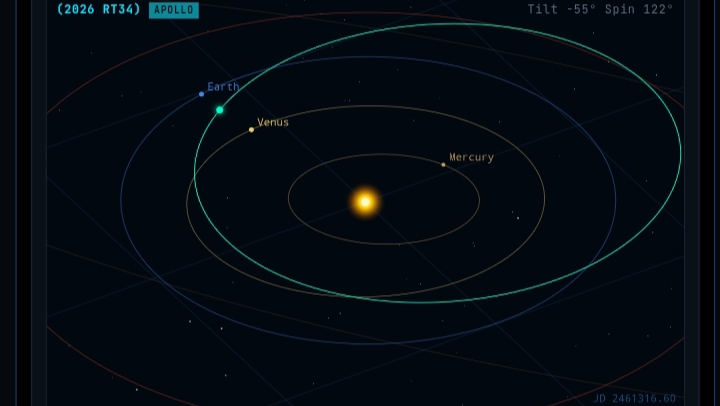
0.055 LD
20,965 km · 0.000140 au · v_rel 13.08 km/s · tied with 2026 SZ2
Encounter (UTC)
2026-Sep-13 09:08
Est. diameter
3 m (H 30.4, pv 0.14)
Diameter range
2.3 – 5.0 m
Earth radii
3.3 R(E)
Passes inside 1 lunar distance
Sorted by miss distance. Diameter is the Bowell range, albedo 0.25–0.05. None of these thirteen is a PHA.
| Object | Epoch (UTC) | Dist (LD) | Dist (km) | v_rel | Diameter | Status |
|---|---|---|---|---|---|---|
| 2026 RT34 | 2026-Sep-13 09:08 | 0.055 | 20,965 | 13.1 | 2–5 m | Routine |
| 2026 SZ2 | 2026-Sep-20 21:19 | 0.055 | 21,210 | 8.0 | 2–5 m | Routine |
| 2026 RG15 | 2026-Sep-15 07:36 | 0.246 | 94,698 | 9.1 | 16–35 m | Routine |
| 2026 SB | 2026-Sep-15 04:52 | 0.329 | 126,288 | 14.6 | 6–14 m | Routine |
| 2026 RZ | 2026-Sep-03 00:06 | 0.529 | 203,497 | 11.2 | 3–7 m | Routine |
| 2026 RN2 | 2026-Sep-08 13:51 | 0.577 | 221,987 | 12.1 | 4–8 m | Routine |
| 2026 RH10 | 2026-Sep-10 06:39 | 0.646 | 248,260 | 18.2 | 10–23 m | Routine |
| 2026 RO39 | 2026-Sep-14 07:44 | 0.662 | 254,498 | 10.5 | 4–8 m | Routine |
| 2026 RC | 2026-Sep-03 23:09 | 0.757 | 291,087 | 6.2 | 5–10 m | Routine |
| 2026 RH1 | 2026-Sep-02 21:59 | 0.867 | 333,188 | 8.7 | 5–12 m | Routine |
| 2026 RS2 | 2026-Sep-06 19:09 | 0.927 | 356,240 | 7.4 | 3–6 m | Routine |
| 2026 SA8 | 2026-Sep-28 06:45 | 0.988 | 379,868 | 6.6 | 5–11 m | Routine |
| 2026 RB39 | 2026-Sep-17 02:29 | 0.999 | 384,180 | 9.3 | 5–11 m | Routine |
Lead object orbital dossier
2026 RT34
Heliocentric osculating elements from JPL SBDB, epoch JD 2461200.5. Dynamical class: APO (Near-Earth asteroid orbits which cross the Earth’s orbit similar to that of 1862 Apollo). Not a potentially hazardous asteroid. Absolute magnitude H = 30.36.
Semi-major axis a
1.02 au
Eccentricity e
0.394
Inclination i
0.675 deg
Orbital period
1.03 yr
Asc. node Ω
350 deg
Arg. perihelion ω
112 deg
JPL Small-Body Database record: ssd.jpl.nasa.gov/tools/sbdb_lookup.html#/?sstr=2026 RT34
Potentially hazardous asteroids in the month
PHA is a size and orbit-class flag (H ≤ 22 and Earth MOID ≤ 0.05 au), not this month’s miss distance. All three September PHA approaches stayed outside 12 LD.
| Object | Epoch (UTC) | Dist (LD) | Dist (km) | v_rel | Diameter | Status |
|---|---|---|---|---|---|---|
| 2026 OH3 | 2026-Sep-11 04:27 | 12.31 | 4,731,250 | 20.2 | 0.14–0.32 km | PHA |
| 2026 RF10 | 2026-Sep-02 09:00 | 13.45 | 5,171,080 | 17.1 | 0.11–0.26 km | PHA |
| 2026 NT2 | 2026-Sep-17 05:07 | 16.09 | 6,182,950 | 12.5 | 0.23–0.52 km | PHA |
Month analysis · JPL CAD clock
The September window contains 165 catalogued Earth close-approaches inside 0.05 au. Thirteen were sub-lunar, led by 2026 RT34 and 2026 SZ2 at 0.055 LD — both a few metres across, and both non-PHA. The largest sub-lunar body was 2026 RG15, about 16–35 m, at 0.25 LD on 15 September. Three objects carry a PHA flag; the nearest of those, 2026 OH3, missed by 12.3 LD. Median miss distance was 5.73 LD. Fastest relative velocity was 26.9 km/s (2026 SL7, 17.6 LD). No listed object is on an impacting trajectory.
Approaches in month
165
Inside 1 LD
13
Inside 5 LD
66
PHA in window
3
Median miss
5.73 LD
Fastest v_rel
26.9 km/s
Closest object
2026 RT34
Closest PHA
2026 OH3
Methodology
Distances and epochs are nominal JPL close-approach solutions. Lunar distance is 384,400 km; 1 au is 149,597,870.7 km. Diameter is not a measured size: it is the Bowell range D[km] = 1329 / sqrt(pv) × 10^(−H/5), pv 0.25–0.05, with a midpoint at pv 0.14. PHA status is the JPL flag from the CAD query, not a function of September’s miss distance.
Reporting style follows the Astrophyzix Orbital Refinement System.
Methodology documents
-
Daily NEO Reporting Methodology
DOI: 10.5281/zenodo.22868834 -
Orbital Refinement System & Orbital Viewer Documentation
DOI: 10.5281/zenodo.23049067
Data provenance
Window: 2026-09-01 to 2026-10-01, Earth, dist-max 0.05 au
Source 1: NASA/JPL SBDB Close Approach Data API
endpoint: https://ssd-api.jpl.nasa.gov/cad.api?date-min=2026-09-01&date-max=2026-10-01&dist-max=0.05&fullname=true
docs: ssd-api.jpl.nasa.gov/doc/cad.html
count: 165
Source 2: same API, pha=true
count: 3 (2026 OH3, 2026 RF10, 2026 NT2)
Source 3: JPL SBDB lookup for 2026 RT34
endpoint: https://ssd-api.jpl.nasa.gov/sbdb.api?sstr=2026%20RT34
spkid: 54653909 · orbit class APO · pha false
Constants:
- AU = 149597870.7 km (IAU 2012 Resolution B2)
- Lunar distance = 384400 km (JPL/IAU nominal mean)
- Earth mean radius = 6371 km (IUGG)
Source note: For live CNEOS Scout and Sentry use the Dual-watch tracker: astrophyzix.com/p/live-asteroid-tracker-v9.html
Primary references: NASA/JPL CNEOS Close Approach Data (cneos.jpl.nasa.gov/ca), SBDB (ssd.jpl.nasa.gov). Object hazard status should be verified against the CNEOS Sentry table. Nominal miss distances can shift for short-arc discoveries.