

Astrophyzix Live CAD and Scout Report 04 October 2026
Astrophyzix Observatory Fleet Status
Of the 84 tracked objects, 2 are PHA-class; SWAN26Q (below) is confirmed as one of them. The other remains unidentified in the data seen so far. The single largest tracked object, ec0001 (NEOCP) at ≈ 22,411 m, still isn't among the nine objects profiled here.
Approach Distance Scale
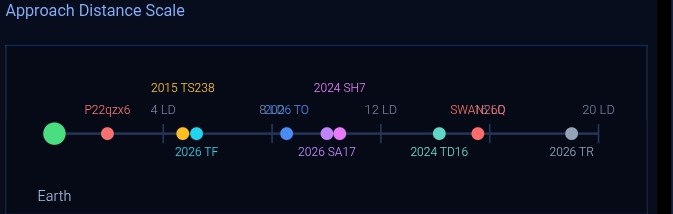
This Week's Closest-Approach Objects
| Object | Date (TDB/UTC) | Distance | Vel. (km/s) | Size | H | ARI | Source |
|---|---|---|---|---|---|---|---|
| P22qzx6 (NEOCP) | 10-03 23:48 | 1.946 LD | 14.60 | 81 m | 23.2 | 46 | Scout |
| 2015 TS238 | 10-08 17:12 | 4.719 LD | 15.81 | 30 m | 25.4 | 34 | CAD |
| 2026 TF | 10-04 15:07 | 5.221 LD | 9.15 | 20 m | 26.2 | 30 | CAD |
| 2026 TO | 10-09 11:40 | 8.537 LD | 6.81 | 15 m | 26.8 | 21 | CAD |
| 2026 SA17 | 10-05 13:45 | 10.017 LD | 11.34 | 20 m | 26.2 | 22 | CAD |
| 2024 SH7 | 10-04 00:43 | 10.488 LD | 10.76 | 12 m | 27.3 | 20 | CAD |
| 2024 TD16 | 10-07 07:37 | 14.144 LD | 11.80 | 17 m | 26.6 | 17 | CAD |
| SWAN26Q (NEOCP) | 09-16 18:24* | 15.567 LD | 56.70 | 16,235 m | 11.7 | 60 | Scout |
| 2026 TR | 10-05 21:36 | 19.010 LD | 7.97 | 29 m | 25.5 | 13 | CAD |
All are tagged SAFE except SWAN26Q, which is PHA-class per Scout's scoring (see its dedicated report — link in Sources). *SWAN26Q's date is its last Scout run, not a close-approach date; at e ≈ 1 its geometry doesn't resolve to one. 2026 TO and 2026 TR don't yet have expanded orbital elements in the data seen.
Orbit Comparison: the Five Fully-Resolved Objects
Five objects now have full published orbital elements: 2015 TS238, 2026 TF, 2026 SA17, 2024 SH7 and 2024 TD16. (P22qzx6 remains an unconfirmed Scout candidate with no fixed semi-major axis; 2026 TO and 2026 TR weren't expanded; SWAN26Q's near-parabolic orbit is covered separately in its own report.)
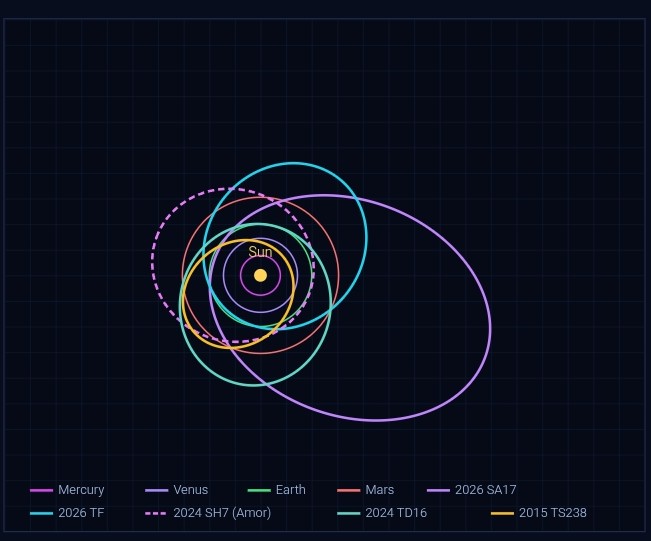
Schematic only, orientation approximate. 2026 SA17's orbit (purple) dwarfs the rest, reaching 4.67 au at aphelion — well past Mars, into the inner asteroid belt. 2024 SH7 (dashed, Amor-class) is the only orbit that doesn't cross Earth's — it approaches from outside without quite reaching Earth's path.
Individual Object Profiles
An unconfirmed Scout candidate, last run 2026-10-03 23:48 UTC, based on 11 observations across a 47.05-day arc.
| Parameter | Value |
|---|---|
| Miss distance | 1.946 LD (≈ 747,989 km, 0.005 au) |
| Velocity | 14.60 km/s |
| Absolute magnitude (H) | 23.2 |
| Estimated diameter | ≈ 61–136 m (nominal ≈ 81 m), H-derived |
| Sampled eccentricity / inclination | 0.467–0.525 / 8.91°–10.03° |
| Scout scores | NEO 100 · PHA 0 · Geocentric 0 · Tisserand 0 |
An ordinary, moderately eccentric, prograde orbit — nothing exotic. At solar elongation 161° (near opposition) it's well-placed for follow-up.
| Parameter | Value |
|---|---|
| Close approach | 2026-10-08 17:12 TDB, ± 7 days 06:25 — largest timing uncertainty in the batch |
| Miss distance | 4.719 LD (0.01213 au) |
| Velocity | 15.81 km/s |
| Orbit class | Apollo (APO) |
| a / e / i | 1.14 au / 0.499 / 3.32° |
| q / Q | 0.573 au / 1.71 au |
| Period | 447 days |
| Earth MOID | 0.0047 au |
| Tisserand (TJ) | ≈ 5.37 † |
| H / size | 25.4 / ≈ 22–49 m (nominal 30 m) |
This pass is ≈ 2.6× farther than the orbit's own Earth MOID — a previously-catalogued (2015) object re-observed on a fresh 7-day arc this apparition.
| Parameter | Value |
|---|---|
| Close approach | 2026-10-04 15:07 TDB, timing uncertainty < 1 minute |
| Miss distance | 5.221 LD (0.01342 au) |
| Velocity | 9.15 km/s |
| Orbit class | Apollo (APO) |
| a / e / i | 1.69 au / 0.44 / 8.59° |
| q / Q | 0.947 au / 2.43 au |
| Period | 803 days |
| Earth MOID | 0.0134 au |
| Tisserand (TJ) | ≈ 4.09 † |
| H / size | 26.234 / ≈ 15–34 m (nominal 20 m) |
Approach essentially matches the orbit's own MOID — about as tight as this geometry gets — despite only a 1-day arc.
| Parameter | Value |
|---|---|
| Close approach | 2026-10-09 11:40 TDB |
| Miss distance | 8.537 LD |
| Velocity | 6.81 km/s — slowest object in this batch |
| H / size | 26.8 / ≈ 15 m nominal |
Orbital elements still not available for this object.
| Parameter | Value |
|---|---|
| Close approach | 2026-10-05 13:45 TDB, timing uncertainty < 1 minute |
| Miss distance | 10.017 LD (0.02574 au) |
| Velocity | 11.34 km/s |
| Orbit class | Apollo (APO) |
| a / e / i | 2.81 au / 0.662 / 3.46° |
| q / Q | 0.951 au / 4.67 au — reaches well past Mars, toward Jupiter's orbit |
| Period | 1,720 days (4.71 years) — longest in this batch |
| Data arc | 12 days / 31 observations |
| Earth MOID | 0.0056 au |
| Tisserand (TJ) | ≈ 2.95 † — right at the classic asteroid/comet boundary (TJ = 3) |
| H / size | 26.217 / ≈ 15–34 m (nominal 20 m) |
Correction to the earlier version of this digest: the "Sentry-tracked" tag was right — CNEOS Sentry does carry an active entry for 2026 SA17, not a null/absent one as the live tracker's raw CAD field suggested.
| CNEOS Sentry — Earth Impact Risk Summary | |
|---|---|
| Torino Scale (maximum) | 0 |
| Palermo Scale (max / cumulative) | −6.92 / −6.92 |
| Impact probability (cumulative) | 1.0 × 10⁻⁷ (1 in 10 million) |
| Potential impacts found | 1 |
| Search technique | IOBS |
| Vimpact / Vinfinity | 15.79 km/s / 11.19 km/s |
| Weighted H / diameter / mass | 26.2 / 0.019 km (19 m) / 9.4 × 10⁶ kg |
| Weighted impact energy | 0.28 Mt (mean, weighted by impact probability) |
| Basis | 31 observations, 2026-09-20 to 2026-10-02 |
A Torino Scale of 0 means "no hazard" in practical terms, and a Palermo Scale of −6.92 is deep in negative territory — several orders of magnitude below the routine background risk level. Combined with a cumulative impact probability of 1 in 10 million, this is a textbook example of a low-probability, single-solution Sentry entry: normal for a short-arc object, and the kind of listing that's expected to clear automatically as more observations tighten the orbit, not a cause for concern. Separately, the 5 October approach (0.0257 au) remains roughly 4.6× farther than the orbit's own MOID (0.0056 au) — the widest such gap in this batch — and the Tisserand parameter of 2.95 still sits just under the asteroid/comet boundary of 3, worth noting without implying cometary activity.
| Parameter | Value |
|---|---|
| Close approach | 2026-10-04 00:43 TDB, ± 3 days 19:55 |
| Miss distance | 10.488 LD (0.02695 au) |
| Velocity | 10.76 km/s |
| Orbit class | Amor (AMO) — the only non-Earth-crossing orbit in this batch |
| a / e / i | 1.59 au / 0.36 / 17.5° — highest inclination among the CAD-confirmed objects here (until 2024 TD16, below) |
| q / Q | 1.02 au / 2.16 au |
| Period | 732 days |
| Data arc | 2 days / 39 observations |
| Earth MOID | 0.0213 au |
| Tisserand (TJ) | ≈ 4.26 † |
| H / size | 27.31 / ≈ 9–21 m (nominal 12 m) — smallest in this batch |
Amor asteroids approach Earth's orbit from outside without crossing it (perihelion > 1.017 au) — unlike every Apollo in this batch. At q = 1.02 au, 2024 SH7 just barely stays on the far side of that line.
Updated with exact figures from the JPL Small-Body Database lookup tool (orbit solution JPL 1), replacing the live tracker's rounded values.
| Parameter | Value |
|---|---|
| Close approach (this digest) | 2026-10-07 07:37 TDB, ± 3 days 13:05 |
| Miss distance | 14.144 LD (0.03634 au) |
| Velocity | 11.80 km/s |
| Orbit class | Apollo (APO) |
| Eccentricity (e) | 0.3677769198 ± 0.00041575 |
| Semi-major axis (a) | 1.5840715521 au ± 0.0010438 |
| Perihelion (q) | 1.0014865960 au ± 1.53e-6 — fractionally outside Earth's own orbit |
| Aphelion (Q) | 2.1665565083 au ± 0.0014277 |
| Inclination (i) | 19.1491503631° ± 0.012648 — highest in this batch |
| Node (Ω) / Peri (ω) / M | 17.2566092° / 352.6597792° / 302.9638492° (at epoch) |
| Epoch | JD 2461200.5 (2026-Jun-09.0 TDB) |
| Time of perihelion (tp) | 2026-Oct-02.374 TDB — just 5 days before the 7 Oct Earth approach |
| Orbital period | 728.2166742 days (1.9937486 yr) ± 0.71978 d |
| Mean motion (n) | 0.4943584 deg/day |
| Earth MOID / Jupiter MOID | 0.00456634 au / 3.29037 au |
| Tisserand (TJ, official) | 4.254 |
| Condition code / norm. resid. RMS | 7 / 0.57324 |
| Obs. arc used | 2024-10-11 to 2024-10-13 (22 observations total) — solution dated 2024-Oct-13; not updated since |
| H | 26.61 ± 0.45331 (MPO873057) |
The full history explains a lot: 2024 TD16 was almost certainly discovered during its own closest-ever approach. On 2024-Oct-10 it passed the Moon at just 0.00539 au and Earth at 0.00647 au (≈ 2.5 LD) — one day after the 11–13 October observation arc that still defines its only orbit solution today. Every later prediction, including the 7 October 2026 approach in this digest, is propagated forward from that single three-day arc with no further refinement, which is why the timing uncertainty grows the farther out the date (see table below).
| Date (TDB) | ± Uncertainty | Body | Distance (au) | Min–Max (au) | Vrel (km/s) |
|---|---|---|---|---|---|
| 2018-Nov-10 08:51 | 6d 19:56 | Earth | 0.39566 | 0.29100 – 0.50063 | 18.65 |
| 2020-Oct-31 14:06 | 5d 03:50 | Earth | 0.25873 | 0.18753 – 0.33050 | 15.51 |
| 2022-Oct-22 00:02 | 3d 00:21 | Earth | 0.12697 | 0.09109 – 0.16408 | 13.14 |
| 2024-Oct-10 15:04 | < 00:01 | Moon | 0.00539 | 0.00538 – 0.00541 | 11.81 |
| 2024-Oct-10 16:35 | < 00:01 | Earth (discovery) | 0.00647 | 0.00646 – 0.00649 | 11.95 |
| 2026-Oct-07 07:37 | 3d 13:05 | Earth | 0.03634 | 0.02055 – 0.07614 | 11.80 |
| 2028-Sep-30 15:32 | 5d 04:11 | Earth | 0.09685 | 0.05433 – 0.14893 | 11.93 |
| 2030-Sep-23 23:24 | 6d 09:42 | Earth | 0.16522 | 0.10849 – 0.22499 | 12.45 |
| 2032-Sep-15 03:31 | 7d 06:14 | Earth | 0.24125 | 0.17600 – 0.30739 | 13.48 |
Note the ± uncertainty growing in both directions away from the tight 2024 discovery apparition (when the arc was actively being observed) — a clean illustration of how prediction confidence decays with propagation time from a single short arc.
Already covered in full in a separate Astrophyzix report (near-parabolic, retrograde, likely long-period/cometary candidate — see Sources below for the link). Included here only for batch context: 15.567 LD, 56.70 km/s, H 11.7, nominal size ≈ 16,235 m, ARI 60.
| Parameter | Value |
|---|---|
| Close approach | 2026-10-05 21:36 TDB |
| Miss distance | 19.010 LD — most distant in this batch |
| Velocity | 7.97 km/s |
| H / size | 25.5 / ≈ 29 m nominal |
Orbital elements not yet available for this object.
Risk Assessment
No impact threat, with one flagged exception.
- Eight of nine objects are SAFE and not PHA-class. SWAN26Q is PHA-class per Scout's automated scoring but is unconfirmed, far away (15.6 LD), and shows 0% impact-flagged samples — see its dedicated report.
Two objects sit near classification boundaries.
- 2026 SA17's Tisserand parameter (≈ 2.95) sits just under the asteroid/comet dividing line of 3 — dynamically borderline, though still classified and tracked as an ordinary Apollo asteroid.
- 2024 TD16's perihelion (1.00 au) sits almost exactly at Earth's own distance from the Sun, right at the edge of what keeps it classified Apollo rather than Amor.
2026 SA17's Sentry entry, confirmed.
- CNEOS Sentry lists a genuine (Torino 0, Palermo −6.92, 1-in-10-million) impact-probability solution for 2026 SA17 — this corrects the earlier version of this digest, which treated the tracker's null raw-sentry field as the full picture. The risk level itself remains negligible and is expected to clear as the orbit is refined.
2024 TD16 was likely a discovery-flyby object.
- Its only observation arc (11–13 Oct 2024) immediately followed a 2.5 LD Earth passage on 10 Oct 2024 — every later prediction, including the 7 Oct 2026 approach in this batch, is propagated from that single arc with no update since.
Orbit quality varies widely.
- 2026 TF: sub-minute timing despite a 1-day arc. 2015 TS238 and 2024 SH7: multi-day timing uncertainties despite confirmed orbits. 2024 TD16's uncertainty demonstrably grows the farther a prediction sits from its 2024 arc (see its approach-history table) — arc length and elapsed time since, not just arc length alone, govern timing precision.
- 2026 TO, 2026 TR and P22qzx6 (Scout) remain without full elements in the data seen so far.
Astrophyzix Digital Observatory Scientific Summary
This updated digest now covers nine objects from Astrophyzix's live CAD/Scout monitoring window (2026-10-04 → 2026-10-10), from 1.95 LD (P22qzx6) to 19.01 LD (2026 TR). Five now carry full orbital solutions, spanning a compact 1.14 au Apollo (2015 TS238) up to a 2.81 au, Jupiter-reaching Apollo (2026 SA17) whose Tisserand parameter sits right at the classic 3.0 asteroid/comet boundary. 2024 SH7 is notable as the batch's only Amor — approaching but not crossing Earth's orbit — while 2024 TD16's perihelion lands almost exactly on Earth's own orbital distance.
Two cross-checks against primary JPL sources refined this picture further. CNEOS Sentry confirms a genuine, negligible-risk impact-probability entry for 2026 SA17 (Torino 0, 1-in-10-million) — correcting an earlier null reading from the live tracker's raw field. And the JPL SBDB lookup for 2024 TD16 reveals it was very likely discovered during its own closest-ever Earth flyby (2.5 LD on 10 October 2024), with every later prediction — including the 2026 approach in this batch — still riding on that single three-day arc.
SWAN26Q remains the batch's one PHA-class, unconfirmed object, covered separately. The remaining three (2026 TO, 2026 TR, and Scout candidate P22qzx6) are reported at whatever level of detail — full, partial, or summary — the source data actually provided, without filling gaps by estimation.
Sources
- Astrophyzix Live Multi-Watch Asteroid Tracking & NASA CAD/Scout/Sentry System (v9.0) — astrophyzix.com/p/live-asteroid-tracker-v9.html
- Astrophyzix dedicated report — SWAN26Q (NEOCP), referenced above
- CNEOS Close-Approach Tables (JPL CAD)
- NASA/JPL Scout — NEOCP Object Triage
- CNEOS Sentry Impact Monitoring — Earth Impact Risk Summary for 2026 SA17
- NASA/JPL Small-Body Database Lookup — precise elements and close-approach history for 2024 TD16
Attribution & Usage
All images and original, evidence-backed analysis in this report are the property of Astrophyzix. If referenced, cited, or used as a source elsewhere, correct attribution to Astrophyzix Observatory with a direct, clickable link to (www.astrophyzix.com) is legally required - without exception.
To protect the scientific integrity and rigorous standards of the service and data we publish - this content is officially copyright registered, timestamped, monitored and protected by copyrighted.com on the behalf of Astrophyzix. Legal action will be taken against websites, AI scrapers and AI Answer Systems who modify/use/redistribute this content in part or full without transparent details of any modifications made and/or linked attribution . © Registration: NIFXI5589ncD892z.