

Near-Earth Object (NEO) Close-Approach Report: Asteroid 2026 TP6
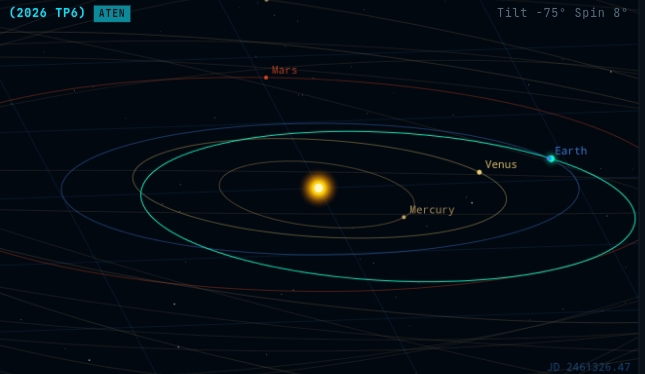
Orbital and close-approach dossier for a newly-characterized Aten-class near-Earth asteroid, built from the JPL Small-Body Database (SBDB) lookup tool — orbit solution JPL 2. This is a single-object dossier, not a live CNEOS CAD/Scout stream. Live Multi-watch CAD/Scout/Sentry tracker.
(2026 TP6) is a small Aten-class near-Earth asteroid, first observed 6–12 October 2026 and formally characterized two days ago from a 6-day arc. Its newly-fitted orbit shows an imminent close Earth approach on 15 October 2026, at approximately 0.57 lunar distances (218,413 km) — closer than the Moon itself — followed roughly 7½ hours later by a close pass of the Moon. Despite the tight geometry, 2026 TP6 is not a Potentially Hazardous Asteroid: at an estimated 9–21 m across, it falls far below the PHA size threshold regardless of its small Earth MOID.
Close-Approach History (2020–2056)
Full close-approach table from the JPL SBDB record for 2026 TP6, covering approaches to Earth, the Moon, Venus and Mars from the fitted orbit. The 15 October 2026 Earth & Moon pair is the only non-routine entry; all others are ordinary, well-separated passes.
| Date/Time (TDB) | ± Unc. | Body | Dist (au) | Dist (km) | Dist (LD) | v_rel (km/s) | Status |
|---|---|---|---|---|---|---|---|
| 2020-Jun-02 04:46 | 21:14 | Earth | 0.07898 | 11,815,240 | 30.74 | 11.97 | Routine |
| 2021-Jun-02 23:17 | 3d 06:57 | Earth | 0.14704 | 21,996,871 | 57.22 | 6.43 | Routine |
| 2025-Sep-27 22:10 | 17:57 | Earth | 0.19253 | 28,802,078 | 74.93 | 6.82 | Routine |
| 2026-Oct-15 00:01 | 00:04 | Earth | 0.00146 | 218,413 | 0.57 | 10.28 | Notable |
| 2026-Oct-15 07:29 | 00:05 | Moon | 0.00161 | 240,853 | — | 10.85 | Notable |
| 2026-Dec-21 00:58 | 12:18 | Venus | 0.07376 | 11,034,339 | — | 8.00 | Routine |
| 2027-Oct-09 18:11 | 02:26 | Earth | 0.15414 | 23,059,016 | 59.99 | 14.69 | Routine |
| 2038-Sep-11 22:48 | 8d 16:54 | Venus | 0.07082 | 10,594,521 | — | 8.00 | Routine |
| 2043-Jan-25 10:45 | 5d 01:06 | Mars | 0.08736 | 13,068,870 | — | 5.51 | Routine |
| 2056-May-31 08:58 | 1d 13:50 | Earth | 0.09663 | 14,455,642 | 37.61 | 12.41 | Routine |
1 au = 149,597,870.70 km. LD not shown for Moon/Venus/Mars target rows — lunar distance is conventionally an Earth-relative unit. Uncertainty windows widen for both older and farther-future entries, since every prediction here is propagated from the same single 6-day 2026 observation arc.
Orbital Dossier
(2026 TP6)
Heliocentric osculating elements from JPL SBDB, epoch JD 2461200.5 (2026-Jun-09.0 TDB), orbit solution JPL 2. Dynamical class: ATE (Aten) — near-Earth asteroid orbits with semi-major axis under 1 au, similar to 2062 Aten, that still cross Earth's orbit near aphelion.
Solution quality: condition code 6, normalized residual RMS 0.34291, fit to 30 observations across a 6-day arc (2026-10-06 to 2026-10-12), solved 2026-10-12 06:52:49 UTC. Planetary ephemeris DE441, small-body perturbation ephemeris SB441-N16. Source: JPL, producer Otto Matic.
JPL Small-Body Database record: ssd.jpl.nasa.gov/tools/sbdb_lookup.html#/?sstr=2026%20TP6
2026 TP6 is a newly characterized Aten-class near-Earth asteroid (semi-major axis 0.97737 au) with an Earth MOID of 0.0014922 au. This geometry is consistent with the close approach listed for 15 October 2026 at 0.57 lunar distances (218,413 km, 0.00146 au) and a relative velocity of 10.28 km/s. Absolute magnitude H = 27.288 ± 0.630 corresponds to an estimated diameter of roughly 9–21 m (nominal ~12 m using standard albedo bounds). This places the object well below the H ≤ 22 size criterion used for Potentially Hazardous Asteroid classification; the small MOID alone does not confer PHA status. The orbit solution (JPL 2) rests on 30 observations spanning a 6-day arc (6–12 October 2026) with condition code 6. That arc is sufficient to constrain the imminent Earth encounter to ±4 minutes, while earlier and later tabulated approaches (2020–2056) carry larger uncertainty windows because they are propagated from the same short arc. The table also records a Moon encounter 7.5 hours after the Earth pass at 0.00161 au. No entry in the close-approach table is listed as an impacting trajectory.