Astrophyzix Digital Observatory's
Evidence-First Asteroid Reporting

Astrophyzix.com is the publication of the Astrophyzix Digital Observatory, offering unpaywalled, evidence‑driven analysis and real‑time monitoring of PHAs and NEOs. Our tracking consoles and reporting systems use and provide access to official NASA CNEOS Scout, JPL CAD, NeoWs, JPL SBDB, Horizons and NOAA observational datasets, peer‑reviewed sources, and high‑precision numerical methods (IEEE‑754 Float64, RKN4). Designed for students, educators, researchers, and the public, every console is uniquely designed and engineered by the Astrophyzix Digital Observatory. Our research notes and papers can be found at Astrophyzix.Academia.Edu

Showing posts with label Cited. Show all posts

Saturday, 23 May 2026

Asteroid 2026KW Close Approach Report and Asteroid Profile — Latest Asteroid News & Monitoring by Astrophyzix Observatory

Scientific Close‑Approach & Orbital Report For Asteroid 2026KW — Live Orbital Tracking and Refinement Viewer Integrated With Official NASA API's

Asteroid 2026 KW — Post‑Discovery Orbital Analysis · JPL SBDB Solution JPL 3
✅ Data aligned with: JPL SBDB, CNEOS CAD, NASA Horizons 

The Orbital Refinement image below and the refined status data within the image is computed by Astrophyzix Digital Observatory using its proprietary Live Asteroid Monitoring and Computational Orbital Refinement System using raw NASA API data. 

asteroid 2026KW orbital refinement by Astrophyzix
Apollo NEO Condition Code 7 2‑Day Data Arc NO IMPACT RISKSee JPL Solution

Key Takeaways of Asteroid 2026 KW (JPL Solution JPL 3)

  • NASA JPL Solution: Solution JPL 3 · Epoch 2461000.5 (2025‑Nov‑21.0 TDB) · SPK‑ID 54630404
  • Orbit class: Apollo NEO — a = 1.4127 au, e = 0.4172, i = 27.65°, orbital period 613.3 days.
  • Earth MOID: 0.0076064 au (~1.14 million km) — close in astronomical terms, but no impact geometry.
  • Size estimate: H = 25.669 → approximate diameter ~20–45 m (albedo‑dependent).
  • Orbit quality: Condition code 7, based on only 28 observations over a 2‑day arc — a very early, still‑refining orbit.
  • Close approaches: • Historical: 1937‑05‑25 Earth at 0.00728 au • Upcoming: 2026‑05‑25 Earth/Moon at 0.00830 au All are non‑impacting.
  • Risk context: Not a PHA — H > 22 and MOID above hazard threshold.
  • Ignore clickbait — Astrophyzix can confirm that no agency lists 2026 KW as a threat.

Scientific Consensus Snapshot of 2026 KW

ParameterStatus
Orbit classApollo NEO (Earth‑crossing)
Epoch2461000.5 TDB (2025‑Nov‑21)
Semi‑major axis (a)1.4127066 au
Eccentricity (e)0.4171896
Inclination (i)27.6521°
Earth MOID0.0076064 au (~1.14 million km)
Jupiter MOID3.46706 au
Absolute magnitude (H)25.669
Condition code7 (high uncertainty; 2‑day arc)
Observations28 (2026‑05‑20 → 2026‑05‑22)
Hazard levelNon‑hazardous; no impact solutions

Saturday, 16 May 2026

Newly Discovered Asteroid 2026 JH2 Pre-approach Report and Asteroid Data Profile & Simulator - Latest Evidence-First PHA NEO Asteroid News By Astrophyzix Digital Observatory

NASA SBDB Horizons Data · Astrophyzix Scientific Close‑Approach Report 

Asteroid 2026 JH2 — Pre‑Close Approach Analysis · 16 May 2026 - (Image: Astrophyzix Orbital Viewer)  

📌 Cited by MSN News (May 2026) alongside NASA and ESA as a confirming source for 2026 JH2 safety assessment
✨ Referenced by: MSN News, Copilot News, AviationToday News, iAsk Student, Mojeek, Perplexity, Ecosia, AI insights, Crowdbyte News 

Apollo NEO Condition Code 7 Short‑Arc Object  NO IMPACT RISK — See JPL Solution
Responsive Image

Key Takeaways of Asteroid 2026 JH2

  • NASA JPL Solution: 2026-May-16 06:48:56 | SPK-ID 54629847 (see updated solution report) 
  • Closest pass: 18 May 2026 at 21:23 UTC — 0.24 LD (~91,500 km), well inside GEO but with No current risk of impact reported. 
  • Size estimate: H = 27.3 → ~9–20 m diameter (albedo‑dependent), below radar detectability.
  • Orbit class: Apollo NEO — highly eccentric (e = 0.582), period 3.76 years.
  • Uncertainty: Condition code 7 from a 5‑day arc; short‑warning discovery (8 days).
  • Risk context: Not a PHA; too small for hazard classification.
  • Ignore clickbait, sensational videos and news reports which claim that "there is a big rock about to hit us" — that's simply not true. Follow the evidence, not the entertainment. 

Scientific Consensus Snapshot of 2026 JH2

ParameterStatus
Closest approach2026‑05‑18 21:23 UTC at 0.000611 AU
Nominal miss distance0.238 LD / 91,500 km
Largest uncertaintyCondition code 7 (47 obs, 5‑day arc)
PHA statusNo (H > 22)
Hazard levelNon‑hazardous size; no impact geometry

Thursday, 14 May 2026

Asteroid Apophis 2029 Flyby Scientific Report - What NASA JPL Data Says In 2026 - Asteroid News Without the Hype - Updated 31/05/26

Asteroid (99942) Apophis — 2026 NASA-Verified Scientific Status News Report Update. 
NASA JPL SBDB Solution Date: 2024‑Jun‑25 10:48:08 | Epoch 2461000.5 (2025‑Nov‑21.0) 

Researched, Written and Published by: Astrophyzix Digital Observatory 

ℹ️ No Hype, No Speculation, No Sensationalism - Credible Asteroid News With Clarity - Strict Editorial Standards - Fully Verifiable Sources 

⭐ This report has been featured and cited as the primary source by MSN News and other global media outlets in 39 individual news articles. 

🆙 This report is updated when new agency data is released or updated. 

Responsive image
Reading Time: ~12 min Primary Data: NASA CNEOS / JPL SBDB / JPL Horizons

Classification: Near-Earth Object (Potentially Hazardous Asteroid) Evidence-First Report

📌 Cited by MSN News | Bing Copilot | iAsk Student | Google AI | Google Overview

Apophis 2029 Flyby Key Takeaways

  • No impact risk: NASA’s current orbital solutions for Apophis show zero impact probability for at least the next 100 years.[1]
  • The 2029 flyby: Using official NASA data, Astrophyzix can confirm that on Friday 13 April 2029, Apophis will pass at about 32,000 km above Earth’s surface (about 20,000 miles), closer than geostationary satellites but on a safe, non-impact trajectory.[1],[2]
  • Impact Risk removed: Astrophyzix can conform that high-precision radar observations in 2020–2021 allowed NASA to rule out all impact scenarios for 2029, 2036, and beyond within the 100‑year assessment window.[1],[3]
  • New Science opportunity: The upcoming 2029 encounter is now treated as a science scenario, not a hazard scenario. Astrophyzix Digital Observatory is looking forward to observing and studying this asteroid in 2029 during the flyby event.
  • A Benchmark object: Apophis is used as a reference case in planetary defence simulations, mission design studies, and public‑communication exercises.[4]

Monday, 9 February 2026

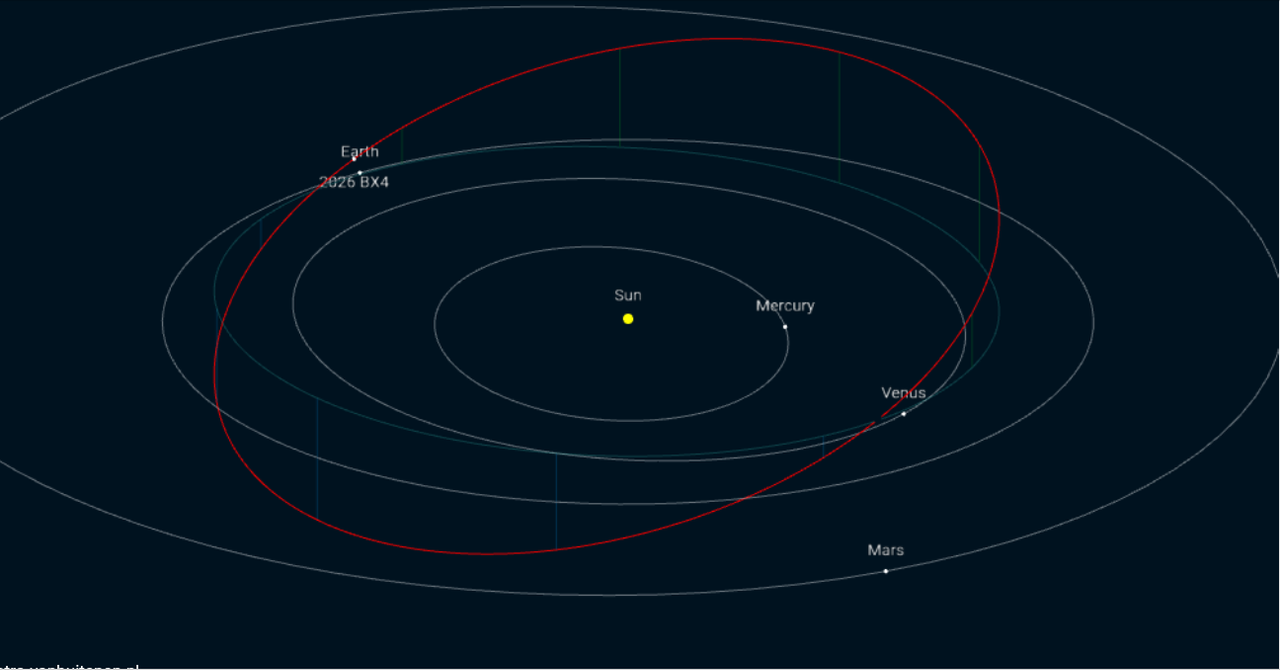
Newly Discovered Asteroid (2026 BX4) and Its February 2026 Close Approach to Earth

MONITORING ACTIVE
Astrophyzix Asteroid Close Approach Series
Information and Data Updated: 10 February 2026
Written by: Astrophyzix Science Communication
 
📌 Cited

Bx4


Newly Discovered Asteroid 2026 BX4

Asteroid 2026 BX4 is a near-Earth asteroid (NEA) identified in early 2026 whose orbital trajectory brings it into relatively close proximity with Earth on 16 February 2026. Near-Earth asteroids are remnants of the early Solar System whose paths have been altered over time by gravitational interactions with planets, particularly Jupiter and Earth. 

Will Asteroid BX4 Hit Earth? No, this asteroid poses no threat to Earth. 

Sunday, 1 February 2026

Debunked: "Greenland UFO" - Claims Are STILL Just Speculation, Not Evidence.

Written by: Astrophyzix Science
Article Type: Myth Busting, Fact Check, Explainer
Published: 01 February 2026 

📌 Cited

Ufo debunking


Debunked: Recent “Greenland UFO” Claims Are Still Just Speculation, Not Evidence

This article follows our earlier analysis of the ‘Greenland UFO’ claim, which examined the origin of the radar imagery and why it was misinterpreted. 

There’s been renewed chatter on social media and forums suggesting that a giant UFO or alien craft is buried beneath the ice of Greenland — claims that occasionally resurface alongside real scientific discoveries. 

Is there a UFO buried under the ice in Greenland? NO! 

Sunday, 25 January 2026

DEBUNKED: Buried UFO Under Greenland Ice and Donald Trump 2026: Spoiler Alert — Its Nonesense

Written by: Astrophyzix Science 
Article Type: Myth Correction, Explainer, Evidence Check
Published: 25 January 2026 

📌 Cited


Greenland ufo debunking


Nothing E.T. This Way Comes: Debunking the “Alien Spacecraft Under Greenland’s Ice” Rumour


Is there a UFO under Greenland?

No, there is no evidence of any alien spacecraft buried under Greenland’s ice. 

Radar imagery that sparked these claims is misinterpreted, and what exists is known Cold War-era installations like Camp Century. Scientific research and satellite data confirm these reports are natural ice formations and human-made structures, not extraterrestrial technology.

Saturday, 24 January 2026

The UFO and UAP Disclosure Movement In 2026 —The Lack of Evidence, Media Hype and Shifting Narratives Explored and Explained

Written by: Astrophyzix Science News
✅ Evidence-First Explainer Article 
Published: 24 January 2026 

📌 Cited by Grokipedia

Disclosure movement


What Is the Disclosure Movement?


Once confined to the fringes, UFO claims have re-entered the mainstream under the label Unidentified Anomalous Phenomena (UAPs). By 2026, a growing disclosure movement has emerged, blending genuine scientific uncertainty with speculative claims, media sensationalism, and persistent allegations of government secrecy. While some unanswered questions remain, many of the movement’s most dramatic assertions continue to lack verifiable evidence.

Discover exactly what Disclosure means in terms of government, law and science in our follow up article. 

Tuesday, 20 January 2026

Asteroid 2002 LX and Its 2026 Flyby: A Cosmic Near-Miss on 27 January 2026

MONITORING ACTIVE
Astrophyzix Asteroid Close Approach Series
Information and Data Updated: 9 February 2026

Asteroid 2002 LX Orbit chart

Written by: Astrophyzix Science News on 20/01/2026


Asteroid 2002 LX Overview

Asteroid 2002 LX is a near-Earth object belonging to the Apollo group of asteroids, meaning its orbit crosses Earth’s path around the Sun. It was discovered in 2002 and has been observed regularly since then, allowing astronomers to build a well-defined orbital model. Because its orbit brings it relatively close to Earth on occasion, it is classified as a Potentially Hazardous Asteroid, a technical designation based on proximity rather than any imminent danger.

Thursday, 15 January 2026

Asteroid 2340 Hathor Close Approach 17/01/26

MONITORING ACTIVE

Earth’s Slender Neighbor from the Sky

Astrophyzix Asteroid Close Approach Series
Information and Data Updated: 10 February 2026
Written by: Astrophyzix Science Communication 
7 Minute read 
Published: 15 January 2026

Asteroid Hathor Charts for 2026 close approach

Abstract

Floating through the inner Solar System with the grace of an orbital dancer, asteroid 2340 Hathor is a fascinating space rock that has captured astronomers’ attention since the mid-1970s. Named after an ancient goddess yet rooted in modern science, Hathor embodies the intersection of myth, celestial mechanics, and planetary defense.

While it poses no imminent danger, Hathor is notable for an upcoming close approach to Earth on 17 January 2026, an event that has placed it firmly back on astronomers’ observation schedules.

Wednesday, 14 January 2026

Asteroid 242708 (2005 UK1) 2026 Observational Study Notes

MONITORING ACTIVE

Close-Approach of Asteroid 2005 UK1 - Astrophyzix Asteroid Close Approach Series 

Written by: Astrophyzix Science Communication
Date published:: 14 January 2026
Date Modifed
: 11 February 2026

Orbital chart of asteroid 242708 (2005 UK1) showing its trajectory relative to Earth and the Sun, with close approach on 12 January 2026.
Figure 1. Orbit of 242708 (2005 UK1) relative to Earth and the Sun, showing its close approach on 12 January 2026.


Abstract

This article provides a detailed overview of asteroid 242708 (2005 UK1), an Apollo-class near-Earth object that made a safe close approach to Earth on 12 January 2026. The article summarizes its discovery, orbital characteristics, size estimates, and monitoring status, providing context for near-Earth object research and planetary defense efforts.

Independent Direct Source Verification
Uncompromised Crossref DOI Resolver · Live and direct meta data fetch
Awaiting DOI input