Live Independent Verifiable and reproducible Unpaywalled NASA-sourced

Astrophyzix Digital Observatory

Trusted for Asteroid News, Research, Data & Analysis

Delivering unpaywalled, evidence-driven analysis, public research tools, real-time datasets and monitoring and tracking of all PHA/NEO asteroids, comets and solar system objects.

Every tracking console is designed and engineered here. Systems directly ingest multiple NASA datasets covering over 1.57 million objects, then run live, verifiable probabilistic orbital analysis and deliver an instant deterministic summary of close approaches. Used by students, educators, researchers, and the public. Data provenance is traceable, verifiable and transparent. Original research papers are published on Astrophyzix.academia.edu, registered with official DOIs via Zenodo and academically indexed by OpenAIRE.

  • NASA API'S
  • ✅ CNEOS Scout
  • ✅ JPL CAD
  • ✅ NeoWs
  • ✅ SBDB
  • ✅ Horizons
  • ✅ Sentry
Showing posts with label NEO Classification. Show all posts

Near Earth Asteroid 2026 JH2 Pre-approach Report and Asteroid Data Profile & Simulator - Latest Evidence-First PHA NEO Asteroid News By Astrophyzix Observatory UPDATED 30 August 2026

NASA SBDB Horizons Data · Astrophyzix Scientific Close‑Approach Report 

Asteroid 2026 JH2 — Pre‑Close Approach Analysis · 16 May 2026 - (Image: Astrophyzix Orbital Viewer)  

📌 Cited by MSN News (May 2026) alongside NASA and ESA as a confirming source for 2026 JH2 safety assessment
✨ Referenced by: MSN News, Copilot News, AviationToday News, iAsk Student, Mojeek, Perplexity, Ecosia, AI insights, Crowdbyte News 

Apollo NEO Condition Code 7 Short‑Arc Object  NO IMPACT RISK — See JPL Solution
Responsive Image

Key Takeaways of Asteroid 2026 JH2

  • NASA JPL Solution: 2026-May-16 06:48:56 | SPK-ID 54629847 (see updated solution report) 
  • Closest pass: 18 May 2026 at 21:23 UTC — 0.24 LD (~91,500 km), well inside GEO but with No current risk of impact reported. 
  • Size estimate: H = 27.3 → ~9–20 m diameter (albedo‑dependent), below radar detectability.
  • Orbit class: Apollo NEO — highly eccentric (e = 0.582), period 3.76 years.
  • Uncertainty: Condition code 7 from a 5‑day arc; short‑warning discovery (8 days).
  • Risk context: Not a PHA; too small for hazard classification.
  • Ignore clickbait, sensational videos and news reports which claim that "there is a big rock about to hit us" — that's simply not true. Follow the evidence, not the entertainment. 

Scientific Consensus Snapshot of 2026 JH2

ParameterStatus
Closest approach2026‑05‑18 21:23 UTC at 0.000611 AU
Nominal miss distance0.238 LD / 91,500 km
Largest uncertaintyCondition code 7 (47 obs, 5‑day arc)
PHA statusNo (H > 22)
Hazard levelNon‑hazardous size; no impact geometry

Newly Discovered NEO Asteroid (2026 GD) Exclusive Close Approach Report and Object Profile Astrophyzix Digital Observatory NASA Data

Astrophyzix Near-Earth Object (NEO) Close Approach Report: (2026 GD) Newly Discovered Asteroid Will Pass Closer than the Moon. 

Written by: Astrophyzix Digital Observatory

📌 Cited by DiscoverWildScience 📌 Cited by MSN News 📌 Cited by Bing Copilot News
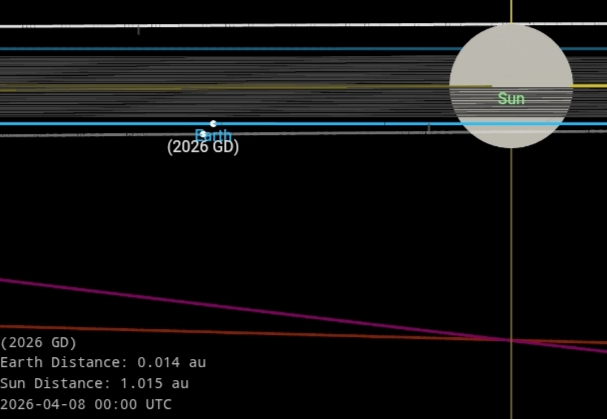
NEO close approach visualisation

Introduction

New updates found in our JPL Solution 2 Report


Asteroid (2026 GD) is a recently observed Apollo-class near-Earth object (NEO) identified in April 2026. With a short observational arc of just 1 day, its orbital solution remains preliminary and subject to refinement. Despite this, current data indicates an exceptionally close Earth approach occurring on 09 April 2026.


The object’s very low Earth Minimum Orbit Intersection Distance (MOID) and near-term encounter geometry place it within the category of close-approach monitoring priority objects, although no confirmed impact risk is currently established based on available solutions at this time. Astrophyzix will update you as new data comes in. 

Key Takeaways


  • Apollo-class near-Earth asteroid with Earth-crossing orbit.
  • Very close Earth approach on 2026-Apr-09 at ~0.00168 AU.
  • Equivalent to approximately 0.65 lunar distances (~251,000 km).
  • Estimated relative velocity: ~12.66 km/s.
  • Small object (~20–30 meters estimated diameter range).
  • Extremely low Earth MOID: 0.000525 AU.
  • Orbit uncertainty remains high (condition code 7).
  • No confirmed impact risk in current datasets at the time of this report. 


Scientific Consensus Snapshot


The orbital parameters for (2026 GD) are based on a limited observational dataset spanning approximately one day. As a result, uncertainties remain significant, reflected in its condition code of 7. (Explanation of Code 7 below) 


Additional observations are required to refine its trajectory and reduce positional uncertainty. Close-approach predictions at this stage should be treated as provisional.


EXCLUSIVE NEO REPORT: Newly Discovered NEO Asteroid 2026 FG6 and it's Current Close Approach March 2026

Exclusive Report: Asteroid 2026 FG6 (SPK-ID 54606975) Newly Discovered Near-Earth Object Which Was Discovered Just Two Days Before it's Close Approach


Published on: 27 March 2026

📌 Cited by iAsk Student

Descriptive Alt Text
Image Credit: NASA JPL SBD


Introduction (Latest update here) 


2026 FG6 (SPK-ID 54606975) is an Apollo-class Near-Earth Object (NEO) recently discovered on March 25, 2026 by automated surveys cataloged by JPL’s Solar System Dynamics team. This asteroid was identified following routine scanning of near-Earth space, and its extremely small Earth Minimum Orbit Intersection Distance (MOID) immediately marked it as noteworthy. Observations over just two days have provided preliminary orbital data, though with high uncertainty (Condition Code 7), emphasizing the need for continued tracking to refine its orbit and assess any potential hazard.


Despite its short observation arc, 2026 FG6’s Earth MOID of 0.00045 au (~67,000 km) makes it one of the closest-passing NEOs identified in recent weeks. Its absolute magnitude of H = 27.369 suggests a very small object, likely only a few meters in diameter, but its proximity highlights the importance of rapid follow-up for newly discovered NEOs. - It poses no impact risk.


ℹ️ Sources / Technical / Mathematical / Scientific / Academic / Integrators / Methods
Sources
  • NASA APIs
  • CNEOS Scout
  • JPL CAD
  • NeoWs
  • SBDB
  • Horizons
  • Sentry
Stack
  • IEEE-754 Float64
  • RKN4
  • Yoshida-4
  • Dormand–Prince / DOPRI5
  • DOPRI8 /DOP853
  • Verlet
  • N-Body
  • Einstein–Infeld–Hoffmann
  • DE441
  • ΛCDM
  • J2
  • Meeus
  • Yarkovsky
  • Schwarzschild GR
  • Simon 1994
  • Holsapple–Schmidt
  • Collins / Pierazzo / Ward–Asphaug
  • AIS-Wide
  • Abyssal 4 km
  • WebGPU
  • DOI Registered
  • Academia.edu
  • Zenodo
  • OpenAIRE
Independent Direct Source Verification
Uncompromised Crossref DOI Resolver · Live and direct meta data fetch
Awaiting DOI input