

2026 Close Approach to Earth of Asteroid 884793 (2017 VR12)
📌 Cited
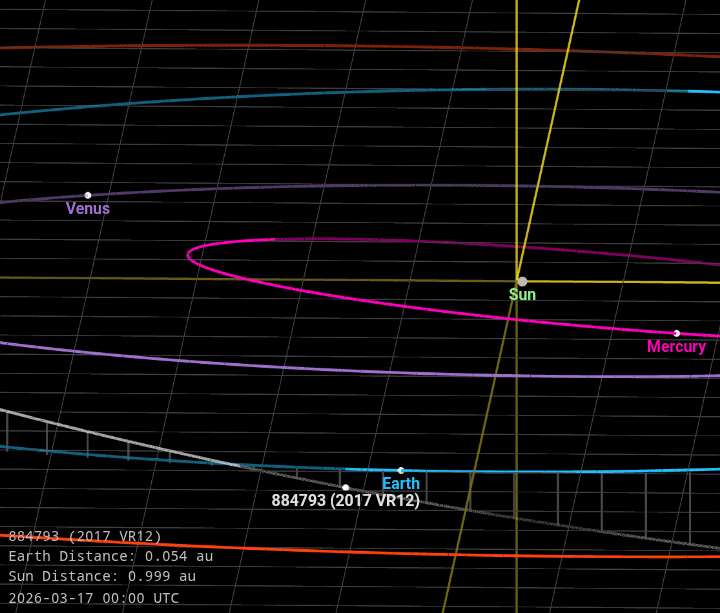
Close Approach 19 March 2026
Asteroid 884793 (2017 VR12) is scheduled for a significant close approach to Earth on 19 March 2026 at 17:39 TDB. This encounter is part of its routine orbit as an Apollo-class Near-Earth Object (NEO) and a Potentially Hazardous Asteroid (PHA), though it poses no immediate impact risk.
| Parameter | Value | Units |
|---|---|---|
| Close Approach Date (TDB) | 2026-03-19 17:39 | UTC / TDB |
| Nominal Distance from Earth | 0.05352 | AU (~8.0 million km) |
| Relative Velocity | 6.44 | km/s |
| Minimum Orbit Intersection Distance (MOID) | 0.00684174 | AU |
| Classification | Apollo, NEO, PHA | — |
This approach, while closer than many main-belt asteroids, remains well outside any impact risk threshold. Observatories worldwide are tracking 2017 VR12 to refine its orbital elements and monitor future encounters. Radar and optical observations will help confirm its precise trajectory, rotation state, and physical characteristics in preparation for its 2026 flyby.
For real-time updates and precise ephemerides, refer to the JPL Small-Body Database entry for 884793 (2017 VR12).
Asteroid Profile: 884793 (2017 VR12)
This profile presents institutional-grade information about asteroid 884793 (2017 VR12) as cataloged by the NASA JPL Small-Body Database. All data is sourced from official JPL measurements and publications.
Discovery & Identification
| Parameter | Value |
|---|---|
| Designation | 884793 (2017 VR12) |
| Discovery Date | 2017-11-10 |
| Discoverer | Pan-STARRS 1 |
| Discovery Site | Haleakala |
| Classification | Apollo, NEO, PHA |
| SPKID | 20884793 |
Osculating Orbital Elements (Epoch 2025-Nov-21.0)
| Element | Value | Units |
|---|---|---|
| Eccentricity (e) | 0.2693245682191976 | — |
| Semi-major Axis (a) | 1.369162794713618 | au |
| Perihelion (q) | 1.000413616205583 | au |
| Inclination (i) | 9.216568528587654 | deg |
| Longitude of Ascending Node (Ω) | 347.2413468941426 | deg |
| Argument of Perihelion (ω) | 180.818983224046 | deg |
| Mean Anomaly (M) | 291.4627815274728 | deg |
| Time of Perihelion (tp) | 2461111.9050902742 | TDB |
| Orbital Period | 585.17 | days |
| Earth MOID | 0.00684174 | au |
| Jupiter MOID | 3.23803 | au |
| Tisserand Parameter (Jupiter) | 4.776 | — |
Physical Parameters
| Parameter | Value | Units |
|---|---|---|
| Absolute Magnitude (H) | 20.58 | mag |
| Rotation Period | 1.37755 | h |
| Reference | LCDB (Rev. 2023-Oct) | — |
Close Approach Data (Selected)
| Date (TDB) | Body | Nominal Distance | Velocity (V-rel) |
|---|---|---|---|
| 2018-03-07 08:18 | Earth | 0.00966 au | 6.30 km/s |
| 2026-03-19 17:39 | Earth | 0.05352 au | 6.44 km/s |
| 2071-02-17 02:44 | Earth | 0.11691 au | 8.02 km/s |
Radar Astrometry
Radar measurements provide precision orbital refinement. Selected observations:
| Date (UTC) | Delay (µs) | Frequency (MHz) | Observer |
|---|---|---|---|
| 2018-03-07 07:15 | 0.500 | 2380 | P.A. Taylor |
| 2018-03-07 05:40 | 0.5 | 8560 | M. Brozovic |