
Live Independent Verifiable and reproducible Unpaywalled NASA-sourced

Astrophyzix Digital Observatory

Trusted for Asteroid News, Research, Data & Analysis

Delivering unpaywalled, evidence-driven analysis, public research tools, real-time datasets and monitoring and tracking of all PHA/NEO asteroids, comets and solar system objects.

Every tracking console is designed and engineered here. Systems directly ingest multiple NASA datasets covering over 1.57 million objects, then run live, verifiable probabilistic orbital analysis and deliver an instant deterministic summary of close approaches. Used by students, educators, researchers, and the public. Data provenance is traceable, verifiable and transparent. Original research papers are published on Astrophyzix.academia.edu, registered with official DOIs via Zenodo and academically indexed by OpenAIRE.

  • NASA API'S
  • ✅ CNEOS Scout
  • ✅ JPL CAD
  • ✅ NeoWs
  • ✅ SBDB
  • ✅ Horizons
  • ✅ Sentry
Showing posts with label planetary Defence. Show all posts

Astrophyzix Planetary Impact Engine: The Most Technically Advanced Academic Module Engineered into a Legacy CMS, Ever. Impossible Made Possible

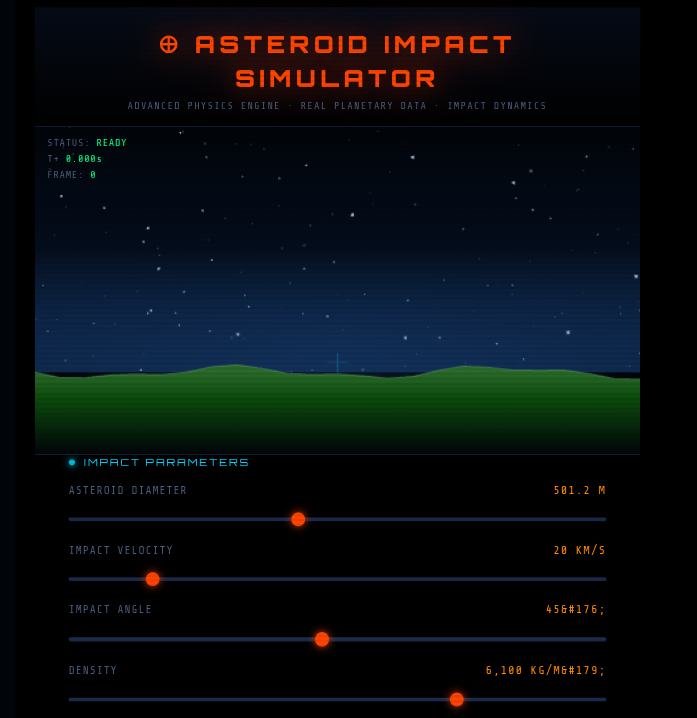
Introducing the Advanced Multi-Planetary Impact and Airburst Engine

📌 Cited by Cyber-Amber Tech News | 📌 Cited by Aviation Today News


Astrophyzix Impact Engine Screenshot


The Most Technically Advanced, Fully Functioning Academic Module Engineered into a Legacy CMS, Ever

Asteroid and comet impacts are among the most energetic natural processes in the Solar System. From the formation of planetary crusts to the extinction-level events that have reshaped life on Earth, impact physics sits at the intersection of planetary science, geophysics, and atmospheric dynamics. At Astrophyzix, we are introducing a new tool designed to bring this complex, multidisciplinary science into a coherent, interactive framework: the Advanced Multi-Planetary Impact and Airburst Engine.

This system is not a simplified toy model. It is a physics-driven simulation environment grounded in peer-reviewed literature, incorporating validated scaling laws, atmospheric entry models, and planetary datasets sourced from leading scientific institutions. Its purpose is to bridge the gap between abstract equations and intuitive understanding—allowing users to explore impact scenarios across multiple worlds with scientifically credible outputs.
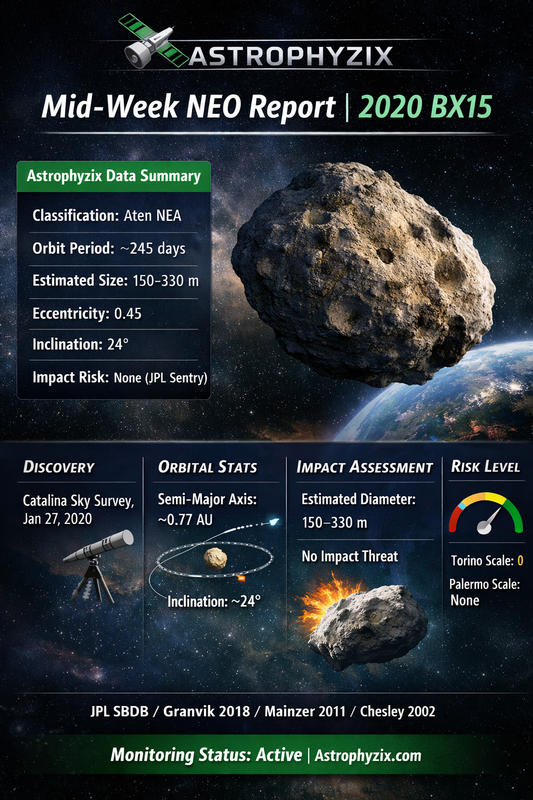
Asteroid 2020 BX15 Near-Earth Asteroid: Planetary Defence Profile

Digital Observatory Planetary Defence NEO Report — Asteroid 2020 BX15


MONITORING ACTIVE

Object: 2020 BX15 (Updated: 2 March 2026) 
Classification: Aten Near-Earth Asteroid (NEA)
Discovery Date: 27 January 2020 (Catalina Sky Survey)
Data Source: NASA JPL Small-Body Database (SBDB) & Minor Planet Center

2020 Bx15

Introduction 

This mid-week technical assessment summarises the orbital state, physical constraints, and planetary defense status of near-Earth asteroid 2020 BX15 using official NASA/JPL orbital solutions and peer-reviewed near-Earth asteroid research. 

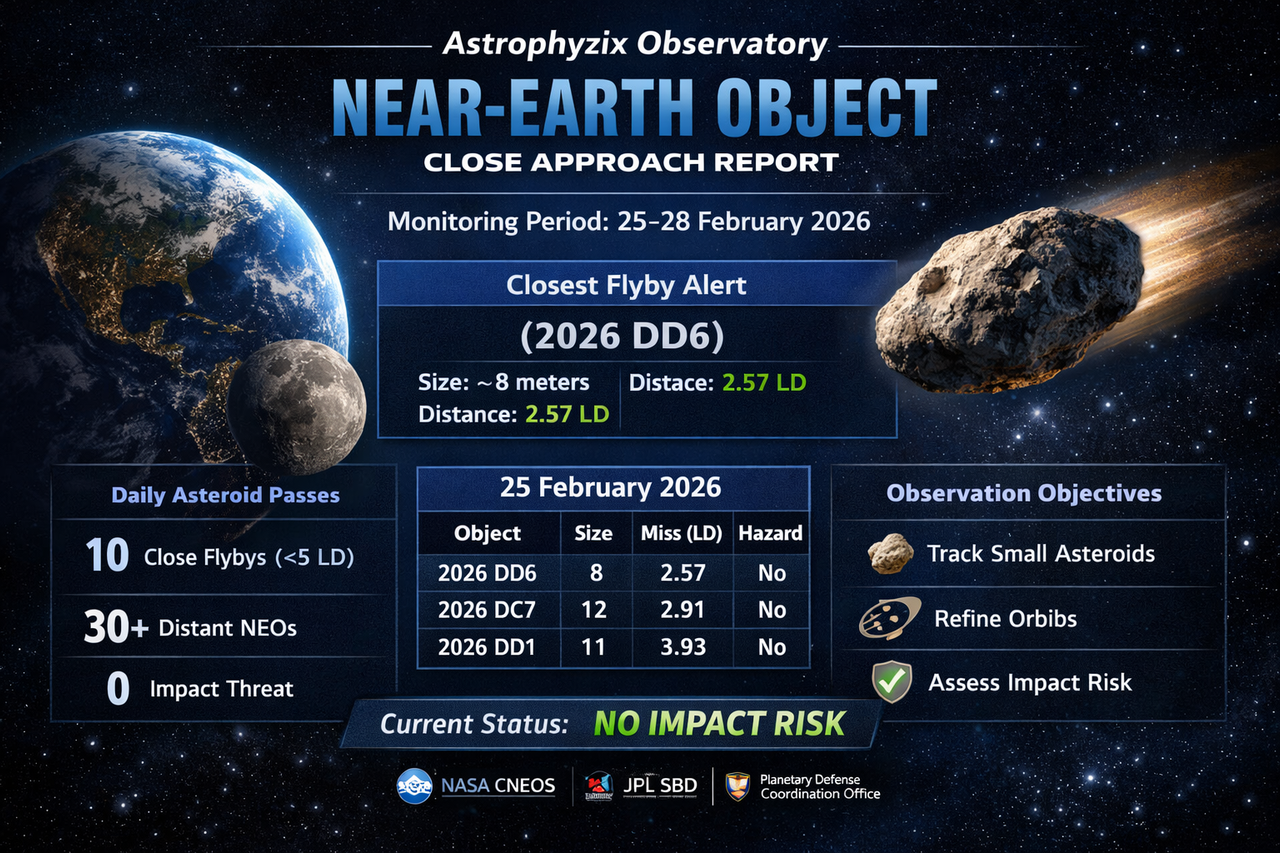
Midweek Asteroid NEO Close Approach Report: 25 February 2026

MONITORING ACTIVE

Astrophyzix Digital Observatory Planetary Defence: Near-Earth Object Close Approach Briefing

Monitoring Window: 25–28 February 2026
Written by: Astrophyzix Digital Observatory and Planetary Defence Centre
✅ Modified New Data: 27 February 2026
Closest Confirmed Flyby: 2026 DD6
Estimated size: ~8 m
Closest distance: 2.57 Lunar Distances (~0.99 million km)
Status: NO HAZARD

Observatory briefing

Routine orbital surveillance for the final week of February 2026 shows a sequence of small Near-Earth Objects safely transiting the Earth–Moon orbital region. Such passages occur continuously due to the large population of minor bodies whose solar orbits intersect Earth’s neighbourhood.

Planetary Defence: Exploring the Observed Science Behind Multiple-Body Near-Earth Systems

Written by: Astrophyzix Digital Observatory and Planetary Defence Research Centre. 
Article Type: Astronomy, Physics, CNEOS News, Explainer, Peer-reviewed Sources, Planetary Defence 

✅ Modified: 27 February 2026 (added tag) 

Binary neo


Confirmed Binary and Triple Near-Earth Asteroids

Introduction

Near-Earth asteroids (NEAs) are small rocky bodies whose orbits bring them close to Earth. Recent radar and optical observations have revealed that many of these objects exist not as solitary rocks but as binary or triple systems, where two or three bodies orbit one another. This article examines the confirmed cases of such systems, presenting only verified, peer-reviewed findings to provide an accurate, factual overview of their physical properties, orbital dynamics, and significance for planetary science.

ℹ️ Sources / Technical / Mathematical / Scientific / Academic / Integrators / Methods
Sources
  • NASA APIs
  • CNEOS Scout
  • JPL CAD
  • NeoWs
  • SBDB
  • Horizons
  • Sentry
Stack
  • IEEE-754 Float64
  • RKN4
  • Yoshida-4
  • Dormand–Prince / DOPRI5
  • DOPRI8 /DOP853
  • Verlet
  • N-Body
  • Einstein–Infeld–Hoffmann
  • DE441
  • ΛCDM
  • J2
  • Meeus
  • Yarkovsky
  • Schwarzschild GR
  • Simon 1994
  • Holsapple–Schmidt
  • Collins / Pierazzo / Ward–Asphaug
  • AIS-Wide
  • Abyssal 4 km
  • WebGPU
  • DOI Registered
  • Academia.edu
  • Zenodo
  • OpenAIRE
Independent Direct Source Verification
Uncompromised Crossref DOI Resolver · Live and direct meta data fetch
Awaiting DOI input