Astrophyzix Digital Observatory
Asteroid News, Research & Analysis

Astrophyzix.com is the publication of the Astrophyzix Digital Observatory, offering unpaywalled, evidence‑driven analysis and real‑time monitoring of PHAs and NEOs. Our tracking consoles and reporting systems use and provide access to official NASA CNEOS Scout, JPL CAD, NeoWs, JPL SBDB, Horizons and NOAA observational datasets, peer‑reviewed sources, and high‑precision numerical methods (IEEE‑754 Float64, RKN4). Designed for students, educators, researchers, and the public, every console is uniquely designed and engineered by the Astrophyzix Digital Observatory. Our research notes and papers can be found at Astrophyzix.Academia.Edu

Showing posts with label Myth Correction. Show all posts

Saturday, 9 May 2026

The Pentagon’s New UFO Archive: What the Evidence Actually Shows - Scientific Analysis Without Hype and Sensationalism

The Pentagon’s New UFO Archive: What the Evidence Actually Shows

What the evidence actually shows in the newly released U.S. UAP UFO archive


Introduction 

For decades, unidentified flying objects — now more commonly referred to as UAPs (Unidentified Anomalous Phenomena) — have occupied a strange space between national security, scientific curiosity, public fascination, and conspiracy culture. 


That conversation intensified again following the recent public release of historical UFO-related material through the U.S. government portal at war.gov/UFO.


Public Response 

The archive has already generated dramatic headlines across social media and online commentary, with some claiming the release “confirms aliens,” while others dismiss the material entirely. Neither extreme accurately reflects the available evidence.


A careful examination of the released material instead reveals something more nuanced:

 governments have spent decades investigating aerial observations they could not immediately identify, primarily because unidentified objects in restricted airspace represent potential intelligence and defence concerns. 


  • That reality is important — but it is certainly not equivalent to proof of extraterrestrial visitation.


This article examines the release from an evidence-first perspective, separating verified information from speculation while evaluating what the documents actually demonstrate.


What Was Released?

The newly public archive appears to compile historical records connected to UFO and UAP investigations conducted by various U.S. government agencies over several decades. 


Reports indicate that the collection includes material linked to:

  • the Department of Defense,
  • military aviation incidents,
  • intelligence assessments,
  • radar observations,
  • pilot testimony,
  • and previously scattered archival records.


Coverage of the release by major outlets such as the Washington Post suggests the archive is being presented as a transparency initiative rather than a declaration of extraordinary discoveries.


Historically, UFO investigations within the United States have included:

  • Project Sign,
  • Project Grudge,
  • Project Blue Book,
  • the Advanced Aerospace Threat Identification Program (AATIP),
  • and more recent Pentagon UAP review offices.

Saturday, 25 April 2026

The Buga Sphere Has NOT Been Confirmed to be 12,560 Years Old Using Carbon Dating - Here is What The Science Really Says

The “Buga Sphere” Dating Claim Examined: A Forensic Analysis of the Evidence

πŸ“Œ Cited by:  - Enigmaticideas.com
Buga Sphere analysis image

Written by: Astrophyzix Digital Observatory


Key Takeaways

  • There is no verifiable scientific evidence that the “Buga Sphere” is 12,560 years old
  • The reported radiocarbon dating applies to organic residue, not the object itself
  • No institutional confirmation from the University of Georgia can be verified
  • No peer-reviewed studies, laboratory reports, or reproducible analyses exist
  • All claims of advanced technology remain unsupported by material evidence

Introduction

In early 2026, renewed attention was directed toward an object commonly referred to online as the “Buga Sphere.” Claims circulated suggesting that the object had been scientifically dated to approximately 12,560 years before present, with references made to testing allegedly conducted by the University of Georgia using Accelerator Mass Spectrometry (AMS).


These claims have been widely shared across non-scientific platforms, often accompanied by interpretations involving advanced technology, lost civilisations, or anomalous origins. This article examines those assertions using established scientific methodology, with particular focus on dating techniques, evidential standards, and verification requirements.

Tuesday, 10 March 2026

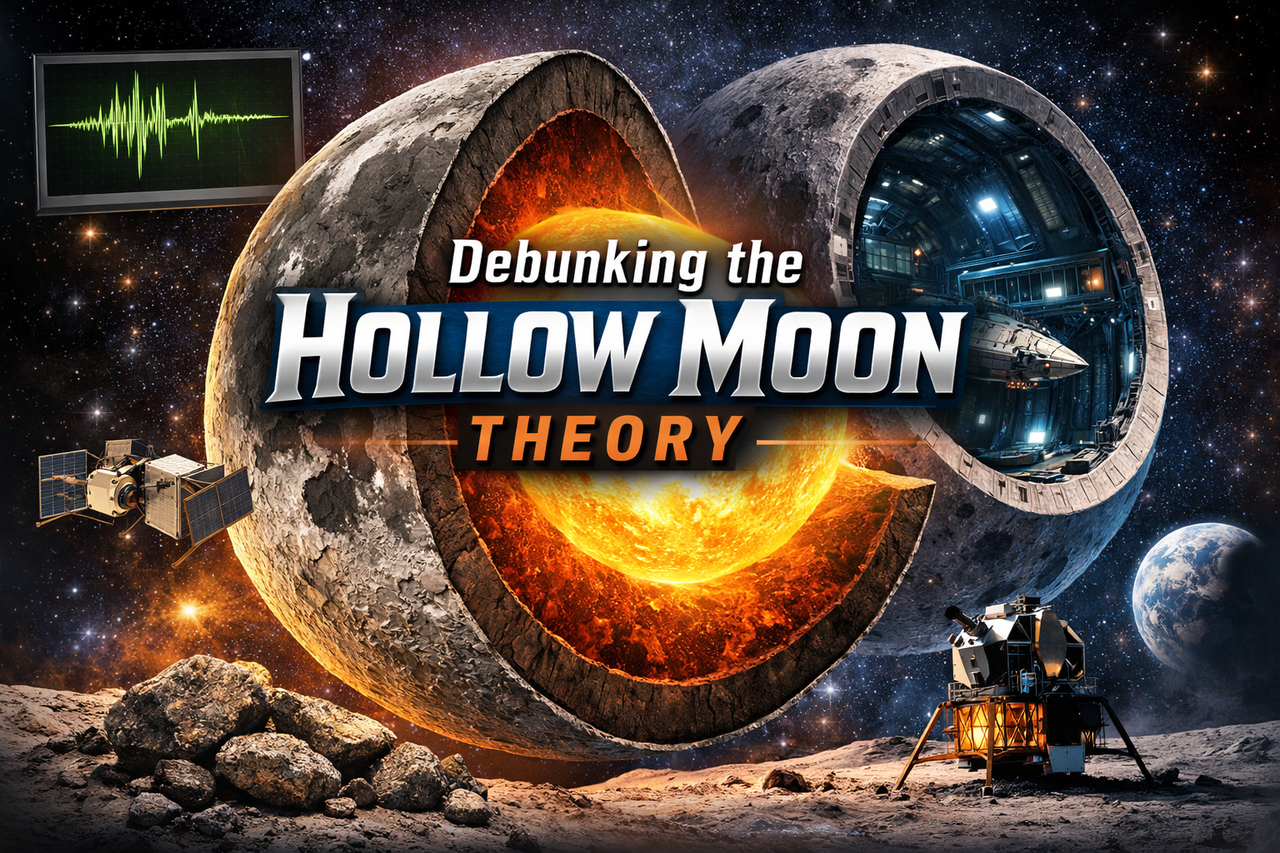
The “Hollow Moon” Hypothesis: A Scientific Examination and Explainer of a Persistent Lunar Myth

Key Takeaways (🚨 Spoiler Alert)
πŸ“Œ Cited
 

  • The Moon is not hollow. Seismic data from Apollo missions show waves travelling through solid internal layers.
  • Modern analyses reveal the Moon has a crust, mantle, and metallic core similar to other rocky planetary bodies.
  • Gravity measurements from spacecraft such as GRAIL detect dense internal structures inconsistent with a hollow interior.
  • Lunar rock samples confirm the Moon formed naturally through planetary processes following a giant impact with Earth.
  • All current geophysical, gravitational, and geochemical evidence strongly supports a solid differentiated lunar interior.
⏱ Estimated Reading Time: 15 minutes
✔ Evidence-Based Myth Correction Article
πŸ”· Written By: Astrophyzix Science Communication
πŸ“š Peer-Reviewed DOI Sources

The “Hollow Moon” Hypothesis: A Scientific Examination of a Persistent Lunar Myth

The idea that Earth’s Moon might be hollow has circulated for decades within fringe literature, conspiracy forums, and pseudoscientific media. Variations of the claim suggest the Moon is either an artificial structure, a massive alien spacecraft, or a naturally hollow celestial body containing large internal cavities. While such ideas can appear intriguing in speculative storytelling, they do not withstand examination using modern planetary science methods.

Saturday, 7 March 2026

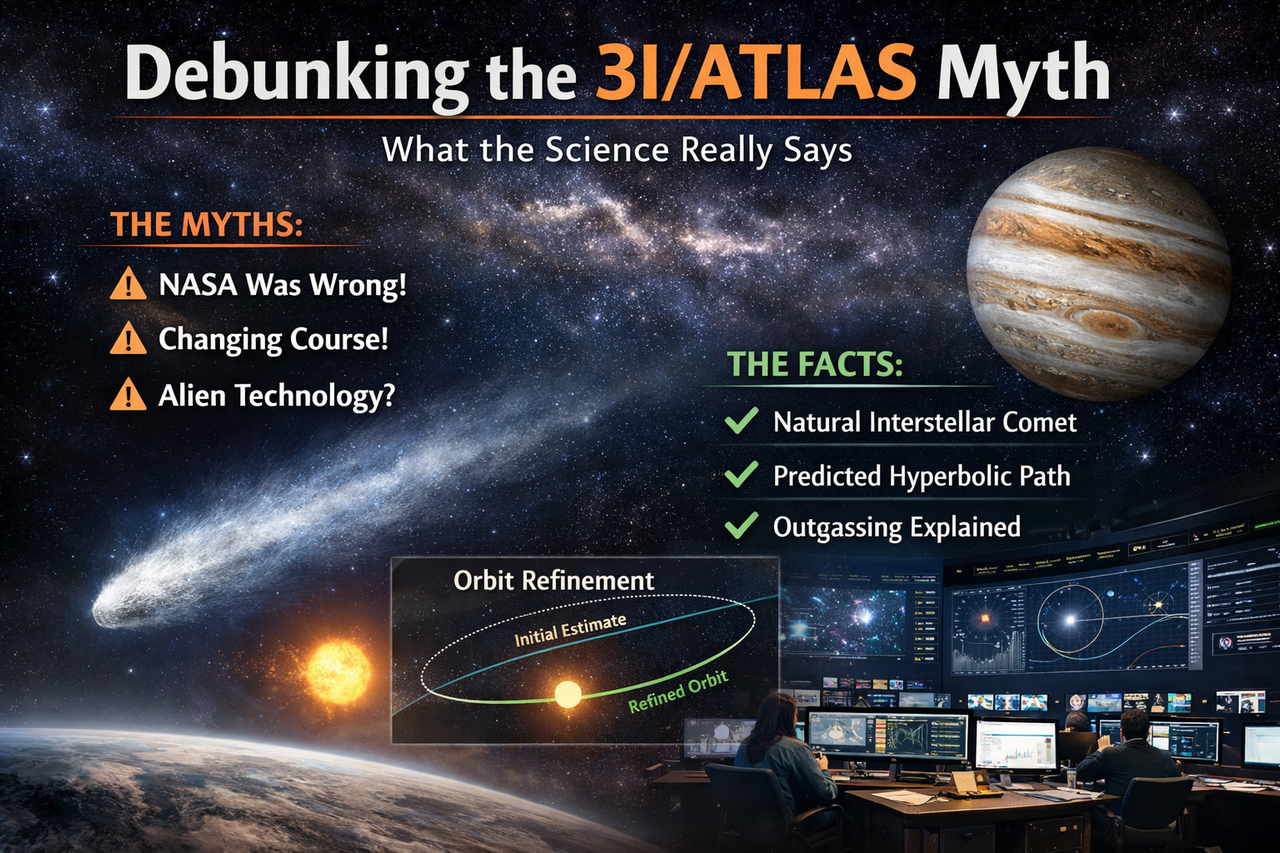
Debunking the 3I/ATLAS 'NASA was Wrong' Myth: What the Peer Reviewed Science Really Says

Written by: Astrophyzix Digital Observatory
Article type: Myth Correction, Peer Reviewed sources, Fact-Check, Evidence-First

πŸ“Œ Cited

 
3I/ATLAS


Debunking the 3I/ATLAS 'NASA was Wrong' Myth: What the Science Really Says and how Obital Refinement Works. 

In late 2025, the interstellar visitor 3I/ATLAS captured worldwide attention—not just from astronomers, but from social media, sensational headlines, and speculation about its origin and behaviour. Some videos and posts claimed that NASA was “wrong” about the object’s trajectory, implying dramatic course changes, artificial propulsion, or even extraterrestrial technology. This article corrects those myths with clear, evidence‑based science from credible observational campaigns and peer‑reviewed research.

Friday, 6 March 2026

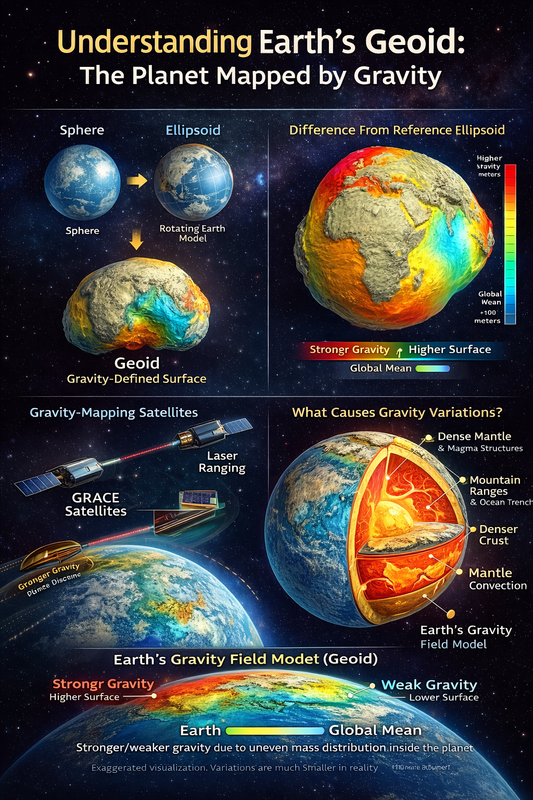
Earth’s True Shape: Understanding the Geoid and the Planet’s Gravity Field

Written by: Astrophyzix Digital Observatory for Space Science and Planetary Defence Research
Article Type: Gravitational modelling, Explainer, Deep-Dive, Evidence-First Science

Earth’s True Shape: Understanding the Geoid and the Planet’s Gravity Field


Geoid
Image property of Astrophyzix Digital Observatory 

What is the Geoid? 

Images of a distorted, lumpy Earth (as above) occasionally circulate across social media with captions claiming that the image shows the planet “as it really looks.” In reality, these images are scientific visualisations of Earth’s geoid—a model that represents the structure of the planet’s gravity field rather than its physical surface. While the visualisation appears dramatic, the actual deviations from Earth’s average radius are extremely small when viewed on planetary scales.

Saturday, 21 February 2026

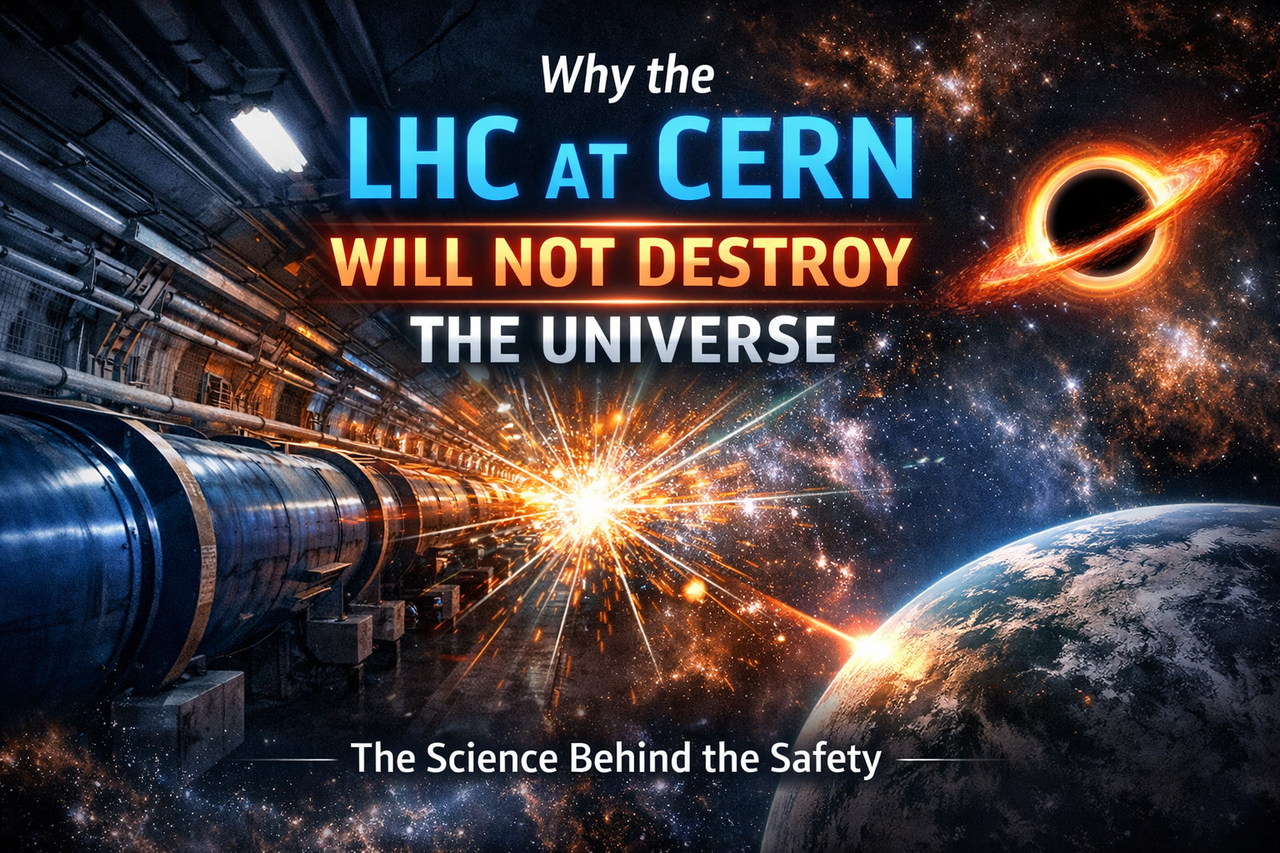
Why the Large Hadron Collider (LHC) at CERN Will Not Destroy the Universe — Explained with Clarity

Written by: Astrophyzix Science Communication 
Article type: Explainer, Evidence-first, Myth Correction, Particle Physics

πŸ“Œ Cited

LHC-clarify

Purpose

Following our previous article about the Large Hadron Collider (LHC) on Astrophyzix, we received several emails from readers asking whether the LHC could pose any threat to the universe. This follow-up article is intended to address those concerns directly and hopefully put your worries at ease, clarifying the science and evidence behind why the LHC poses no credible risk based on current observations and scientific understanding. Click the article title to read the full document. 

Thursday, 12 February 2026

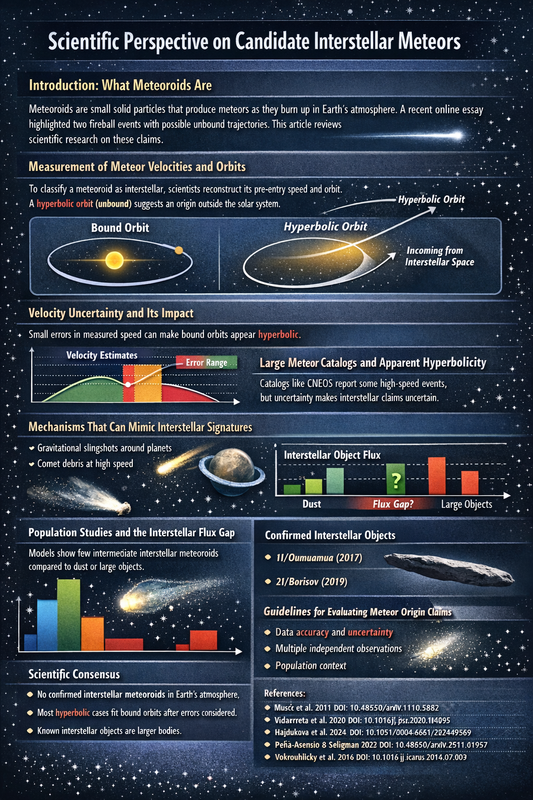
Scientific Perspective on Candidate Interstellar Meteors — A Peer-Reviewed Sourced, Evidence-based Deep-Dive

Written by: Astrophyzix Science Communication
Article Type: Evidence Check, Explainer, Peer-reviewed Cross-referencing 

 
πŸ“Œ Cited
Meteorite


Introduction: What Meteoroids Are

Meteoroids are small solid particles, ranging from sub-millimeter sizes up to meter-scale bodies, that intersect Earth's orbit and produce visible meteors when they ablate in the atmosphere. Determining whether such particles originate inside the Solar System or from interstellar space requires reconstructing their pre-atmospheric orbit. 

A recent online essay by Professor Avi Loeb of Harvard University on his Medium Blog highlighted two fireball events with inferred trajectories that could be interpreted as unbound relative to the Sun’s gravity, sparking public interest. 

Wednesday, 11 February 2026

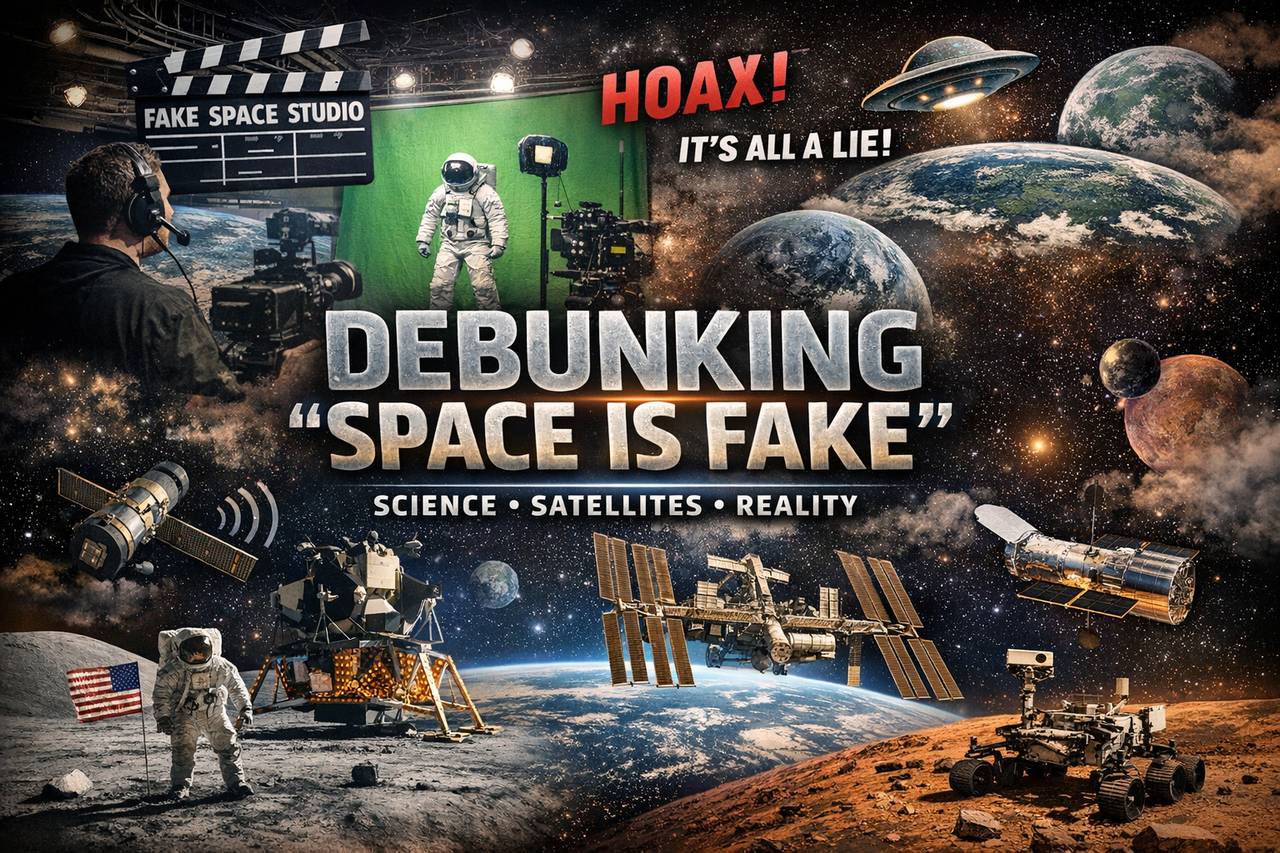
Debunking “Space is Fake”: Science, Satellites, and Conspiracies Explained

Written by: Astrophyzix Science Communication
Article Type: Evidence-Based Myth Correction, Explainer

 
Debunking space is fake


Introduction: Space is what?!?

In recent years, a growing number of online videos, posts, and social media threads have claimed that "space is fake." Proponents of these ideas argue that NASA, ESA, and other space agencies are fabricating images, videos, and scientific data, and that astronauts, satellites, and planetary missions are elaborate hoaxes. While sensational, these claims are not supported by scientific evidence. 

This article examines the psychological, technological, and observational evidence that demonstrates why space exploration is real, and why the so-called "space is fake" narratives fail scientifically.

Independent Direct Source Verification
Uncompromised Crossref DOI Resolver · Live and direct meta data fetch
Awaiting DOI input