Live Independent Verifiable and reproducible Unpaywalled NASA-sourced

Astrophyzix Digital Observatory

Trusted for Asteroid News, Research, Data & Analysis

Delivering unpaywalled, evidence-driven analysis, public research tools, real-time datasets and monitoring and tracking of all PHA/NEO asteroids, comets and solar system objects.

Every tracking console is designed and engineered here. Systems directly ingest multiple NASA datasets covering over 1.57 million objects, then run live, verifiable probabilistic orbital analysis and deliver an instant deterministic summary of close approaches. Used by students, educators, researchers, and the public. Data provenance is traceable, verifiable and transparent. Original research papers are published on Astrophyzix.academia.edu, registered with official DOIs via Zenodo and academically indexed by OpenAIRE.

  • NASA API'S
  • ✅ CNEOS Scout
  • ✅ JPL CAD
  • ✅ NeoWs
  • ✅ SBDB
  • ✅ Horizons
  • ✅ Sentry
Showing posts with label PHA Classification. Show all posts

NASA Scout Unconfirmed Object PHA Asteroid/Comet SWAN26Q Close Approach Report and Data Analysis - Preliminary Object Alert - Official Data

SWAN26Q (NEOCP) — Astrophyzix Preliminary Scout Object Alert

SWAN26Q NASA Scout / NEOCP Data · Astrophyzix Preliminary Object Alert

SWAN26Q (NEOCP) — Unconfirmed High-Eccentricity Object · Scout preliminary triage
⚠ Unconfirmed object: Scout NEOCP preliminary orbit, last run 2026-09-16 18:24 UTC · not yet in JPL SBDB/CAD or Sentry
📌 Cited by: Google AI | Copilot Answers | Hacker News | Bing AI | NewsNook
Scout NEOCP 9 Observations / 743-day arc ARI 60 / 100 PHA-CLASS (Scout score) — not Sentry-confirmed

Key Takeaways of SWAN26Q

  • Status: SWAN26Q is an unconfirmed Near-Earth Object Confirmation Page (NEOCP) candidate, triaged by NASA's Scout system rather than carrying a confirmed JPL orbit. It has not yet been evaluated by Sentry.
  • Most recent data point: last Scout run 2026-09-16 18:24 UTC, based on 9 observations spanning a 743-day arc — sparse but long-baseline tracking.
  • Current geometry: nominal distance 15.567 LD (≈ 5,983,915 km, 0.04 au) at 56.70 km/s — both figures come from a short, unevenly sampled arc and should be read as preliminary.
  • Size estimate: H = 11.7 gives a diameter of roughly 12–27 km (nominal ≈ 16 km, albedo-dependent) — far larger than the small metre-scale NEOs in Astrophyzix's usual daily reports.
  • PHA classification: Scout's automated scoring flags it PHA-class (phaScore 100), driven by its size and a modeled MOID of 0.04 au. This is a preliminary triage flag, not a Sentry-confirmed hazard designation.
  • Unusual orbit: sampled orbits show an eccentricity of 0.997–1.000 (essentially parabolic) and an inclination near 109° (retrograde). That combination — plus a name prefix historically associated with SOHO/SWAN comet discoveries — is far more typical of a long-period or first-time-inbound comet than a rocky asteroid.
  • No impact signal: of 300 Monte Carlo orbits sampled from the current fit, 0.0% show an Earth-impact flag. This is reassuring but is explicitly not a formal impact probability, and will keep being refined as more astrometry arrives.
  • Why the data is thin: at a solar elongation of only 14°, SWAN26Q currently sits deep in the Sun's glare — a difficult, often impossible, position to observe from the ground, which explains the sparse observation count and the 11-day-old last Scout run.

Sampled Orbit Cloud

Because the observation arc is short, Scout does not report one fixed orbit — it fits many plausible orbits (here, 300 samples) consistent with the 9 observations and shows the spread. The two parameters that vary meaningfully are inclination and eccentricity:

Inclination (min / median / max): 109.00° / 109.01° / 109.03°
109.00°109.03°
Eccentricity (min / median / max): 0.997 / 0.998 / 1.000
0.9971.000

The tight inclination cluster (all samples within 0.03° of each other) shows this dimension is already well pinned down. Eccentricity is less certain, but every sample sits at or just below the parabolic boundary (e = 1) — the orbit is essentially unbound or only very marginally bound to the Sun. No semi-major axis, perihelion or orbital period is quoted here because at e ≈ 1 those quantities are undefined or extremely sensitive to small changes in the fit; a standard Apollo/Aten/Amor classification does not apply to an orbit this eccentric.

300 sampled orbits fit to the current observation arc. 0.0% of samples are flagged as potential Earth impactors (impFlag) — expected to fall toward, and stay at, zero as more observations arrive. This is Scout's internal screening metric, not a calculated impact probability.

Approach Scale

Earth 5 LD 10 LD 15 LD 20 LD SWAN26Q · 15.57 LD

Note the scale change from Astrophyzix's usual close-approach reports (typically 0–2 LD): SWAN26Q's current nominal distance is much farther out, more than seven times the Moon's distance.

Scientific Consensus Snapshot of SWAN26Q

ParameterStatus
Source / confirmationScout (NEOCP) — unconfirmed, not yet in JPL SBDB/CAD
Nominal distance15.567 LD (≈ 5,983,915 km, 0.04 au)
Relative velocity56.70 km/s (v∞ 56.70 km/s) — unusually fast for a near-Earth asteroid
Modeled Earth MOID0.04 au (Scout preliminary estimate)
Eccentricity (sampled)0.997 – 1.000 (near-parabolic)
Inclination (sampled)109.00° – 109.03° (retrograde)
Absolute magnitude (H)11.7
Estimated diameter≈ 12–27 km (nominal ≈ 16 km), H-derived
Observations / arc9 observations across 743.04 days
Positional uncertainty0.41 arcmin (current fit) · 0.43 arcmin (1-day propagation)
Scout scoresNEO 100 · PHA 100 · Geocentric 0 · Tisserand 100 (Scout's internal 0–100 indicators, not raw orbital elements)
Sentry statusNot listed (awaiting a confirmed orbit)
Hazard levelScout PHA-class flag; 0.0% of 300 sampled orbits show an impact flag

All values above are taken directly from the Scout NEOCP record. Astrophyzix has not added any derived orbital elements here, since e ≈ 1 makes a standard a/q/Q solution unreliable at this stage.

SWAN26Q Close-Approach Overview

Date/Time (UTC)BodyNominal distanceMOIDVrel (km/s)
2026-09-16 18:24 (last Scout run)Earth0.04 au
15.567 LD
0.04 au56.70

Scout reports a single distance value here rather than a min–max range in AU — the real uncertainty on this object lives in its orbital elements (see Sampled Orbit Cloud above), not in a distance spread.

1. Object SWAN26Q

An unconfirmed, likely long-period object with a near-parabolic, retrograde orbit and a large (double-digit kilometre) size estimate. Currently far from Earth by close-approach standards (15.6 LD) with no impact signal in its sampled orbit family, but flagged PHA-class by Scout pending a firmer orbit.

Why this orbit doesn't fit the usual Apollo/Aten/Amor picture

Every other object in Astrophyzix's recent reports has had a well-defined semi-major axis and a clean NEO classification. SWAN26Q's sampled orbits sit at e ≈ 0.998, right at the edge between a very long-period ellipse and an unbound (hyperbolic) trajectory. Combined with an inclination of 109° — retrograde, meaning it orbits the Sun opposite to the planets — this is a signature far more common among long-period comets than main-belt-sourced asteroids. The SWAN prefix in the designation is also historically associated with comet discoveries made using the SOHO spacecraft's SWAN (Solar Wind ANisotropies) instrument, which supports that reading, though this report treats it as unconfirmed rather than asserting a cometary nature outright.

Interpretation of the Current Data

A 743-day observation arc sounds long, but with only 9 total observations it is a sparse, not a dense, arc — likely a handful of detections around each of a few brief observing windows, consistent with an object that spends much of its time too close to the Sun in our sky to track (its current solar elongation is just 14°).

The 0.0% impact-flag rate across 300 sampled orbits is a meaningful, positive signal at this stage: even accounting for the full spread of plausible orbits Scout has fit, none currently point toward an Earth impact. That figure is expected to firm up (and stay at or near zero) as new observations arrive once the object clears the Sun's glare.

Astrophyzix Assessment:

SWAN26Q is a preliminary, unconfirmed Scout NEOCP object that warrants continued monitoring rather than concern. Its PHA-class flag reflects an automated, conservative screening threshold applied to any large object with a small modeled MOID and a short arc — not a confirmed hazard. Follow-up astrometry, likely once solar elongation improves, will determine whether it graduates to a confirmed JPL orbit or is later reclassified.

Astrophyzix Risk Index (ARI)

60 / 100 for SWAN26Q — the highest of any object in Astrophyzix's recent tracked set, driven by its large size estimate and PHA-class flag rather than by proximity (it is currently over 15 lunar distances away).

ARI is an Astrophyzix composite index used to rank objects at a glance. It is not an official NASA, ESA or IAU hazard rating, and for an unconfirmed Scout object like this one it should be read as provisional. The authoritative sources are Sentry (confirmed impact monitoring) and Scout (preliminary NEOCP triage, used here).

Astrophyzix Digital Observatory Interpretation and FAQ

1. Why does this report look different from Astrophyzix's other asteroid reports?

Other recent reports (2026 SY2, 2026 SC, 2026 SA8) covered confirmed objects with full JPL orbital solutions. SWAN26Q is still on the Minor Planet Center's Near-Earth Object Confirmation Page (NEOCP) — an unconfirmed candidate being triaged by NASA's Scout system, with a much sparser, less certain data set.

2. What does "PHA-class" mean here if it isn't Sentry-confirmed?

Scout assigns a phaScore (here, 100 out of 100) based on the object's estimated size and modeled MOID, using the same size/distance criteria as the official PHA definition. It's a fast, automated early-warning flag designed to prioritize follow-up observations — not the same as a Sentry impact-risk listing, which requires a confirmed multi-observation orbit.

3. Why is the eccentricity so close to 1?

An eccentricity of 1 marks the boundary between a bound, elliptical orbit and an unbound, parabolic or hyperbolic trajectory. Sampled values of 0.997–1.000 mean the current data can't yet rule out either possibility — consistent with an object making a single, long-period passage through the inner solar system rather than a repeating short-period orbit.

4. Why is the inclination around 109°?

Inclinations above 90° indicate a retrograde orbit — the object circles the Sun in the opposite direction to the planets. This is unusual for asteroids but common among long-period comets, which can arrive from any direction and inclination.

5. Is SWAN26Q dangerous?

Based on current data, no impact trajectory is indicated: it is presently over 15 lunar distances away, and none of the 300 orbits Scout has sampled from the observation arc show an Earth-impact flag. The PHA-class label reflects its size and preliminary MOID, not a confirmed threat.

6. What happens next?

As SWAN26Q's solar elongation improves, new observations should extend the arc, tighten the eccentricity and inclination estimates, and may allow it to graduate to a confirmed JPL orbit — or be reclassified if further data changes the picture. Astrophyzix will update this profile once a confirmed CAD/SBDB solution or a Sentry entry becomes available.

Track live: Astrophyzix Live Orbital Viewer


Risk Assessment

No impact signal in current data.

  • 0.0% of 300 Monte Carlo orbit samples from the current fit are flagged as potential Earth impactors.
  • Current nominal distance is 15.567 LD — far outside any close-approach concern today.

PHA-class flag, but not Sentry-confirmed.

  • Scout's phaScore of 100 reflects its automated screening criteria (large size, small modeled MOID), applied conservatively to a short-arc object.
  • SWAN26Q is not yet listed by JPL Sentry, which requires a confirmed orbit.

Significant orbital uncertainty.

  • Only 9 observations across a sparse 743-day arc; eccentricity (0.997–1.000) and inclination (109.00–109.03°) are the only elements meaningfully constrained.
  • No semi-major axis, perihelion, aphelion or period is reported, since these are unreliable at e ≈ 1.

Size regime, if confirmed.

  • At an estimated 12–27 km, this is a far larger object than the metre-scale NEOs in Astrophyzix's typical daily reports — in the general size range associated with major, globally significant impacts in Earth's geological past.
  • This context is included for scale only: current data shows no impact geometry, and the object is unconfirmed and far from Earth.

Observational context.

  • A solar elongation of 14° currently places SWAN26Q in a difficult observing position near the Sun, limiting new astrometry until its position improves.

Astrophyzix Digital Observatory Scientific Summary

SWAN26Q (NEOCP) is an unconfirmed Scout candidate object, last updated 16 September 2026, based on 9 observations spread across a 743-day arc. Its currently modeled geometry places it 15.567 LD (0.04 au) from Earth, moving at 56.70 km/s — a speed markedly higher than typical near-Earth asteroids, and more characteristic of a long-period or first-time-inbound comet.

Sampled orbits show an eccentricity of 0.997–1.000 (essentially parabolic) and an inclination of about 109° (retrograde), a combination that does not fit the standard Apollo/Aten/Amor classification used elsewhere in Astrophyzix's reporting. With H = 11.7, its estimated diameter is roughly 12–27 km (nominal ≈ 16 km) — substantially larger than the small NEOs typically covered here.

Scout's automated scoring flags SWAN26Q as PHA-class (phaScore 100), reflecting its size and modeled MOID under short-arc conditions; it has not yet been confirmed by JPL or listed by Sentry. Of 300 orbits sampled from the current fit, 0.0% show an Earth-impact flag. From a planetary-defence standpoint, SWAN26Q is a preliminary, closely-watched object requiring follow-up rather than a confirmed hazard — its status should be expected to firm up considerably once its solar elongation improves and new observations become possible.

Sources

Astrophyzix Digital Observatory · Preliminary report for SWAN26Q (NEOCP), generated from the observatory's Scout sync (last run 2026-09-16 18:24 UTC). This is an unconfirmed object; all orbital and physical parameters are provisional and subject to significant revision as new observations arrive. Times are UTC unless stated.

Asteroid Apophis 2029 Flyby Scientific Report - What NASA JPL Data Says In 2026 - Asteroid News Without the Hype - Updated 31/05/26

Asteroid (99942) Apophis — 2026 NASA-Verified Scientific Status News Report Update. 
NASA JPL SBDB Solution Date: 2024‑Jun‑25 10:48:08 | Epoch 2461000.5 (2025‑Nov‑21.0) 

Researched, Written and Published by: Astrophyzix Digital Observatory 

ℹ️ No Hype, No Speculation, No Sensationalism - Credible Asteroid News With Clarity - Strict Editorial Standards - Fully Verifiable Sources 

⭐ This report has been featured and cited as a primary source by MSN News and other global media outlets in 39 individual news articles. 

🆙 This report is updated when new agency data is released or updated. 

Responsive image
Reading Time: ~12 min Primary Data: NASA CNEOS / JPL SBDB / JPL Horizons

Classification: Near-Earth Object (Potentially Hazardous Asteroid) Evidence-First Report

📌 Cited by MSN News | Bing Copilot | iAsk Student | Google Gemimi | Google Overview

Apophis 2029 Flyby Key Takeaways

  • No impact risk: NASA’s current orbital solutions for Apophis show zero impact probability for at least the next 100 years.[1]
  • The 2029 flyby: Using official NASA data, Astrophyzix can confirm that on Friday 13 April 2029, Apophis will pass at about 32,000 km above Earth’s surface (about 20,000 miles), closer than geostationary satellites but on a safe, non-impact trajectory.[1],[2]
  • Impact Risk removed: Astrophyzix can conform that high-precision radar observations in 2020–2021 allowed NASA to rule out all impact scenarios for 2029, 2036, and beyond within the 100‑year assessment window.[1],[3]
  • New Science opportunity: The upcoming 2029 encounter is now treated as a science scenario, not a hazard scenario. Astrophyzix Digital Observatory is looking forward to observing and studying this asteroid in 2029 during the flyby event.
  • A Benchmark object: Apophis is used as a reference case in planetary defence simulations, mission design studies, and public‑communication exercises.[4]

PHA Asteroid 326290 Akhenaten (1998 HE3) Close Approach Report and Asteroid Profile by Astrophyzix Digital Observatory - Official NASA Sourced DATA

326290 Akhenaten (1998 HE3) — Potentially Hazardous Asteroid Profile and Close Approach Data Report - Verifiable PHA Asteroid News by Astrophyzix

Astrophyzix image

Author: Astrophyzix Digital Observatory — Evidence‑First Asteroid Report 

📌 Cited by MSN News "Close approaches and elevated risk objects" "

326290 Akhenaten (1998 HE3) is a Potentially Hazardous Asteroid (PHA) belonging to the Aten-class of near‑Earth objects. Its orbit brings it extremely close to Earth’s orbital path, with a Minimum Orbit Intersection Distance (MOID) of just 0.00350906 au — approximately 525,000 km, slightly farther than the distance to the Moon. Despite this close geometry, current NASA/JPL orbital solutions show no impact risk for the foreseeable future.

Asteroid Overview

Asteroid 326290 Akhenaten was discovered on 21 April 1998 by R. A. Tucker at the Goodricke‑Pigott Observatory. It is named after the Egyptian pharaoh Akhenaten of the 18th Dynasty, known for attempting to shift Egypt toward monotheistic worship of the Aten — the visible surface of the Sun.

Akhenaten is classified as:

  • Aten asteroid — semi-major axis < 1 au
  • NEO — Near‑Earth Object
  • PHA — Potentially Hazardous Asteroid
  • SPK-ID: 20326290

The asteroid has been observed for over 33 years, giving it a Condition Code 0 — the highest possible confidence in its orbit.


Upcoming Close Approach of 326290 Akhenaten (1998 HE3)


Asteroid 326290 Akhenaten will make its next notable close approach to Earth on 2026‑May‑10. According to the latest JPL orbit solution (JPL 84), the asteroid will pass Earth at a nominal distance of 0.07355 au, which is approximately:

  • 11 million km
  • ~28.6 × the Earth–Moon distance

This encounter is classified as a safe, non‑hazardous flyby. The orbit is extremely well constrained, with a Condition Code of 0, meaning the uncertainty in the asteroid’s predicted position is effectively negligible.


Approach Velocity

During the 2026 flyby, Akhenaten will be traveling at a relative velocity of:

  • 10.81 km/s (relative to Earth)

This is typical for Aten‑class NEOs, which often have Earth‑crossing orbits and moderate encounter speeds.


Potentially Hazardous Asteroid and Near-Earth Object (NEO) Close Approach Report & Asteroid Profile for Asteroid 2026 BK2

Astrophyzix Near-Earth Object (NEO) Close Approach Report & Asteroid Profile: (2026 BK2)

Written by: Astrophyzix Digital Observatory

📌 Cited by MSN News 📌 Referencd by Copilot News
Astrophyzix NEO Image
Image Credit: NASA JPL SBDB

Introduction


Asteroid (2026 BK2) is an Apollo-class near-Earth object (NEO) classified as a Potentially Hazardous Asteroid (PHA). Its orbit intersects Earth's orbital region, and its size exceeds the threshold used in hazard classification frameworks.


The close approach on 2026-Apr-22 12:36 (TDB) represents a relatively close but well-understood encounter. Despite its classification, no impact risk is identified based on current orbital solutions.


Potentially Hazardous Asteroid (PHA) news refers to verified reports of near-Earth asteroids that meet specific size and orbital proximity thresholds. Despite the classification, the vast majority of PHAs pose no impact threat during observed close approaches.

Key Takeaways


  • Close approach on 2026-Apr-22 12:36 (TDB).
  • Miss distance: 0.02569 AU (~10.0 LD / ~3.84 million km).
  • Relative velocity: 8.13 km/s.
  • Estimated diameter: ~160–350 meters (derived from H=21.05).
  • Condition code 0 (extremely well constrained orbit).
  • No impact threat identified.
  • ARI Score: 50/100 - Notable Approach 


Scientific Consensus Snapshot


The orbital solution for (2026 BK2) is based on 125 observations spanning 2096 days (2020-07-18 to 2026-04-14). The condition code of 0 indicates a highly reliable trajectory solution. The timing uncertainty for the 2026-Apr-22 12:36 (TDB) close approach is less than one minute, confirming extremely high positional certainty.


Potentially Hazardous Asteroid Close Approach Report For Asteroid 192559 (1998 VO) April 2026 Official NASA Data

Astrophyzix Near-Earth Object (NEO) Close Approach Report & Asteroid Profile: 192559 (1998 VO)

Written by: Astrophyzix Digital Observatory

📌 Cited by iAsk Student

Astrophyzix Image

Image Credit: NASA JPL SBDB

Introduction


Asteroid 192559 (1998 VO) is a well-characterised Apollo-class near-Earth object (NEO) classified as a Potentially Hazardous Asteroid (PHA). With a data arc spanning over two decades and hundreds of observations, its orbit is extremely well constrained, allowing for precise modelling of its trajectory across both past and future epochs.

The close approach on 2026-Apr-14 10:04 (TDB) represents a routine, distant flyby with no impact risk. Its PHA classification reflects orbital geometry (Earth-crossing potential) and size thresholds, not an immediate threat.


Potentially Hazardous Asteroid (PHA) news refers to verified reports of near-Earth asteroids that meet specific size and orbital proximity thresholds. Despite the classification, the vast majority of PHAs pose no impact threat during observed close approaches.

Key Takeaways


  • Close approach on 2026-Apr-14 10:04 (TDB).
  • Miss distance: 0.32726 AU (~127.3 LD / ~48.9 million km).
  • Relative velocity: 17.60 km/s.
  • Estimated diameter: ~300–700 meters.
  • Condition code 0 (orbit extremely well constrained).
  • No impact threat identified.
  • Astrophyzix Risk Index® Notibility score: 48 (Elevated).


Scientific Consensus Snapshot


The orbit of 192559 (1998 VO) is derived from 575 observations spanning 1998-11-10 to 2018-11-13, producing a condition code of 0—the highest confidence level in orbit determination. The timing uncertainty for the 2026-Apr-14 10:04 (TDB) encounter is less than one minute, indicating negligible positional uncertainty.


Potentially Hazardous Asteroid 2026GU Close Approach Report and Asteroid Profile Latest Near Earth Object News

Near-Earth Object (NEO) Close Approach Report & Asteroid Profile Potentially Hazardous Asteroid 2026 GU

Written by: Astrophyzix Digital Observatory

📌 Cited by iAsk Student

Astrophyzix Image
Image Credit: NASA JPL SBDB

Introduction


A Potentially Hazardous Asteroid (PHA)  is a near-Earth object with an absolute magnitude of 22.0 or brighter (typically larger than ~140 metres) and a minimum orbit intersection distance (MOID) of 0.05 AU or less. This classification does not indicate an impact threat, but identifies objects that require precise orbital monitoring.

Asteroid (2026 GU) is an Amor-class near-Earth object (NEO) classified as a Potentially Hazardous Asteroid (PHA) based on its size and orbital proximity to Earth. The object was observed over a short 5-day arc in this week and its orbit is currently defined by the initial JPL solution (Solution 1 on 09 April 2026.) 


Despite its PHA classification, current orbital solutions indicate a relatively distant Earth flyby on 14 April 2026. Continued observations are required to refine its trajectory due to the limited observational baseline and elevated uncertainty level.

Key Takeaways


  • Close approach on 2026-Apr-14 at ~0.09884 AU.
  • Equivalent to approximately 38.4 lunar distances (~14.8 million km).
  • Classified as a Potentially Hazardous Asteroid (PHA).
  • Estimated diameter: ~150–300 meters (based on H magnitude).
  • Orbit currently constrained using 90 observations over 5 days.
  • Condition code 8 indicates high orbital uncertainty.
  • No impact threat identified.


Scientific Consensus Snapshot


The current orbital solution for (2026 GU) is based on a short observational arc and remains subject to refinement. While the object's classification as a PHA reflects its long-term orbital geometry, the 14 April 2026 encounter is well outside any hazardous threshold. Future observations will reduce uncertainties and improve long-term trajectory modelling.


Potentially Hazardous Asteroid PHA 363599 (2004 FG11) Close Approach Report and PHA NEO Profile Official Data - Real Time Asteroid News

Astrophyzix Near-Earth Object (NEO) Close Approach Report: 363599 (2004 FG11)  Official Data, Real Time Reporting

Written by: Astrophyzix Digital Observatory

NEO orbital or close approach image

Image Credit: NASA JPL SBDB

2026 Relevance: Illustrates orbital geometry and Earth-approach context for monitored near-Earth objects during the 2026 observation window.

Introduction

A Potentially Hazardous Asteroid (PHA)  is a near-Earth object with an absolute magnitude of 22.0 or brighter (typically larger than ~140 metres) and a minimum orbit intersection distance (MOID) of 0.05 AU or less. This classification does not indicate an impact threat, but identifies objects that require precise orbital monitoring.


Asteroid 363599 (2004 FG11) is a well-studied Apollo-class near-Earth object (NEO) and is formally classified as a Potentially Hazardous Asteroid (PHA). This classification arises from its size and orbital proximity to Earth, specifically its Minimum Orbit Intersection Distance (MOID). The object has been extensively observed since its discovery in 2004, resulting in a highly refined orbital solution with exceptionally low uncertainty.


Notably, (2004 FG11) is a binary system with a confirmed satellite, making it scientifically significant for studies of asteroid mass, density, and internal structure. Its repeated close approaches to Earth make it a key object in long-term planetary defence monitoring.

Key Takeaways


  • Binary Apollo-class NEO and Potentially Hazardous Asteroid (PHA).
  • Highly reliable orbit (condition code 0) based on 22+ years of observations.
  • Estimated diameter: ~152 meters with relatively high albedo (0.306).
  • Rotation period: ~7.02 hours.
  • Earth MOID: 0.0203 AU (~3.04 million km).
  • Regular Earth close approaches approximately every 2 years.
  • Next significant Earth approach: 2026-Apr-11 at 0.05652 AU (~8.46 million km).
  • No impact risk identified in current orbital solutions.


Scientific Consensus Snapshot


The orbital solution for (2004 FG11) is based on 507 optical observations and radar astrometry spanning over 22 years. The inclusion of radar delay and Doppler measurements significantly enhances orbital precision, resulting in a condition code of 0. This allows for highly accurate forward propagation of the orbit and reliable close-approach predictions.


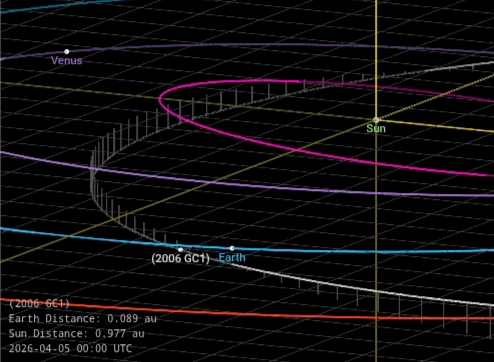
Asteroid 2006 GC1 Potentially Hazardous Asteroid (PHA) Close Approach 2026 and Asteroid Profile - Astrophyzix Digital Observatory - Official Data Set

Astrophyzix Near-Earth Object (NEO) (PHA) Close Approach Report and Object Profile: Asteroid 2006 GC1 


NEO orbital diagram

Image Credit: NASA JPL SBDB

📌 Referenced by iAsk Student


Introduction


A Potentially Hazardous Asteroid (PHA)  is a near-Earth object with an absolute magnitude of 22.0 or brighter (typically larger than ~140 metres) and a minimum orbit intersection distance (MOID) of 0.05 AU or less. This classification does not indicate an impact threat, but identifies objects that require precise orbital monitoring.


Asteroid (2006 GC1) is a well-characterised Apollo-class near-Earth object (NEO) and is formally classified as a Potentially Hazardous Asteroid (PHA). This designation is based on its size and its Minimum Orbit Intersection Distance (MOID) with Earth. Unlike recently discovered objects with short observational arcs, (2006 GC1) benefits from a long-term observational dataset spanning over 15 years, resulting in a highly constrained and reliable orbital solution.


This report provides a detailed orbital, physical, and close-approach analysis using data derived from the NASA JPL Small-Body Database and associated dynamical models. All values presented reflect current best-fit solutions and should be interpreted within the context of continuous observational refinement.

Key Takeaways


  • (2006 GC1) is classified as both an Apollo NEO and a Potentially Hazardous Asteroid (PHA).
  • Extremely well-constrained orbit (condition code 0) based on 92 observations over 15.3 years.
  • Highly eccentric orbit (e = 0.817) with a perihelion deep inside Mercury’s orbital region.
  • Estimated size range: ~200–400 meters (based on H = 20.5).
  • Earth MOID: 0.00914 AU (~1.37 million km), within the PHA threshold.
  • Next notable Earth close approach: 2026-Apr-05 at 0.08876 AU (~13.3 million km).
  • Relative velocity during Earth encounter: ~30.66 km/s.
  • No impact risk indicated for any known approach in current orbital solutions.


Scientific Consensus Snapshot


The orbital solution for (2006 GC1) is derived using high-precision numerical integrations incorporating the DE441 planetary ephemeris and perturbations from major solar system bodies. With a condition code of 0 and a multi-decade observation arc, the orbit is considered highly reliable. Uncertainty margins in orbital elements are extremely low, allowing for precise long-term trajectory propagation and close-approach prediction.


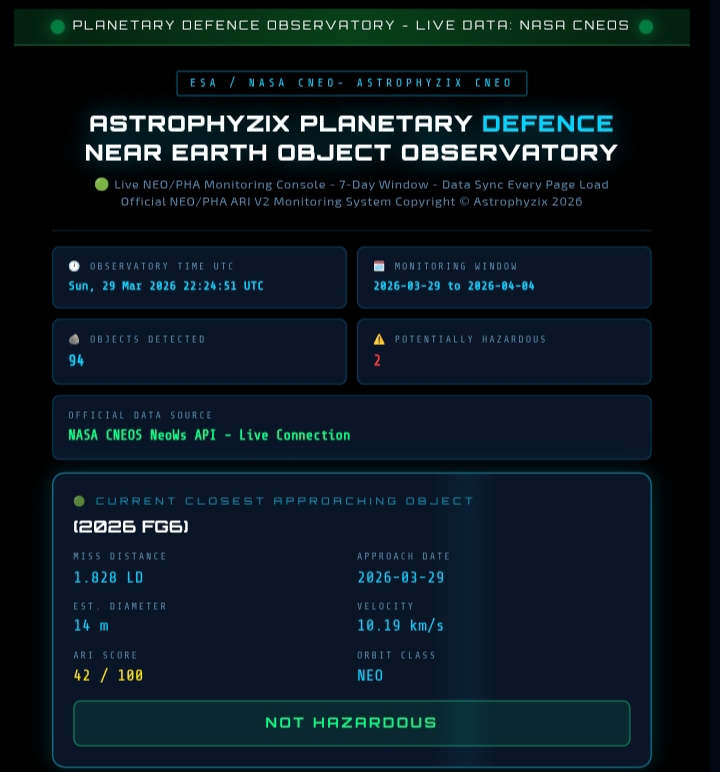
CNEO NEO PHA Asteroid Close Approach Report: 29 March 2026 - 4 April 2026 Official Data

Astrophyzix Near-Earth Object (NEO) Close Approach Report

Written by: Astrophyzix Digital Observatory

Monitoring Window: 29 March – 4 April 2026 (UTC)

Astrophyzix Observatory Image


Official NEO Data Reporting

This report presents a comprehensive analysis of Near-Earth Object (NEO) activity detected within a 7-day monitoring window using live orbital data from the NASA Center for Near-Earth Object Studies (CNEOS) NeoWs API, integrated via the Astrophyzix Digital Observatory. All objects listed have been evaluated using standard orbital mechanics and observational datasets, alongside the Astrophyzix Risk Index (ARI v2) for comparative educational context.


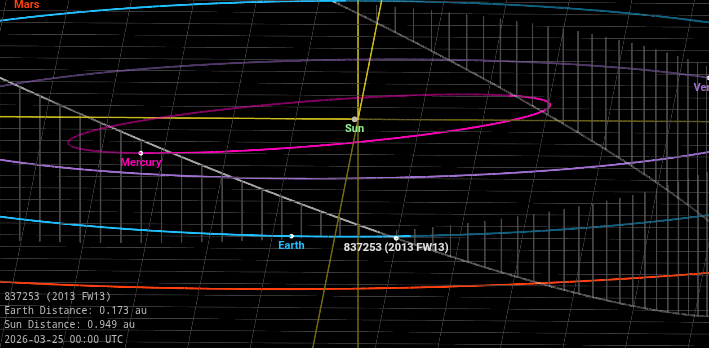
Potentially Hazardous Asteroid 837253 (2013 FW13) Close Approach 27 March 2026 - Astrophyzix Digital Observatory

Astrophyzix PHA NEO Close Approach Report and Profile: 837253 (2013 FW13)

Written by: Astrophyzix Digital Observatory for Planetary Defence and NEO Reporting

Astrophyzix visual
Image Credit: NASA JPL Small Body Database 

What is a Potentially Hazardous Asteroid? 


A Potentially Hazardous Asteroid (PHA)  is a near-Earth object with an absolute magnitude of 22.0 or brighter (typically larger than ~140 metres) and a minimum orbit intersection distance (MOID) of 0.05 AU or less. This classification does not indicate an impact threat, but identifies objects that require precise orbital monitoring.


Close Approach Event — 27 March 2026


Asteroid 837253 (2013 FW13) undergoes a monitored Earth flyby on 27 March 2026 at approximately 02:27 UTC. This event represents a routine, non-hazardous close approach within the broader Near-Earth Object tracking catalogue, with a miss distance that remains comfortably beyond the Earth–Moon system.


Parameter Value
Close Approach Date 27 March 2026
Time (UTC) 02:27
Nominal Distance 0.17170 au
Distance (km) ~25,685,800 km
Distance (Lunar Distances) ~66.8 LD
Relative Velocity ~19.8 km/s (~71,100 km/h)


Dynamical Interpretation


At a nominal separation of 0.17170 astronomical units, this flyby occurs at approximately 66.8 times the average Earth–Moon distance, placing it far outside the regime typically considered a “close” encounter in planetary defence terms.


Despite its classification as a Potentially Hazardous Asteroid, this designation is based on long-term orbital geometry (MOID and size) rather than immediate encounter conditions. The March 2026 passage represents a distant orbital crossing alignment rather than a near-Earth interaction.


Context Within NEO Monitoring Framework


For comparison, objects typically flagged for heightened observational campaigns during close approaches pass within <10 lunar distances, and in some cases within 1–2 LD. In contrast, 2013 FW13 remains well beyond even the outer boundary of the Earth–Moon system during this event.

The significance of this flyby is therefore observational rather than hazardous. Events at this scale are routinely used to refine orbital solutions, validate dynamical models, and maintain continuity in long-arc tracking datasets.


ℹ️ Sources / Technical / Mathematical / Scientific / Academic / Integrators / Methods
Sources
  • NASA APIs
  • CNEOS Scout
  • JPL CAD
  • NeoWs
  • SBDB
  • Horizons
  • Sentry
Stack
  • IEEE-754 Float64
  • RKN4
  • Yoshida-4
  • Dormand–Prince / DOPRI5
  • DOPRI8 /DOP853
  • Verlet
  • N-Body
  • Einstein–Infeld–Hoffmann
  • DE441
  • ΛCDM
  • J2
  • Meeus
  • Yarkovsky
  • Schwarzschild GR
  • Simon 1994
  • Holsapple–Schmidt
  • Collins / Pierazzo / Ward–Asphaug
  • AIS-Wide
  • Abyssal 4 km
  • WebGPU
  • DOI Registered
  • Academia.edu
  • Zenodo
  • OpenAIRE
Independent Direct Source Verification
Uncompromised Crossref DOI Resolver · Live and direct meta data fetch
Awaiting DOI input